

This is chapter 1 of this series. You can read the introduction here.
Let’s get the ugly part out of the way first.
Mom was a hoarder. As is likely true for most people in that situation, holding on to things started small and then snowballed. I cannot tell you exactly when it started for her. I only know that over the years, whenever I visited her house, I began to notice things piling up in certain places—things that needed to be put away, organized, read, recycled, or thrown away. Over time, the piles grew.
It wasn’t just the hoarding that became a problem, it was the general uncleanliness too. Stains were left untreated. Dishes piled up in the sink. Basic housekeeping seemed almost nonexistent.
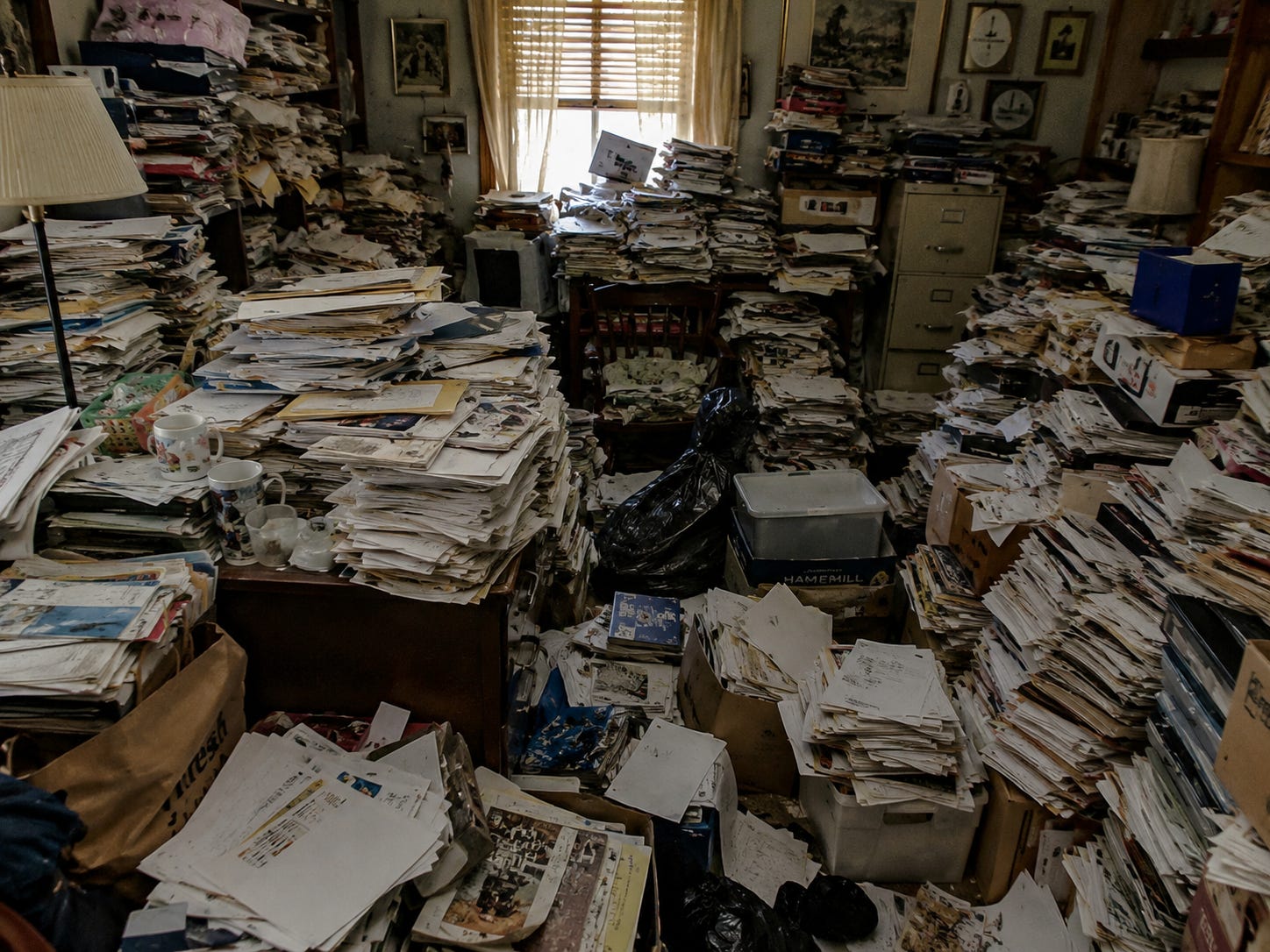
There was a point about four years ago when things became unhealthy and unsanitary. I will spare you the details, but it was atrocious. My brother and his wife flew in, and they, along with my wife and me, sat down with Mom to express our concern. We were logical and emotional in our plea to her to be willing to change. As I later learned, interventions rarely work. And neither did ours. She made promises, but nothing came of them. I consulted friends and professionals, and unfortunately there was not much we could do unless she was willing to accept help.
When we offered to come in and help clean, she generally refused. One reason was that when we helped early on, we moved too quickly for her to supervise every item being sorted and discarded. It wasn’t intentional; we were all working full-time jobs and could only come in on weekends, so we attacked the problem with efficiency and purpose. For Mom, it was overwhelming.
Sometimes other family members had a little more success getting her to allow them in. But despite their best efforts, they were mostly rearranging deck chairs on the Titanic. Her stubbornness and talkativeness would eventually wear them down.
In the summer of 2023, Mom fell and had to go to the hospital with a urinary tract infection, and then on to rehab. During that time, my family and I were out of the country. Her neighbors confided in me that the home had gotten worse and that something needed to be done.
While out of the country, I coordinated with Letty and Lee Inabinet from Visiting Angels in San Antonio to go into her home and at least get the kitchen and bedroom back into livable shape. But I knew we needed Mom’s permission first, so they went and met with her at rehab. She expressed concern about other people going through her things. I had worked with Letty while I was in the Air Force, and I trusted both her and Lee completely. I told Mom that. Letty was wonderful with her, assuring her that they would only clean and organize. Mom agreed. The Visiting Angels team deep-cleaned the main rooms, then returned to rehab to show her photos and reassure her. I remain deeply grateful to the Letty and Lee. If you are in the San Antonio area and need help of that kind, they are the kind of people you want.
Unfortunately, once Mom returned home, she reverted to old habits.
Eventually, after I retired from the military, I realized the only thing I could do was come alongside her and help on a weekly basis, in accordance with her wishes. Thankfully, my military pension gave me the flexibility to scale back and work part-time in my new job at UT San Antonio. I am grateful for the flexibility the folks at UT San Antonio gave me while I was helping my mom. I have no idea how I, or anyone working full-time, could handle something like this.
So from January through May of 2024, just about every week, my wife and I drove to Austin one day a week to go through things in her house with her.
My wife and I are very Type A people. I retired as a Colonel, and my wife has managed her job as a realtor while also managing our family and home through my many military absences over the years. I say all that not to brag, but to say that if there are two people in the world who know how to organize things and get things done, it’s us.
And yet the process of going through Mom’s house almost broke me. Not because we did not know what to do, but because nearly every decision required her approval.
We started in the kitchen. There was stuff everywhere. I did not know where to begin. I opened one drawer, then another, then another. I decided to gather like items, starting with spatulas. I found twelve of them, held them up to Mom, and asked which one she wanted to keep.
She analyzed every spatula. After fifteen minutes, we had negotiated her down to keeping three. But she did not want anything leaving the house, so we had to make two separate piles: one for things that might be given away and one for things that might be thrown away. After spatulas came whisks. After whisks came wooden spoons. And on, and on.
After a few weeks of trips, we finally got the kitchen somewhat organized and cleaned. If organizing was difficult, cleaning was even worse. There were cockroach droppings on every shelf, on dishes, and in cups. We went through gallons of dish soap and cleanser. The pantry contained food that was more than fifteen years old, yet even throwing that away required negotiation.
After the kitchen, we moved to the dining room, which we needed as a staging area for things we had sorted but that she still had not decided whether to donate, recycle, or trash. As we left each week, we gave her assignments, like going through one stack of sorted items and deciding what to throw away. Rarely did she complete them.
From the dining room we moved to her bedroom. By the time we finished going through her clothes, we had filled more than ten moving boxes with dresses, many still in original packaging from an online store.
We had small victories along the way: decluttering a cabinet, seeing the floor in places, and clearing a path wider than a foot. Some things became a game: counting the number of each like item we found to see which there were more of (scissors actually outnumbered spatulas), and seeing what the oldest item in the pantry might be (I found a bottle of alcohol at the back of the top shelf that was from the 1980s).
When Mom was not looking, my wife and I would quietly take things outside and put them into trash bags that we brought back to our house. Why back to our house? Because she would check her outdoor trash can after we left to see what we had thrown away. Call me dishonest if you want, but it was for her good. It was stuff any other person would have called trash.
There were even times when she remembered something that had been in the house but that we had thrown away behind her back weeks prior. She would ask us about it, and depending on what we thought her response would be—or our own frustration level—we would feign ignorance or tell her we had thrown it away. We could not do that too often, or she would lose trust in us. Again, call me dishonest if you want, but she simply was not keeping up with life in a way that ensured her health and safety.
It is difficult to do the right thing for someone when they do not see it as right. It is even harder when they get upset with you. In many ways, over the past few years, the parent-child relationship flipped. I found myself caring for her in ways she once did for me.
This kind of thing is not in the manual of life. Grow up, go to school, get a job, get married, have kids, retire. That is the arc of life as people tend to imagine it. No one really tells you about the stretch where you may need to care for your parents, many times while also continuing to shepherd your own children through life. This is what they call the “sandwich generation.”
Please do not misunderstand me. I am not bitter. I have no regrets about the time I spent with Mom. I am grateful she let us help her, and grateful we had the chance to do it. I am simply saying that the world does not usually explain that this too may be part of life, just as it does not tell you that marriage will involve struggles or that loved ones may have serious health issues. But that is reality.
I will also say that after raising me for nearly 20 years, I feel that the least I can do for my parents is help care for them for whatever period, and in whatever way, they need (and will allow). As difficult as it may be, it seems selfish to do otherwise.
By May, after four months of weekly trips, we finally reached her home office, where all of her important paperwork was “filed”—in stacks, spread around the room. Some piles had collapsed into others. There was a thick layer of dust on everything.
If there was one upside to Mom’s hoarding, it was that she had kept a lot of important paperwork along with the junk. I initially tried to go through each paper there in the house, deciding whether it was important and where it belonged. But she wanted to see each piece of paper too.
Eventually, I just threw the papers into boxes and bags and brought them back to our house. I spent evenings and weekends going through everything page by page. In the end, I was able to figure out where she had bank accounts, credit cards, and other essential information. The downside was that our living room began to smell like her house, which neither my wife nor I liked.
As tedious and lengthy as that process of going through paperwork was, if I had waited until after she passed to do it, it would have been a million times harder. Because I was finding things while she was still alive, I could ask her about them. I also had the luxury of time. If she had died before I had gotten through all the paperwork, I would have been trying to identify all of that information while simultaneously handling every other part of the estate.
Then, the same week we finished going through her office, I had to call the police to check on her.
Advice
To Hoarders
My guess is most hoarders fall into one of two categories: 1) you do not see yourself as a hoarder, or 2) you understand you have a hoarding problem but you don’t know how to break out of it.
If you find yourself in the first category—that is, you do not think you are a hoarder—but there are people in your life telling you that you are, then you likely are a hoarder. Quite often, others see our faults and shortcomings before we do.
Please understand: this is a problem. It is not normal to hold on to things to the degree that you do, especially if it is impacting your health and safety. If people closest to you are expressing concern, please listen.
If you know you are a hoarder but do not know how to get out of it, seek counseling. It is an addiction. Recovery takes time and effort. Maybe you keep things because you do not think your situation can improve, or maybe you do it because of finances, health, or the sheer size of the problem. There are people and organizations who can help, if you let them.
Additional advice:
The goal is not perfection, it’s health, safety, and dignity.
If the whole house feels overwhelming, start with one drawer, one counter, or one corner. Progress over perfection.
Let someone you trust help you make decisions and help you go through things.
To family and friends of a hoarder
I am sorry. I wish I had an easy solution, but I don’t.
Even when my wife and I showed up every week, Mom was rarely willing to let much go, and even after she moved into assisted living she never truly changed the hoarder behavior. As we learned, interventions rarely work. Like most things in life, lasting change has to come from within.
Additional advice:
Document what you are seeing. Photos and notes help you track changes over time.
Don’t assume one difficult conversation will solve anything.
Pace yourself. Protect your own sanity. Burnout is real.
Get outside counsel when needed—social workers, counselors, doctors, or elder-care professionals.
Focus first on health and safety hazards, not aesthetics.
Accept that “better” may be more realistic than “fixed.”
Links to each chapter:
Chapter 10 - Life in Assisted Living
Chapter 11 - Her Final Hours
Chapter 12 - Afterwards
Final Reflections