

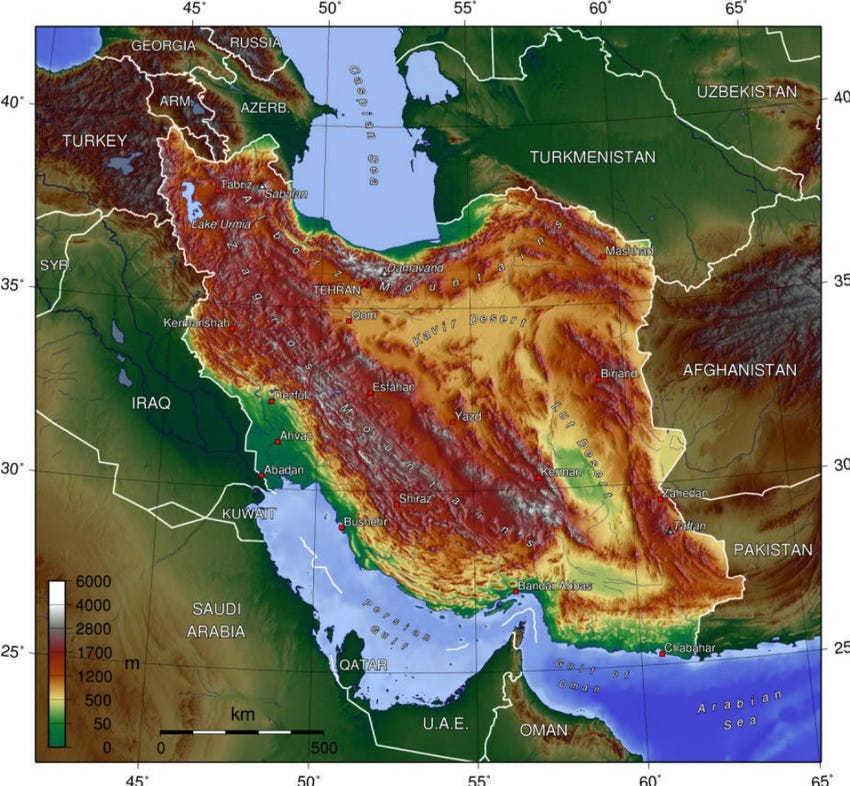
Modern conflict is reinforcing a basic reality: geography still matters—a lot. For instance, as the map below shows, a ground invasion of Iran is very difficult due to mountains on nearly all borders. This is why there is a buildup of American airborne troops in the Middle East.
But this post isn’t about land invasions or airborne assaults on foreign soil.
Instead, since I’ve been seeing a growing number of stories about the Strait of Hormuz, global shipping chokepoints, and the Taiwan Strait, I thought I’d tie them all together. I hope you find this helpful.
------------
For years, it was easy to assume that globalization, digital networks, and advanced technology had reduced the importance of physical geography. But recent events are showing the opposite. Even in an era of AI-enabled warfare and precision strikes, narrow waterways and physical supply routes still determine outcomes. Roughly 20% of the world’s oil supply flows through the Strait of Hormuz, and even limited disruption there has already caused sharp spikes in energy prices.
History shows the danger of trying to solve these disruptions militarily—misjudging second- and third-order effects has led to costly failures in the past.
The Gallipoli Lesson
The Gallipoli campaign during World War I is a case in point, as Niall Ferguson points out in this great piece. The Allied powers attempted to seize control of the Dardanelles Strait to reopen a vital supply route and gain a strategic advantage. What followed was a costly failure—poor planning, underestimated resistance, difficult terrain, and logistical breakdowns led to a prolonged stalemate and eventual withdrawal.
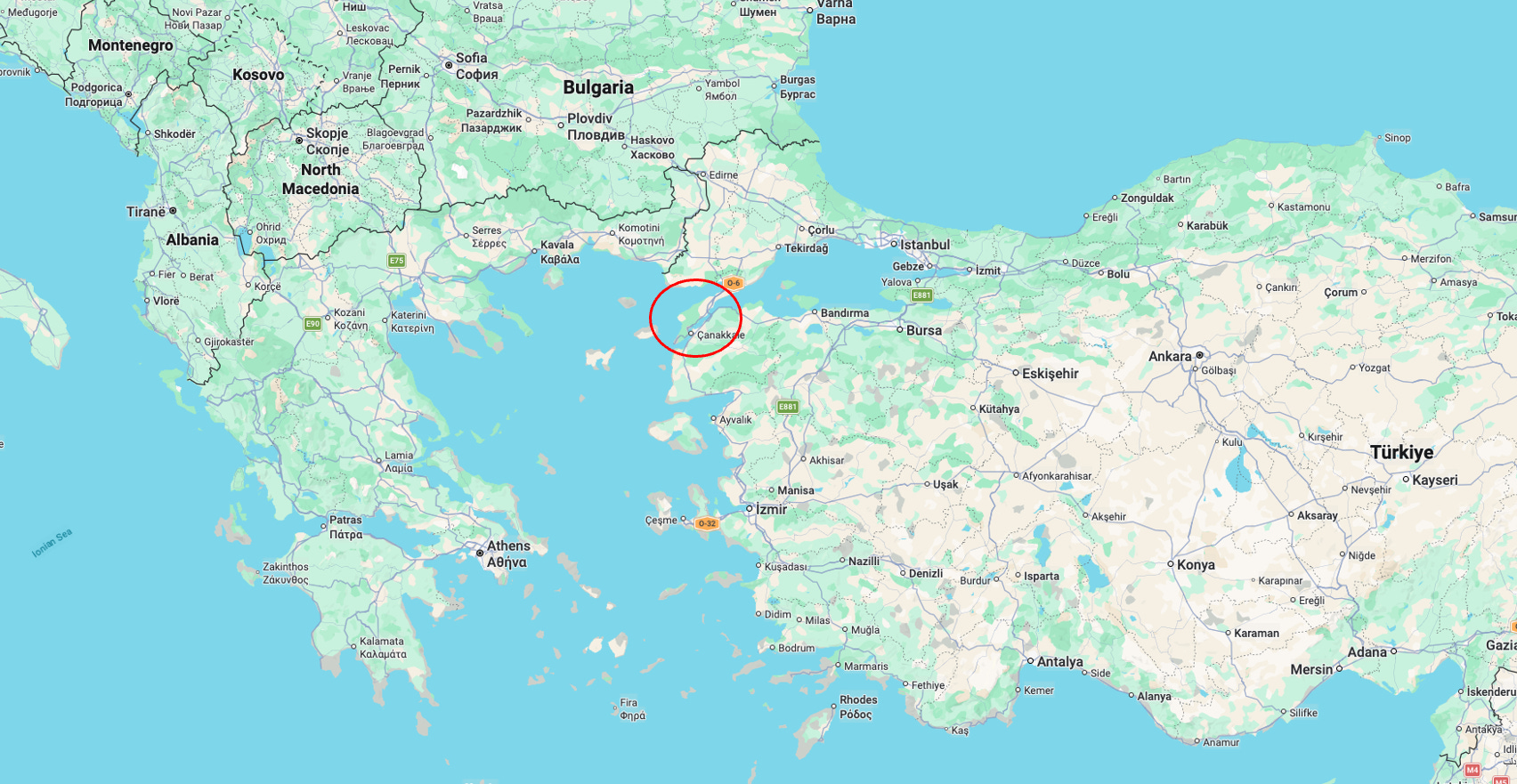
The campaign didn’t just fail militarily; it produced unintended economic and political consequences as well, and those consequences were both immediate and far-reaching. Economically, the failure to reopen the Dardanelles meant that grain shipments from Russia remained blocked, contributing to price volatility and fears of food shortages in Europe. Britain had to intervene heavily in markets—subsidizing shipping, restricting exports, and even attempting to influence commodity prices—measures that distorted normal economic activity and reflected how quickly wartime pressures can override market systems.
Politically, the fallout was just as significant. The failed campaign weakened the British government, forcing Prime Minister H. H. Asquith to form a coalition government and contributing to a loss of confidence in leadership. Winston Churchill, who had championed the operation, was removed from his post and saw his reputation severely damaged (though it was salvaged in WWII). Beyond Britain, the campaign failed to stabilize Russia, which remained economically strained and politically fragile. These were conditions that ultimately contributed to the Russian Revolution. In short, what began as a strategic effort to solve a military and economic problem ended up weakening alliances, destabilizing governments, and compounding the very risks it was meant to resolve.
Chokepoints, it turns out, are complex multi-armed systems that can quickly tighten into a chokehold. Intervening under pressure rarely unfolds as planned, and often produces outcomes far different from what decision-makers expect.
Global shipping chokepoints
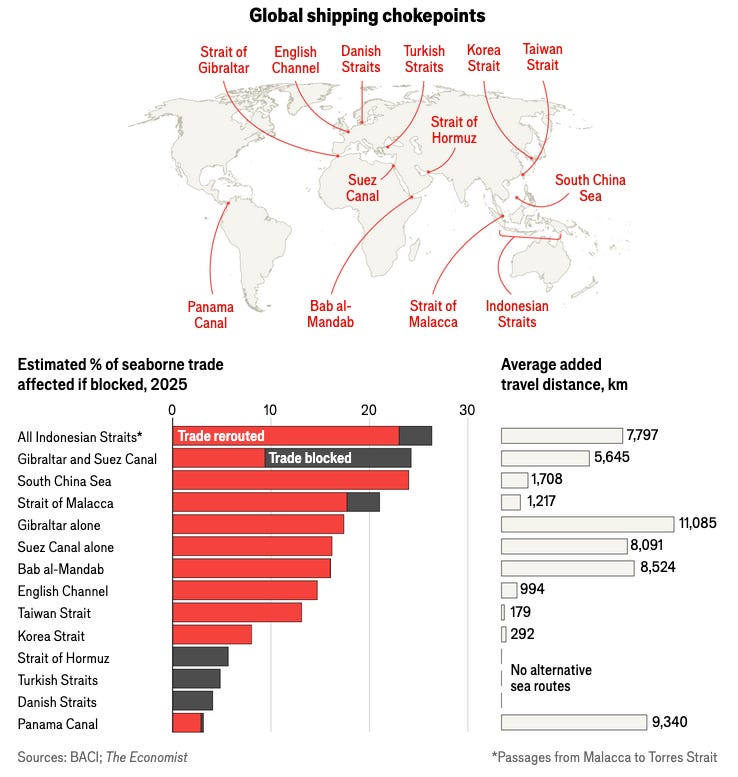
Global trade—worth more than $11.5 trillion annually by sea—depends on a handful of maritime chokepoints. About 80% of global trade by volume and 55% by value moves across oceans, concentrating risk in narrow corridors like Hormuz, Suez, and key Asian straits.
Not all chokepoints carry equal risk. As seen in the image below, Closing Hormuz blocks energy flows with few alternatives, but affects about 6% of global maritime trade. By contrast, disruptions in the Taiwan Strait (~13%), the Suez Canal (~16%), or South China Sea (~24%) would impact a far larger share of global commerce. The most severe scenario, blocking Southeast Asian routes, could affect up to 26% of global trade, forcing massive detours and cascading delays.
Even when rerouting is possible, it comes at a cost: longer routes, higher insurance, and slower delivery times that ripple through supply chains and consumer prices.
The impact of just-in-time logistics
Even limited disruption, such as a quarantine, would force ships to reroute, sometimes adding up to 1,000 miles to journeys, which would raise costs, delay deliveries, and cut off access to key ports. This is especially problematic in a just-in-time (JIT) logistics system, where companies keep minimal inventory on hand and rely on precisely timed deliveries to keep production moving. Designed for efficiency and cost reduction, JIT leaves little room for delay. When shipments arrive late, production lines can halt, downstream deliveries are disrupted, and shortages ripple outward. What begins as a routing adjustment at sea can quickly translate into factory slowdowns, empty shelves, and rising prices. In a more severe scenario, these compounding delays can cause entire supply chains to seize up across industries ranging from electronics to energy, exposing how efficiency-driven systems often sacrifice resilience in the face of disruption.
Rare earths and microchips
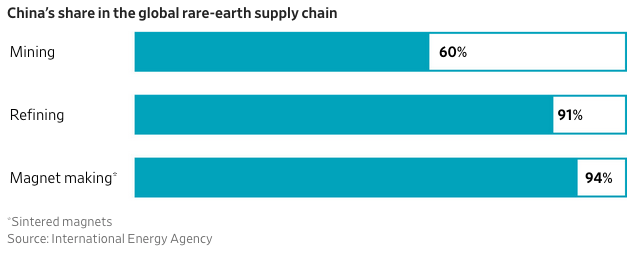
Control over rare earths is becoming just as strategically important as control over energy and trade routes. These minerals, essential for everything from EV motors and wind turbines to advanced electronics and military systems, are heavily concentrated in one place: China, which dominates global production and processing. That concentration is now driving a coordinated push to diversify supply chains. Japan and France, for example, recently agreed to deepen cooperation on rare earth sourcing and refining, including a new facility expected to supply a significant share of Japan’s future demand for key materials like dysprosium and terbium. These efforts reflect a broader shift, as countries invest in alternative suppliers, recycling, and joint ventures to reduce reliance on China, which has already demonstrated its willingness to restrict exports for strategic or political leverage. The result is a growing recognition that rare earths are not just industrial inputs, but are also geopolitical tools that are increasingly central to economic security and global power competition.
The Taiwan Strait
The Taiwan Strait has emerged as economically consequential chokepoint. Approximately $2.45 trillion in goods—more than 20% of global maritime trade—passes through it each year. It is also the center of the global semiconductor industry, with Taiwan producing over 90% of the world’s most advanced chips, including 99% of those used for cutting-edge AI systems.
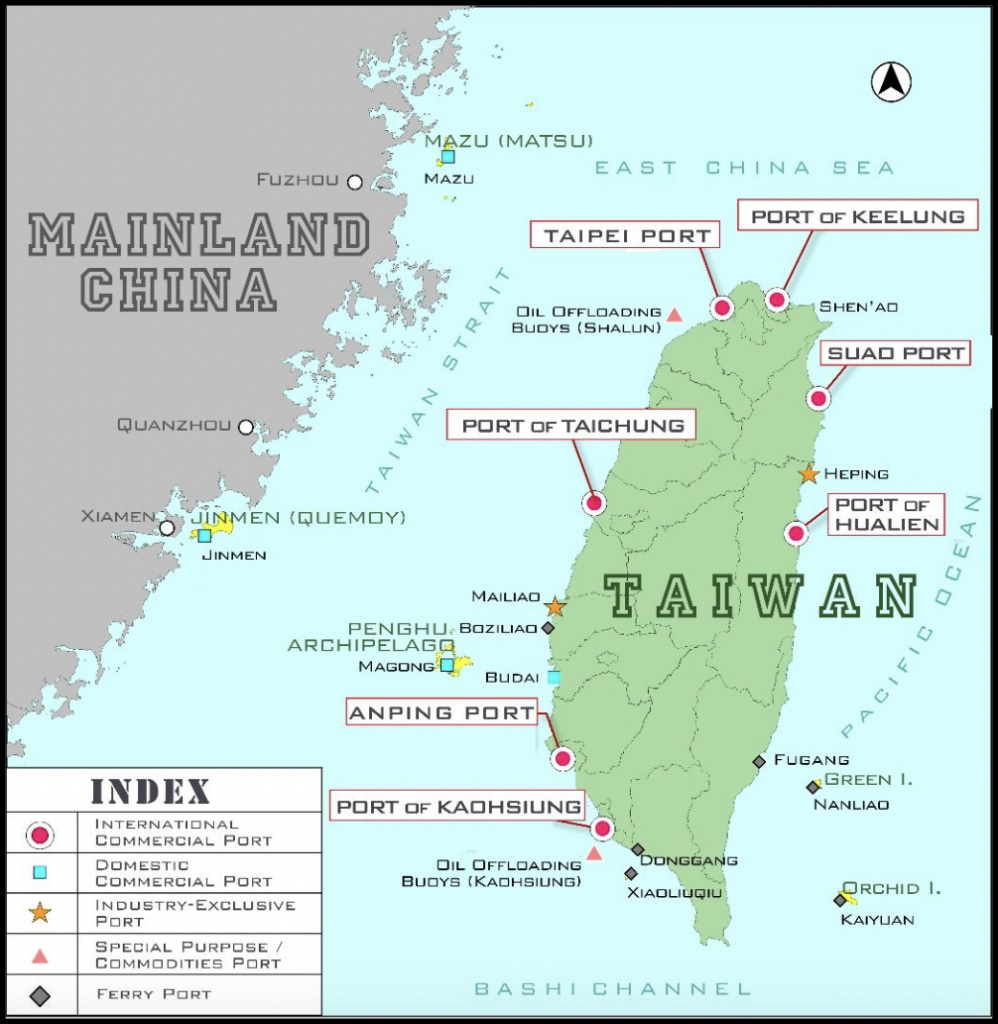
The broader trade exposure is enormous. Taiwan’s ports handle hundreds of billions in goods, while China alone moves roughly $1.3–$1.4 trillion in trade through the strait. U.S. allies are heavily dependent as well: about 32% of Japan’s imports and 30% of South Korea’s imports transit the strait, much of it energy and high-tech components.
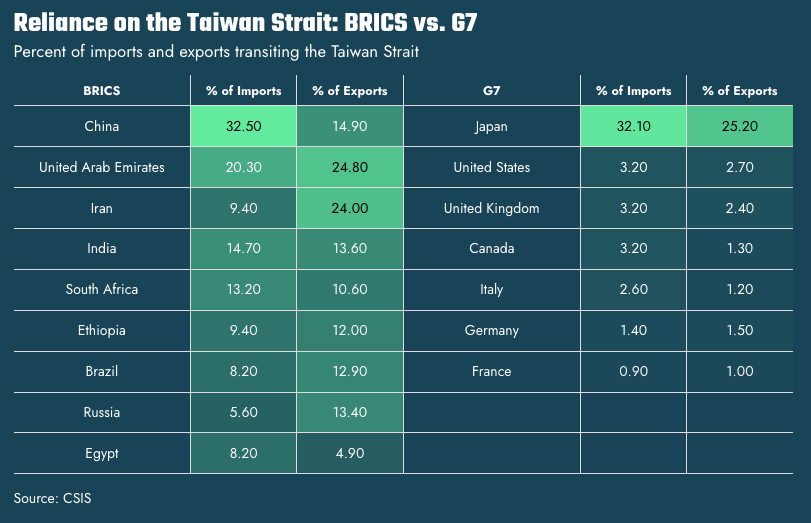
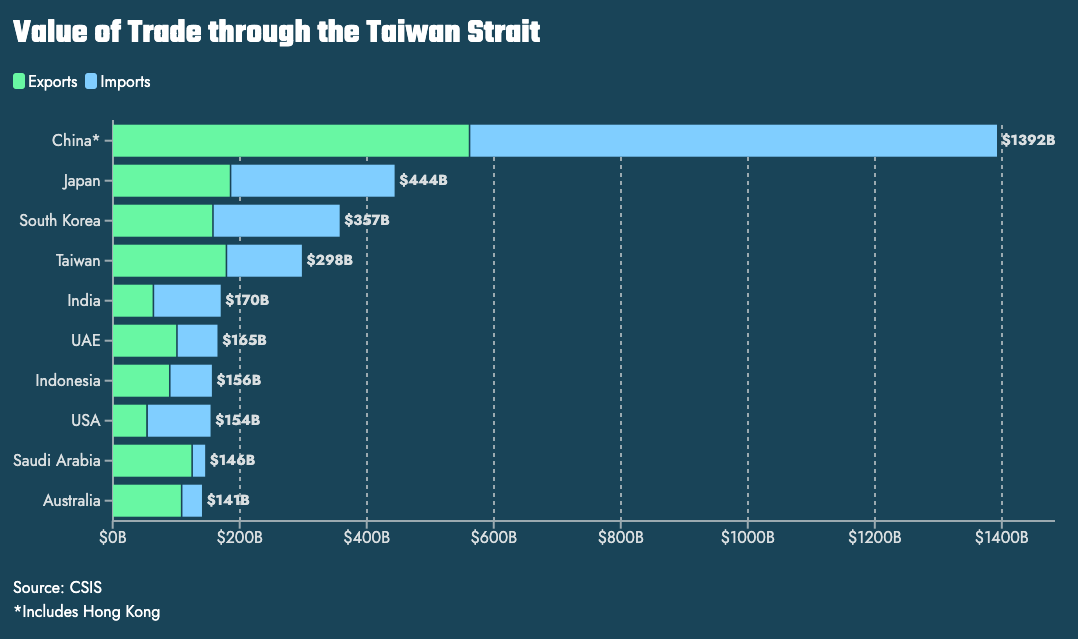
China is increasing pressure on Taiwan through military activity, economic leverage, and “gray zone” tactics that fall short of full invasion. These include potential blockades or restrictions on shipping that could disrupt trade without triggering immediate war.
One advantage of the Taiwan Strait is that alternative routes are available, unlike the Strait of Hormuz. This Economist article does a great job of modeling and mapping potential impacts.
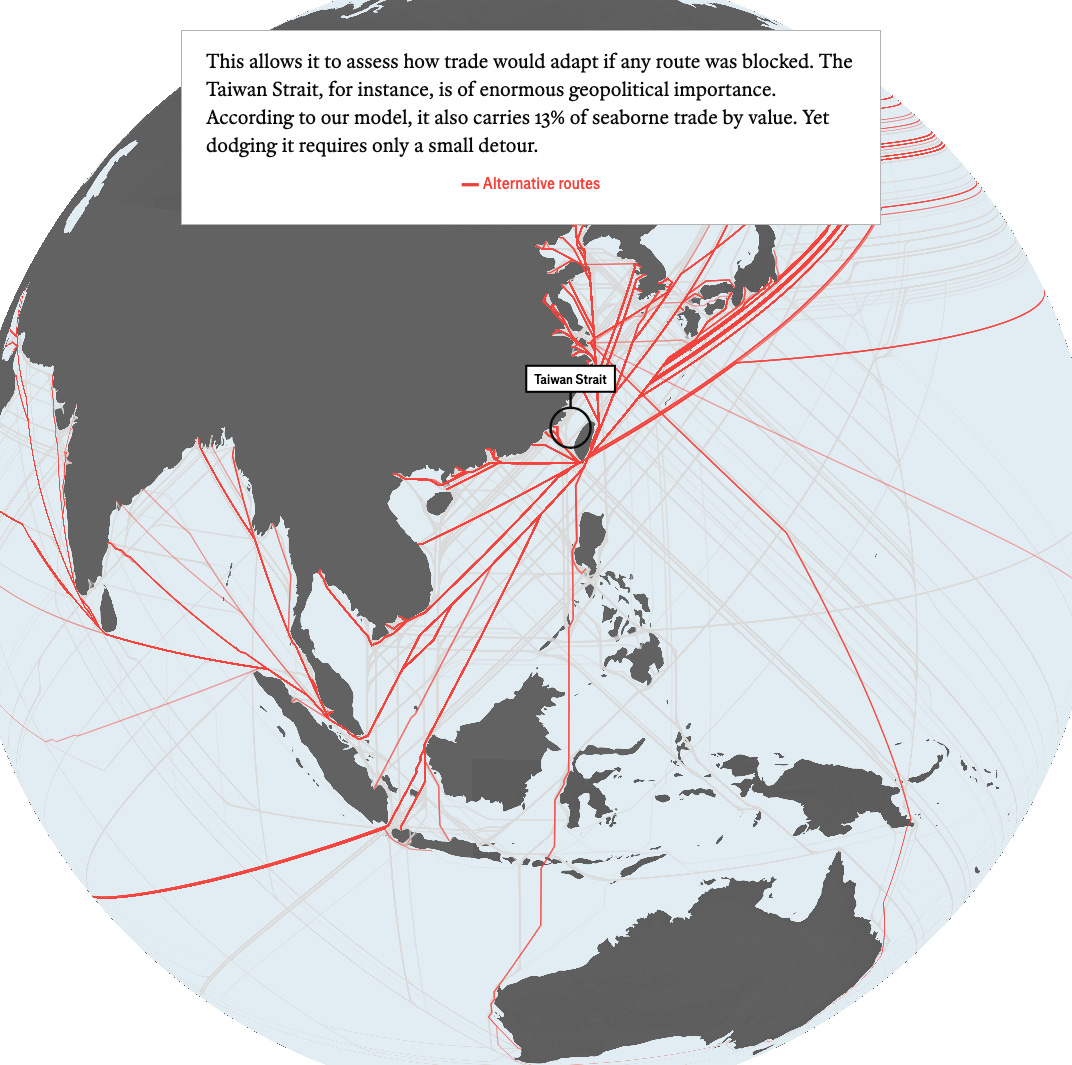
However, if conflict and blockade expanded throughout the South China Sea, the consequences would be far worse.
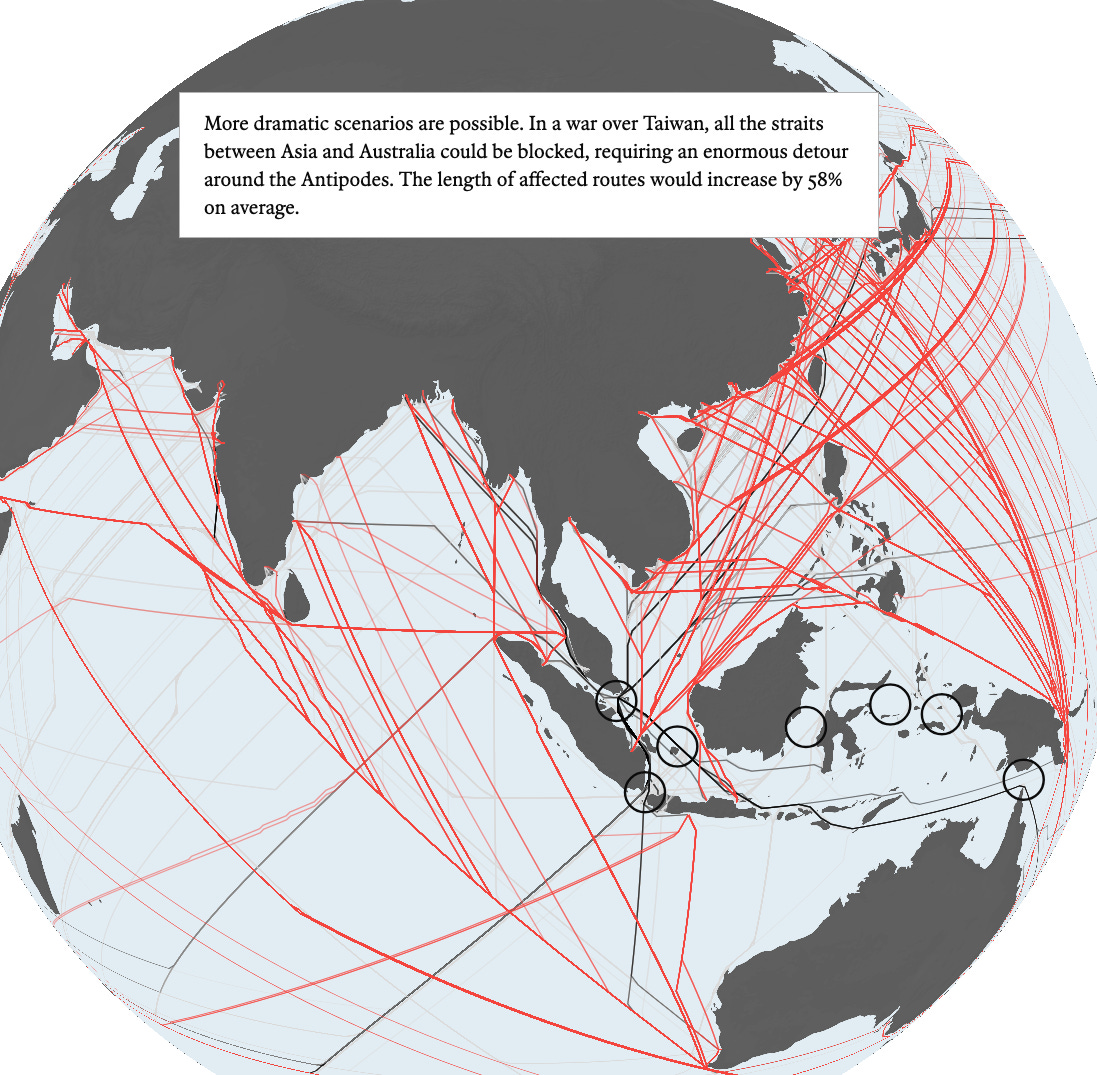
At the same time, uncertainty in U.S. policy and competing global commitments are creating openings for China. Subtle changes in diplomacy or priorities could weaken deterrence, raising the risk of miscalculation. The situation is further complicated by the fact that major powers cannot fully concentrate on multiple theaters at once, increasing the chance that one crisis creates opportunities in another.
In conclusion
The global economy is highly efficient, but also highly concentrated and fragile. A small number of chokepoints carry a disproportionate share of trade, energy, and critical inputs. Disruptions in any one location can cascade quickly across regions, industries, and financial systems.
Countries are responding by stockpiling resources, diversifying supply chains, and investing in domestic production, but these adjustments take time and raise costs. In the near term, the system remains exposed. The question is not whether chokepoints matter, but which one becomes the next breaking point, and how far the shockwaves will spread when it does.
Though this isn’t an article about land invasions or airborne assaults on foreign soil, I do think it appropriate to end with this quote from Lyle Goldstein in his U.S. Naval Institute article comparing Gollipoli and Hormuz:
A closely related point, of course, is that U.S. forces fighting on Iran’s sovereign territory would once again confront the anger of a people defending their homeland. It is no coincidence that the father of modern Turkey, Mustafa Kemal Ataturk, arose out of the single extraordinary battle at Gallipoli. After the bitter lessons learned from wars in Vietnam, Afghanistan, and Iraq, U.S. strategists should be wary of brazen challenges on foreign soil.
The lesson is simple: chokepoints are inevitable, but chokeholds are not. They emerge when efficiency replaces resilience and when alternatives are ignored. Like in wrestling, the key is not to overpower the hold, but to avoid being caught in it in the first place.