

In college, I studied Latin American politics. While covering Argentina, we learned about Eva Perón, who grew up in poverty, became an actress, and later married Juan Perón, who became President of Argentina. In her role as First Lady, she became a voice of the people, championing trade unions, labor rights, and women’s rights. In 1951, while her husband was President, she announced her candidacy for vice president but later withdrew due to backlash and declining health. She died of cancer in 1952 at the age of 33 and has since become a national hero.
Andrew Lloyd Webber wrote a musical about her—Evita. In 1996, the musical was turned into a movie starring Madonna as Eva. The titular song of the musical was Don’t Cry for Me Argentina, which you can watch Madonna sing here:
The song speaks to the complexities of her rise from poverty to power, as she reassures the people that, through her transformation, she is still there to support them. It’s a plea to the Argentinian people to show understanding for all she’s been through, and ultimately, not mourn her death.
I’m reminded of the song as I watch what Javier Milei, the current Argentinian president, is attempting to do.
Eva Perón became one of the defining faces of Peronism by championing the working class and turning the state into an instrument of social protection and mass loyalty. She helped create the emotional and political style of Peronism itself—direct appeals to “the people,” strong symbolism, organized labor as a pillar of power, and a government expected to care for ordinary Argentines.
The current President, Javier Milei, by contrast, has taken a different path. Since taking office in December 2023, he has pushed a libertarian, pro-market agenda centered on cutting state spending, deregulation, labor reform, and weakening the old Peronist model of unions, subsidies, and state-led economic management.
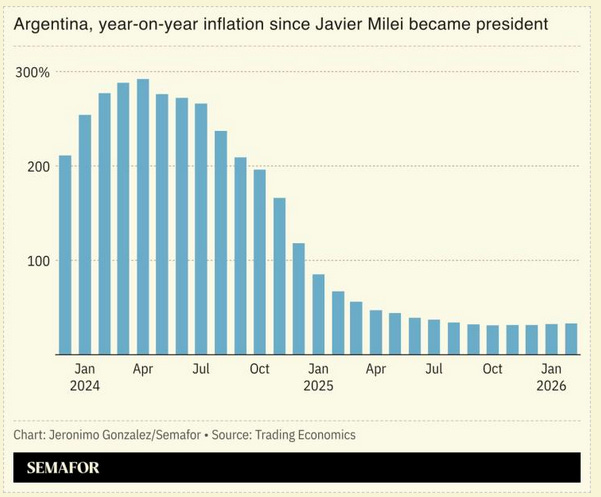
His policies have led to a strong GDP rebound and reduced inflation. For now, he has achieved meaningful stabilization.
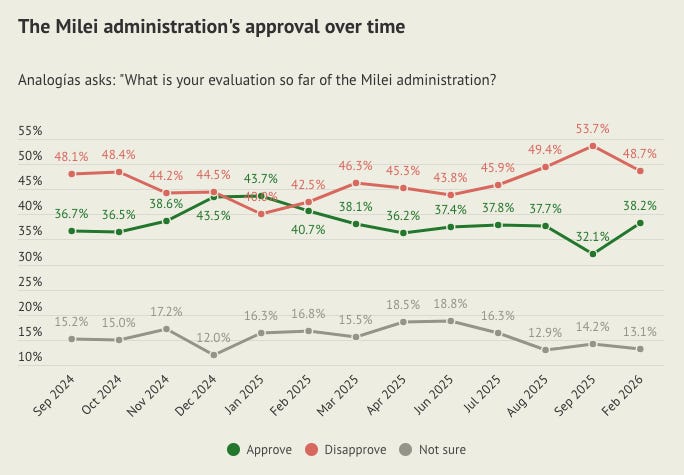
But he has plenty of critics, and some believe that Milei has abandoned the people. Public backlash over austerity measures, along with corruption allegations and stagnant incomes, has eroded his approval ratings.
And so, the lyrics of Don’t Cry for Me Argentina echo in my mind.
It won’t be easy, you’ll think it strange
When I try to explain how I feel
That I still need your love after all that I’ve done….
Don’t cry for me, Argentina
The truth is I never left you
All through my wild days
My mad existence
I kept my promise, don’t keep your distance
In Eva Perón’s pleas to the Argentinian people, I can’t help but wonder if, reimagined, the lyrics could serve as a plea from Milei—that he has not forgotten the people and that his austerity measures are in their long-term best interest, if they’d only trust him and have patience.
No doubt there are many who see Milei’s approach as “mad”—it’s hard not to when you see images like this:

But keep in mind that the inflation rate in Argentina was nearly 300% in 2024, so perhaps a mad approach was required. Even now, at a more “normal” rate, inflation in Argentina sits around 32%. And you thought our U.S. inflation rate was bad at 3.3%.
Time will tell if Milei’s approach works—whether he “kept his promise”—and whether the people have the patience to see it through or instead “keep their distance.”
If not, there’s always the potential for a second, or third, chance.
In a bit of a political twist, Eva’s husband, Juan Peron, was overthrown as President of Argentina in a coup in 1955. Then, almost 20 years later, in 1973, he was elected president again. By that time, he had remarried, and his new wife, Isabel, became vice president alongside him1. When Juan Peron died in 1973, Isabel became president but was later overthrown in another military coup in 1976.
So, when it comes to Latin American politics, the people can be fickle, cycles happen, and anything’s possible.
As an aside, Nicaragua is currently governed by a husband-and-wife pair serving as president and vice president.
I feel like Argentina’s economic crisis is a cautionary tale for the United States. It’s important that we keep our status as the global reserve currency, keep our private sector strong, and cut our deficit spending before we need a figure like Milei to repair the damage.