

NOTE: I’m adding an “AI Disclosure” notice to the end of this and future news summary postings. For many years, whenever I read an interesting article, I would summarize the key points myself or extract relevant passages directly from the article, and then include them beneath the article title and link.
As my schedule has gotten busier, I’ve struggled to find the time to do the summaries myself. I know that many of you find value in the articles I share (you’ve sent me plenty of emails telling me so), and I didn’t like the idea of stopping altogether or sending them only once every few weeks when I had time to compile summaries. In the end, I think getting the information out to you justifies using AI to help with the summaries. So now, when I read an article of interest, I use AI to summarize the key points, and then tweak it to ensure it properly captures what was covered in the article.
But, I’ll tell you, every one of the articles I share are far better as written by the authors themselves, and usually contain far more graphics and charts, than what I include in this newsletter. So, I highly recommend reading them at the source, not only for the better writing, but also to support the writers who wrote them.
As a final note, whenever you see “NOTE,” the words that follow are my own.
ELECTION
1. 2026 Midterm Election Findings
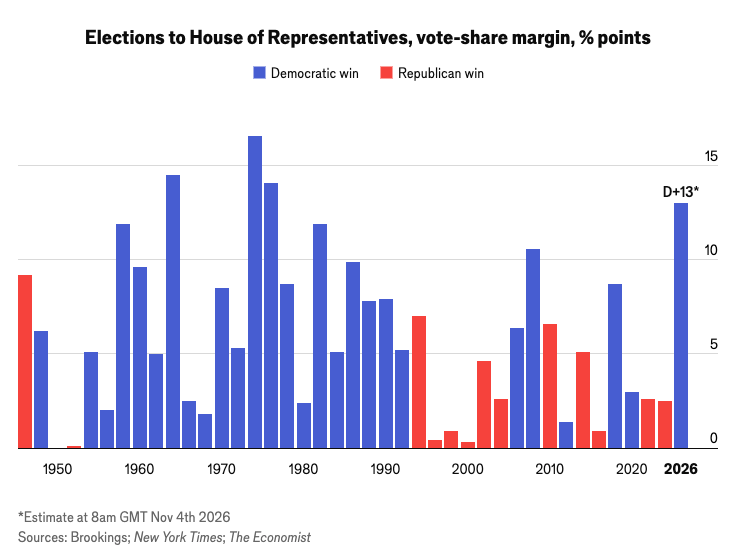
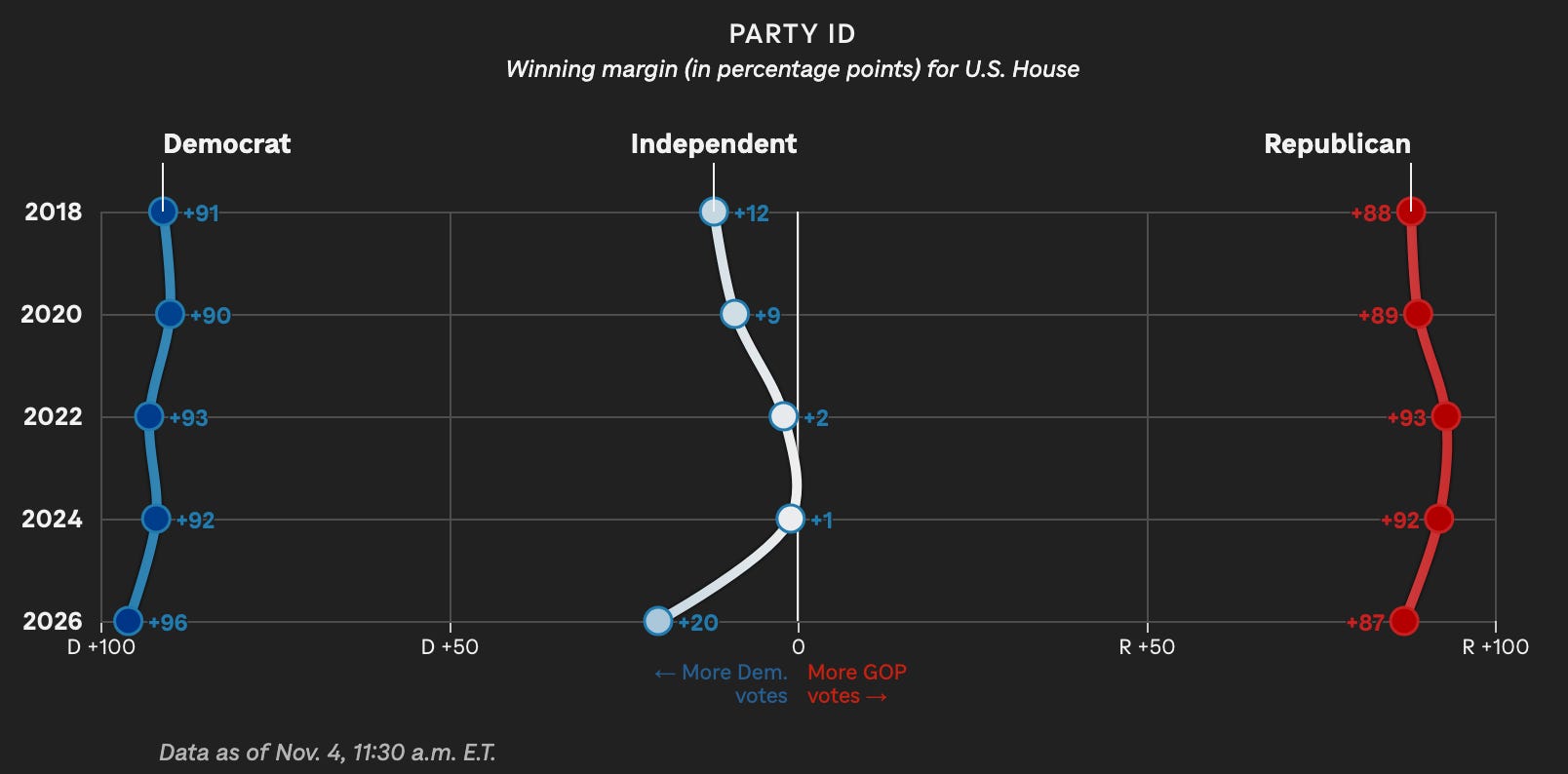
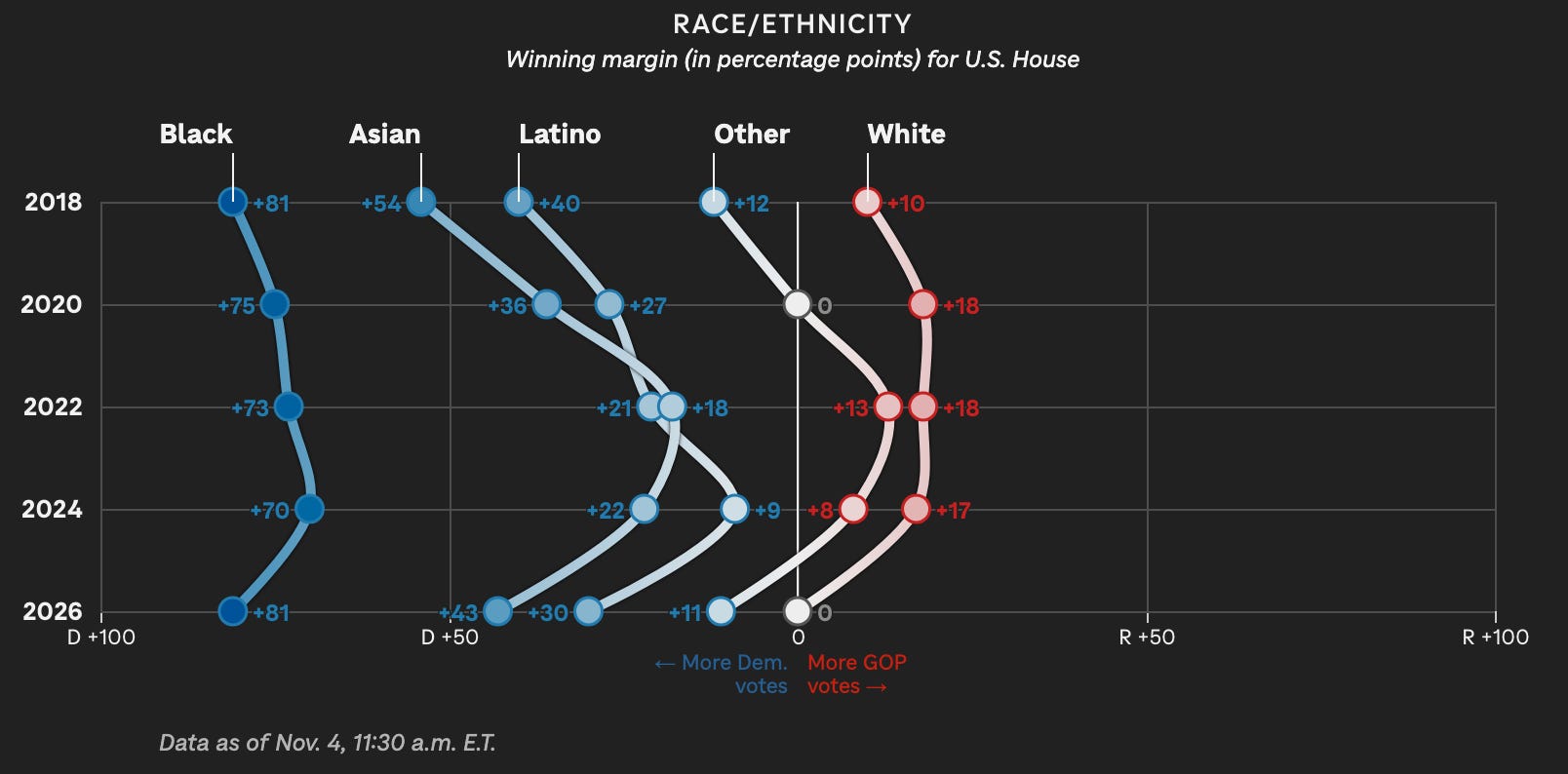
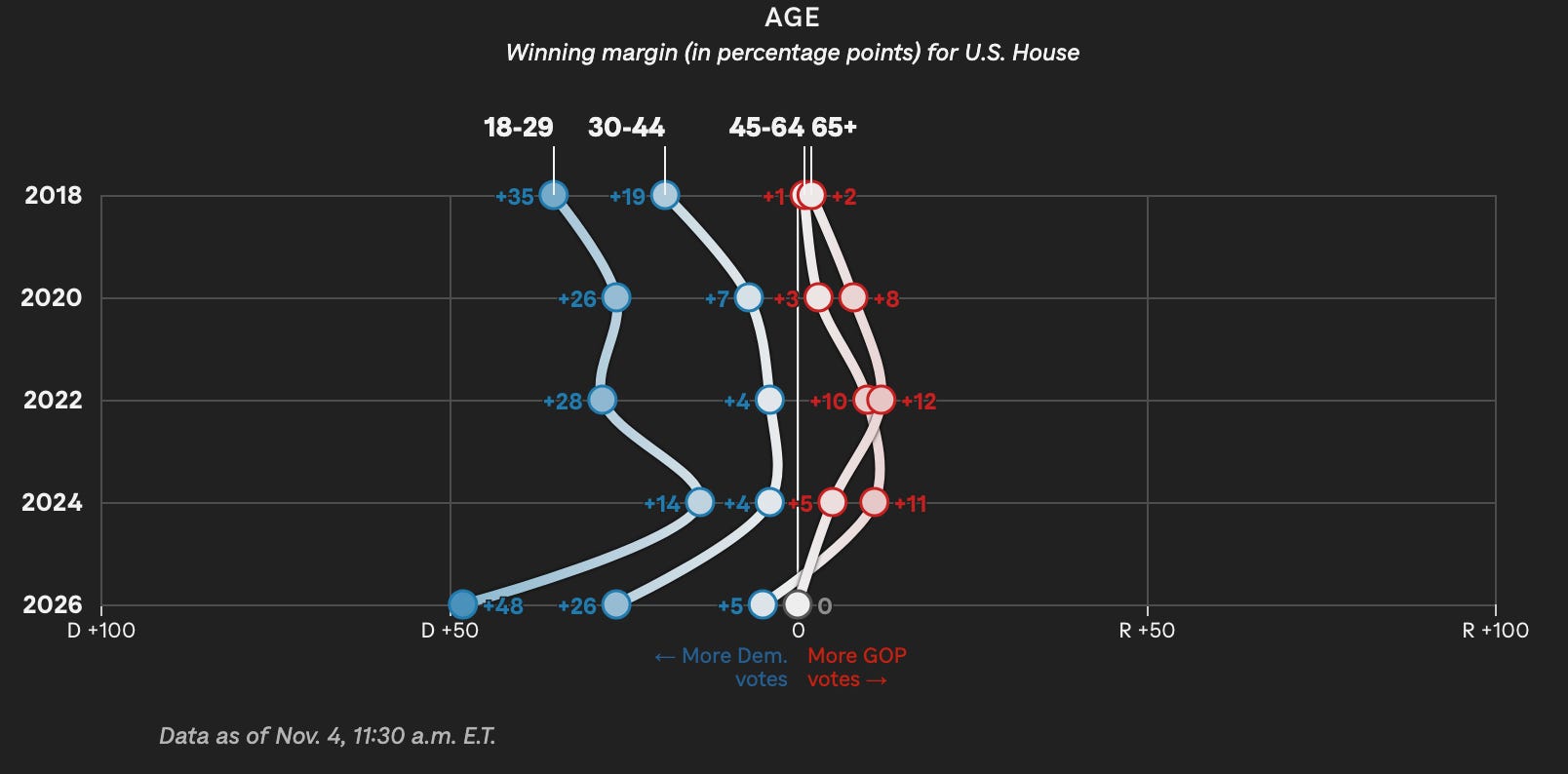
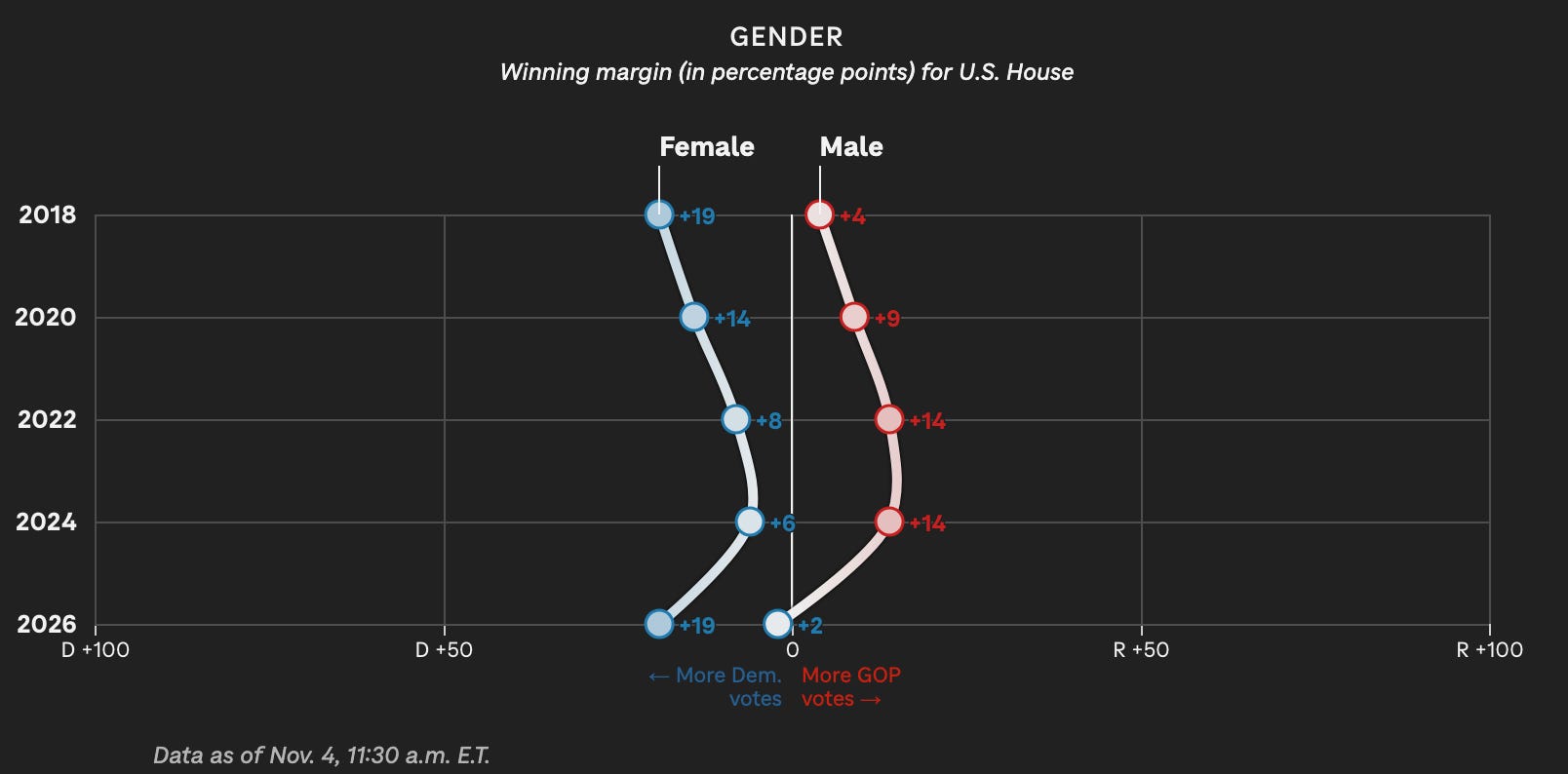
NOTE: As everyone is aware, the recent midterm elections resulted in a significant Democratic victory, with the party gaining control of both the House and Senate while making substantial gains in traditionally Republican states. It also reflected significant changes in voting patterns, the likes of which haven’t been seen in decades. The following three articles contain lots of great data and charts that parse exit poll data. Below the articles are some of the more interesting charts.
See how Latinos, young voters and other demographic groups fueled Democrats’ big wins (NPR)
The Democrats’ extraordinary triumph, explained (Economist)
DEFENSE
2. This Shipping Lane Is Now the World’s Deadliest. It Isn’t Hormuz. (WSJ)
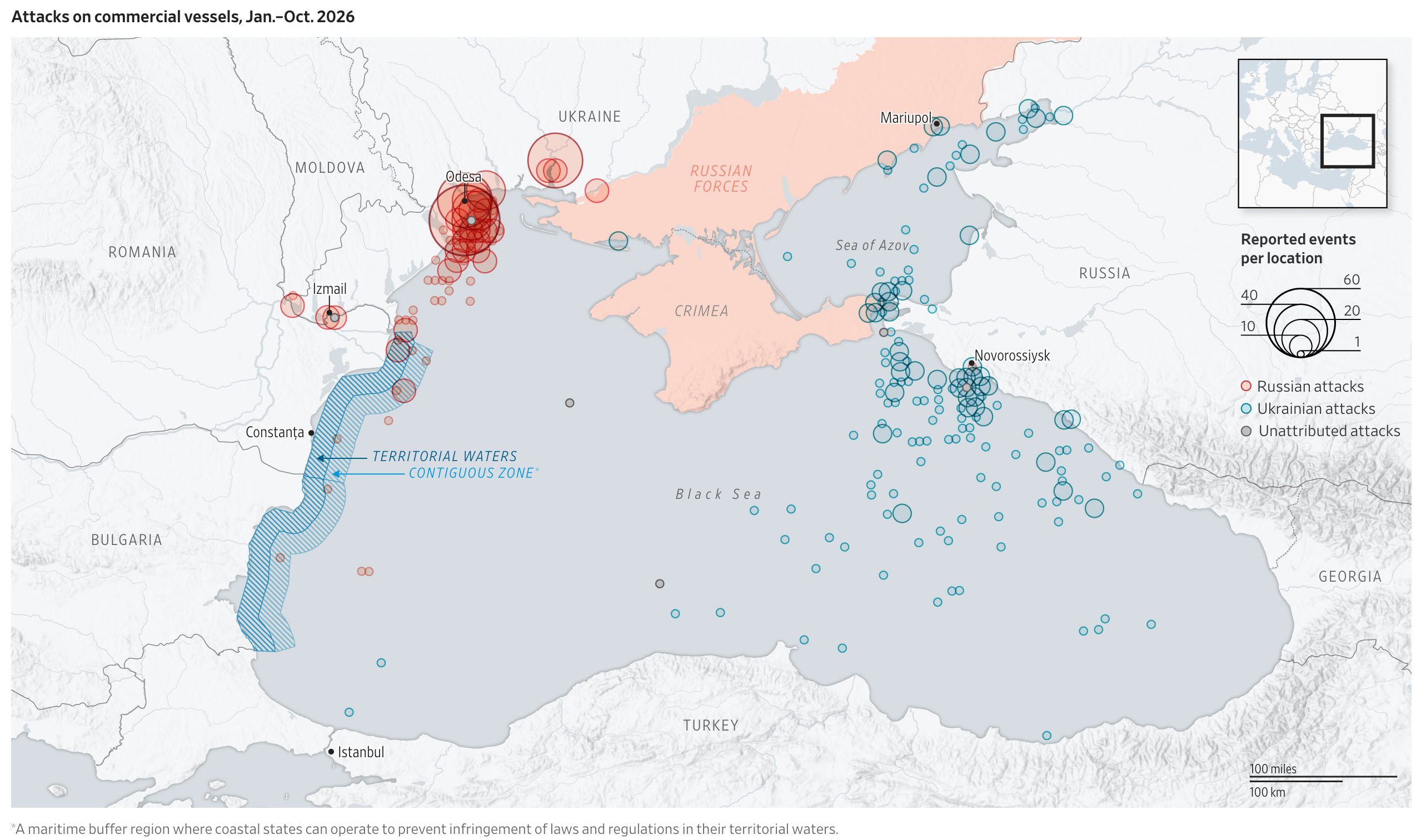
The Black Sea has become one of the world’s most dangerous maritime conflict zones, with more than 300 attacks on commercial vessels reported between January and October 2026. These incidents have killed more than 30 seafarers and left over 20 missing, exceeding the reported maritime casualties associated with the U.S.-Iran conflict in the Strait of Hormuz. Russian forces have targeted vessels transporting Ukrainian agricultural exports, while Ukraine has attacked Russian shipping using drones. The escalating violence has disrupted commercial shipping and threatened vital food exports relied upon by countries in Africa and the Middle East.
The conflict has increasingly spread toward the waters of Romania and Bulgaria, both NATO members. During October, attacks on approximately a dozen vessels near their coastlines resulted in multiple casualties, raising concerns about the possibility of a broader confrontation involving NATO. Some European leaders have attributed these incidents to Russia, although Moscow denies responsibility. The maritime attacks coincide with reported Russian-linked airspace violations and other hostile activities along NATO’s eastern border. In response, NATO allies are increasing support for regional security, while the European Commission has announced plans to accelerate development of a Black Sea maritime-security hub.
The deteriorating security environment has significantly reduced commercial activity across the Black Sea. Ship entries through the Bosporus declined 41% in October compared with the previous year, while total transits in both directions fell 38%. Shipping companies have increasingly avoided waters near Ukraine and Russia, but the expansion of attacks toward NATO territory has reduced the availability of safer routes. The renewed maritime violence represents a reversal of the relative stabilization that followed the initial stages of Russia’s 2022 invasion, when attacks on commercial grain shipments had gradually subsided.
ECONOMY
3. Home Sales in October Plummet to 16-Year Low (WSJ)
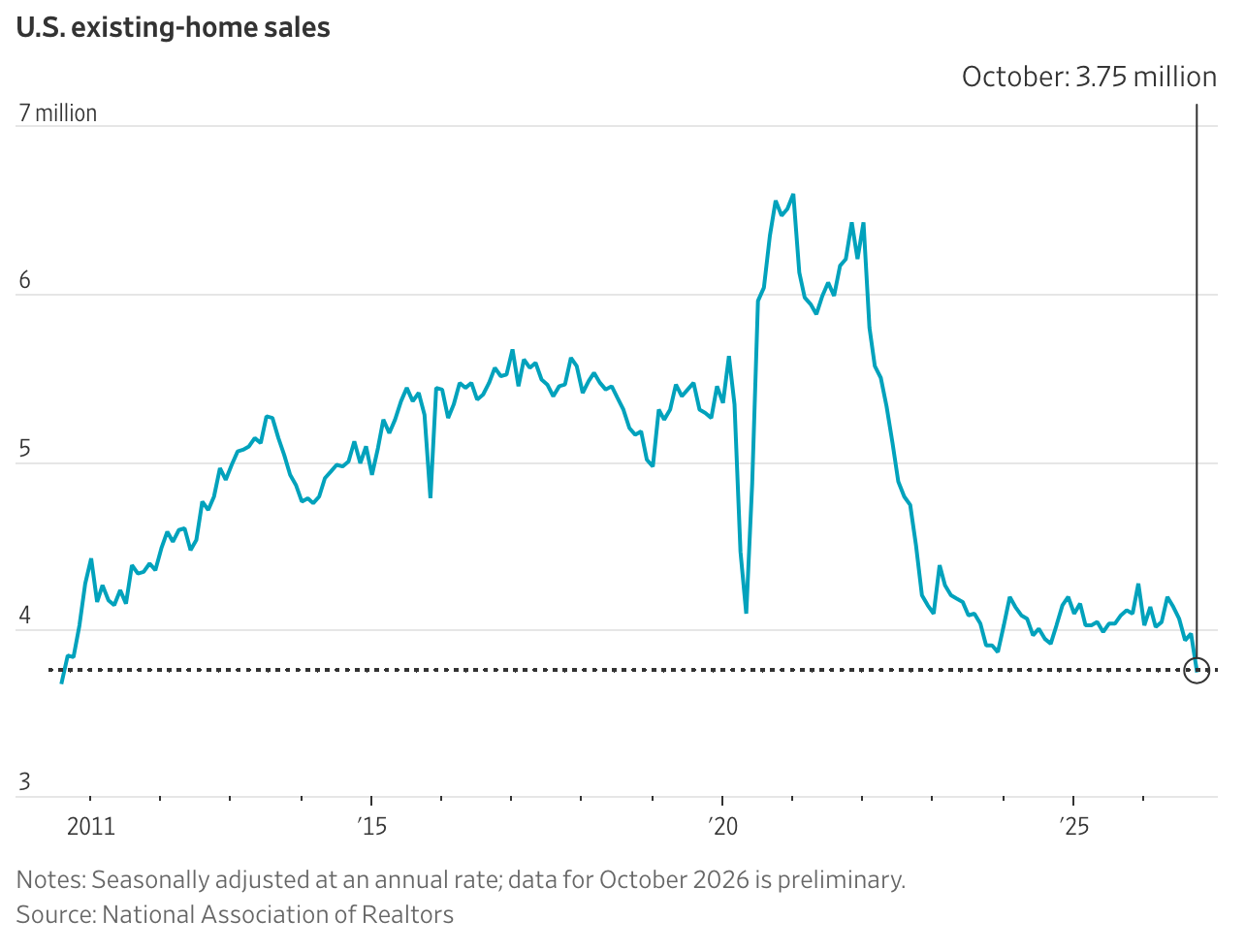
Existing-home sales fell sharply in October, reaching their lowest level since August 2010 and extending a prolonged housing market slowdown. Sales declined 5.5% from September to a seasonally adjusted annual rate of 3.75 million homes, down 8.8% from a year earlier. The decline was largely attributed to mortgage rates exceeding 7%, which discouraged prospective buyers and sharply reduced activity at open houses. Despite weak demand, the national median existing-home price increased 0.4% from a year earlier to $416,700. Prices have remained elevated partly because homeowners with historically low mortgage rates are reluctant to sell, restricting available inventory.
Expectations for a housing recovery have deteriorated as persistent inflation and elevated interest rates continue to undermine affordability. Economists expect rates to remain relatively high into 2027, and Goldman Sachs forecasts just 3.9 million existing-home sales next year, compared with more than 5 million annually before the pandemic.
However, reduced competition is creating opportunities for buyers who can afford current financing costs. Sellers are increasingly offering concessions, including assistance with mortgage-rate buydowns, while some buyers are negotiating substantial price reductions.
BUSINESS
4. This Firefighter Built A $60 Million Secret Door Company With Customers Like Post Malone (Forbes)
Jeremy Barker transformed a small side business selling hidden doors into Murphy Door, a company generating approximately $60 million in annual sales. In 2016, Barker was working as a firefighter while running the growing business, logging an astonishing 500 work hours in a single month. After his wife demanded that he spend more time with the family, he resigned from his firefighting jobs to focus on the company full-time. Today, Murphy Door employs 140 people across three manufacturing plants, with a fourth under construction in Dallas. Barker recently rejected an $80 million acquisition offer and hopes to grow annual sales beyond $100 million before considering selling.
Murphy Door began in 2012 when he built a hidden entrance to a home theater for his children. Unable to find suitable hinges, he designed his own and began selling custom hardware before expanding into concealed doors. A neighbor eventually invested $250,000 for a 10% ownership stake. A breakthrough came in 2013 when a television executive discovered his product at a builders’ trade show, leading to national exposure on home improvement programs and eventually a distribution agreement with Home Depot.
Murphy Door now produces everything from relatively affordable hidden bookcase doors to elaborate custom installations concealing private rooms and specialty collections. Its least expensive products cost under $1,000, while the median sale is approximately $2,380. Custom projects account for roughly three-quarters of revenue, with some exceeding $1 million. The pandemic accelerated growth as homeowners invested in their living spaces, increasing annual sales from $7.7 million to $15 million in one year and then to $24 million the following year. Barker currently spends approximately $5.8 million annually on marketing, primarily through social media advertising and trade shows.
You can see a lot of their doors on their YouTube channel: https://www.youtube.com/@murphydoor.

Watching some of the Murphy Door videos led me to the company, OC Adventure Homes, which has themed homes for rent near Disneyland. It’s an interesting concept. While the homes themselves aren’t spectacular, they have done a neat job of theming each one. Plus, I applaud their website design and the graphical floor plans they include for each home.


TECHNOLOGY
5. Ads in Popular Apps Give Police a Powerful Tool to Spy on Users (Bloomberg)
Webloc, a surveillance technology sold by U.S. company Penlink, allows law enforcement and intelligence agencies to track the movements of hundreds of millions of smartphones worldwide. Originally developed by an Israeli startup, the system collects location data from ordinary mobile applications and can reconstruct a phone’s movements over the previous 12 months. Investigators can identify devices present at specific locations and potentially determine their owners by analyzing movement patterns.
The technology exploits a gap in U.S. privacy protections. Although a 2018 Supreme Court ruling generally requires police to obtain warrants for historical location records from telecommunications companies, federal authorities have argued that the same restrictions do not necessarily apply to commercially purchased data. Webloc has been acquired by ICE, military organizations, and numerous police departments, as well as government agencies in several other countries. ICE spent approximately $9 million on contracts involving Penlink and its predecessor between 2022 and 2026.
Most smartphone users are unaware that their location information may eventually be sold to surveillance companies. Although Penlink argues that its technology supports legitimate criminal investigations and relies on properly obtained data, privacy advocates warn that it could also be used to monitor protesters or individuals engaged in lawful activities. Several states have introduced restrictions, and lawmakers from both parties have questioned whether government agencies are circumventing constitutional safeguards.
NOTE: And, speaking of surveillance…
6. Amazon’s Ring Unveils $250 Flying Security Camera After Delays (Bloomberg)
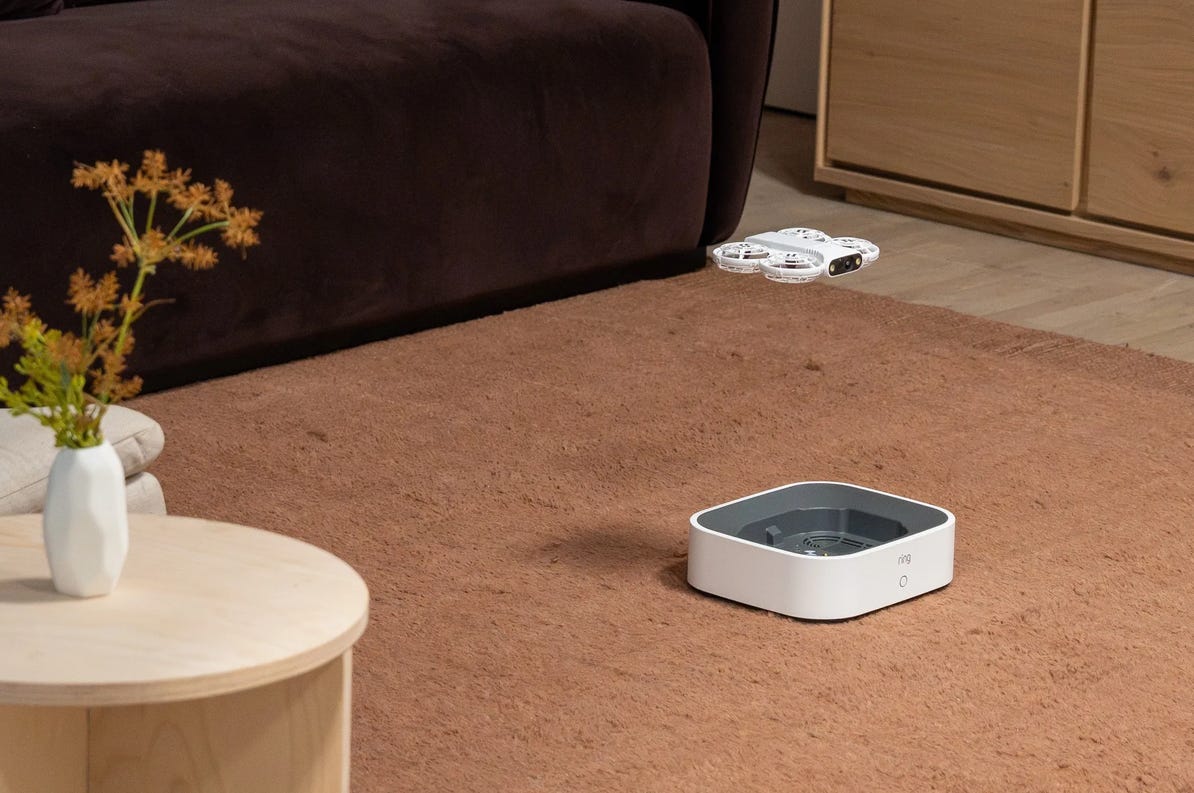
Amazon’s Ring is finally launching its indoor security drone, more than six years after first announcing the concept. The $250 Ring Drone Cam, available in late January, uses AI to fly around a home, conduct scheduled patrols, and investigate alerts from other Ring security devices. It captures 2K video, includes spotlights for nighttime use, and can fly for five to eight minutes before returning to its charging station.
Earlier versions were abandoned because adding sensors and batteries made the drone too heavy and difficult to control. The redesigned model relies heavily on cloud-based AI, although it requires an active Wi-Fi connection and is restricted to indoor use. Ring also introduced the $1,000 Rover Cam, a wheeled security robot based on Amazon’s discontinued Astro robot. Available in mid-December, it records 4K video, patrols areas up to 5,000 square feet, and can operate for 30 minutes at a time. Ring expects the Rover Cam to appeal primarily to businesses, while the less expensive drone is aimed at homeowners looking for a way to monitor their property without installing cameras in every room.
PARENTING
7. The Parents Suing Schools Because Their Kids Got Bad Grades (WSJ)
Parents are increasingly challenging teachers’ grades and evaluations of their children, sometimes escalating disagreements into lawsuits. A 2024 Education Week survey found that 40% of American teachers had experienced parental pressure to change grades, with complaints particularly common among affluent families. Educators attribute the trend partly to greater parental involvement following pandemic-era remote learning and growing anxiety over competitive college admissions. Critics argue that excessive parental intervention undermines teachers’ authority and prevents students from learning accountability.
In Nashville, Tennessee, award-winning teacher Samira Hardcastle resigned after accusing school administrators of changing a student’s grade to satisfy an angry parent. The student had repeatedly failed to complete an assignment, and Hardcastle argued that administrators were teaching students that deadlines and work ethic did not matter.
Technology executive Takashi Kato sued his son’s school district after AI-detection software flagged an English essay as potentially AI-generated, resulting in an academic dishonesty dispute and a lower grade. Kato submitted more than 1,100 pages of documentation to defend his son but eventually dropped the lawsuit without a settlement.
In another case, Weiwei Luo sued after her third-grade son’s teacher noted that he needed to improve his cooperation and responses to classmates following a playground disagreement. The school board upheld the teacher’s evaluation, but Luo challenged the fairness of the appeals process.
8. What Constant Surveillance Is Doing to Children (Atlantic)
NOTE: A good, long read from The Atlantic. The gist:
Digital technology has made it increasingly common for parents to monitor their children throughout childhood and well into adulthood. Apps such as Life360 and Apple’s Find My allow parents to track locations, driving habits, and daily movements in real time. One study found that three-quarters of parents with teenagers ages 14–17 had access to their children’s location data, while more recent research suggests that over half of college students are also being tracked. Life360 alone has approximately 102 million monthly active users. Parents often adopt these tools for convenience and safety, but their widespread availability has also created an expectation that responsible parenting requires constant awareness of a child’s whereabouts.
Child-development experts worry that excessive monitoring may interfere with children’s independence and resilience. Adolescence is an important period for learning to manage uncertainty, solve problems, and make decisions without parental intervention. Constant tracking allows parents to intervene whenever a child encounters difficulty, potentially depriving young people of opportunities to develop confidence through overcoming challenges themselves. Although research on the long-term effects remains limited, psychologists note that teenagers today are generally safer than previous generations, with substantially lower rates of violence and risky behavior. At the same time, young people are less likely to engage in independent activities, and anxiety and depression have increased, although a causal relationship with parental monitoring has not been established.
Constant surveillance may also reinforce parental anxiety. Psychologists describe repeated checking as a form of reassurance seeking that provides temporary relief but can strengthen the urge to monitor. Some parents acknowledge becoming preoccupied with their children’s movements, occasionally intervening unnecessarily or reacting to inaccurate location information. Life360’s leadership argues that tracking can actually increase independence by giving parents enough reassurance to allow activities they might otherwise prohibit. The company maintains that most users rely on the app for everyday coordination rather than intensive surveillance.
Some psychologists and parenting advocates are encouraging families to deliberately restore opportunities for independence. Programs such as Let Grow and experimental independence therapy encourage children to complete age-appropriate activities without direct supervision while helping parents become more comfortable with uncertainty. Early experiences described by participating families suggest that children often demonstrate greater resourcefulness than their parents expect. Parents also report becoming more confident about allowing independence, although abandoning location tracking entirely remains difficult for many.
ENTERTAINMENT
9. Hollywood’s New Superhero Is the Guy Who Tells Moviegoers When to Pee (WSJ)
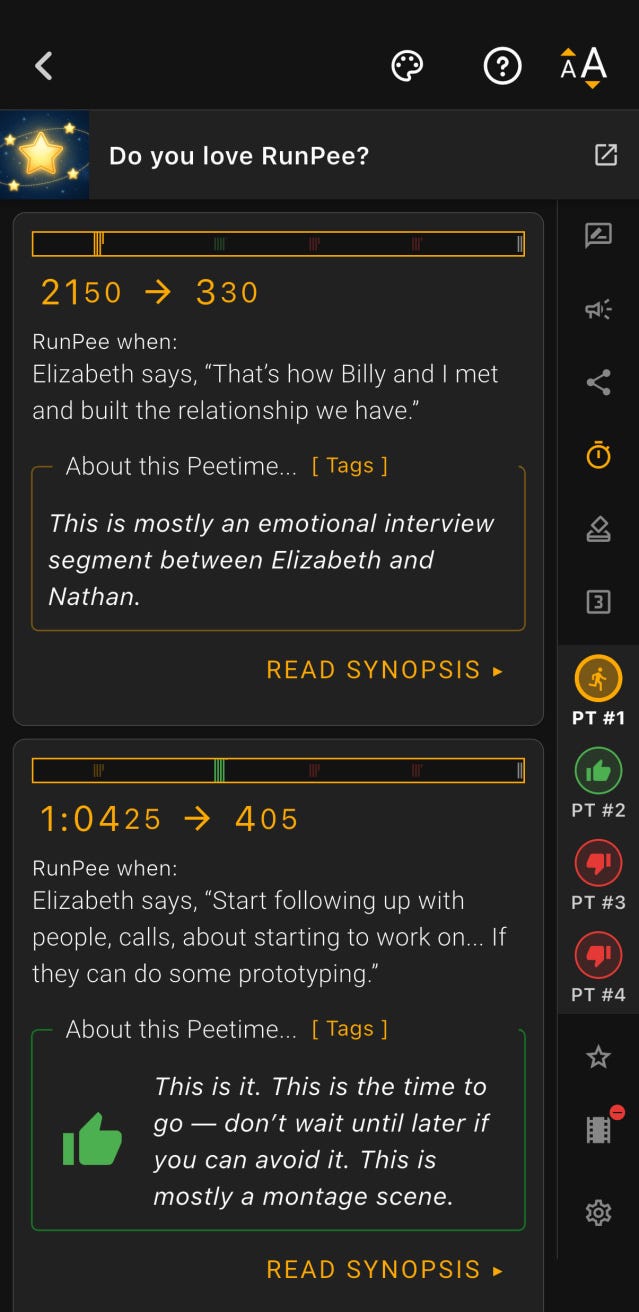
As Hollywood movies grow increasingly longer, moviegoers are turning to RunPee, an app that identifies the best times to take bathroom breaks without missing important scenes. With more films approaching or exceeding three hours and theaters rarely offering intermissions, viewers must either endure the discomfort or risk missing key moments. RunPee solves this problem by recommending bathroom breaks and providing brief summaries of what happens while viewers are away.
The app was created in 2008 by software developer Dan Gardner after he struggled through Peter Jackson’s three-hour King Kong. At the time, unusually long movies were relatively rare, but they have become increasingly common. Action films now average 128 minutes, approximately 25 minutes longer than a few decades ago. RunPee has benefited from this trend, attracting approximately 231,000 active users across 214 countries between March and October 2026. Its biggest surge came during the 2023 Barbenheimer phenomenon, when more than 100,000 people installed the app in a single week.
Gardner and a small team of contributors now prepare bathroom guides for approximately 120 to 150 movies annually. They identify scenes that can be easily summarized, such as straightforward dialogue or montages, while avoiding important action sequences and critical plot developments. Ideally, they identify a potential break every 30 minutes, rating each opportunity according to how much viewers might miss. The app also includes a timer that alerts users when a recommended break is approaching.
AI USE DISCLOSURE
The article summaries in this newsletter are prepared with the assistance of artificial intelligence (AI). I personally select and read every article, use AI to help summarize the key points, and then review and edit the summaries to ensure they accurately reflect the original content.
The original articles are always more detailed and often include valuable charts, graphics, and context that the summaries cannot fully capture. I encourage you to read the actual articles in their entirety and support the writers who wrote them.
Any additional commentary or personal observations, identified by “NOTE,” are my own.