In this post, topics include: critical thinking, defense, jobs, economy & housing, business, technology & AI, life, nature, and a few fun items.
CRITICAL THINKING
NOTE: As the internet and AI expand, it’s becoming increasingly difficult to parse valid information and research from the phony stuff. It’s tempting to want to throw it all out and ignore everything coming at you, especially when the noise is louder than the signal itself.
These days, I am slower to react to the news of the day, preferring to wait until I have more details and a better understanding of the issue before forming an opinion, and definitely before responding emotionally.
Below are two more reasons to be cautious in how you respond to headlines and studies.
1. Relax, Microplastics Aren’t Killing You (FP)
While recent, highly publicized studies claimed alarming levels of plastic in the human brain, those findings have since been challenged, with critics showing the detection method likely confused plastic with ordinary fat molecules. As a result, the most dramatic health claims have been walked back, highlighting how shaky or overstated science can undermine public trust.
NOTE: Don’t get me wrong, I think any amount of plastic in my body is bad and I’m all for reducing/eliminating how much I ingest…it’s just a shame that such a newsworthy study had flaws that undermined it.
2. Named: 50 ‘experts’ and linked brands publishers should treat with caution (Press Gazette)
Press Gazette has published a “PR Hall of Shame” exposing more than 50 apparently fake experts who have appeared over 1,000 times across British newspapers, magazines, and online outlets. The investigation focuses on cases where the experts appear not to exist at all, often using AI-generated images and bios, and highlights how journalists are being flooded with dubious, AI-written press releases from organizations that evade follow-up.
The practice is largely driven by SEO schemes, where fabricated experts and case studies are used to secure valuable backlinks from reputable media. Some operations have run for years and at scale, involving networks of companies and PR agencies and leading to widespread publication of misleading content. Press Gazette warns this trend is accelerating with advances in AI, undermining media credibility, and is urging journalists and PR professionals to report suspected fake experts to help curb the problem.
NOTE: As an aside, if I had a dollar for every suspicious LinkedIn invite I’ve received, I’d at least have $100. I can tell because they have phony looking, or AI-generated, photos and nebulous backgrounds. These days, unless someone sends me a specific message telling me why they want to connect to me, or I know them directly, I don’t accept generic LinkedIn friend requests. Call me snobbish. I just prefer more meaningful connections. (Ironically, if you read farther down you’ll see how LinkedIn is now becoming a hub for dating.)
DEFENSE
3. US military to expand by more than 30,000 troops this year (Military Times)
Congress has approved and funded increases to the size of the U.S. armed forces in fiscal 2026, expanding active-duty end strength by more than 30,000 troops—the largest authorized force since 2023. The Army and Navy will see the biggest gains, while the Air Force, Space Force, and Coast Guard will also grow. The Marine Corps will remain flat. Overall active-duty strength will exceed 1.3 million, with total forces, including reserves and the National Guard, approaching 2.1 million.
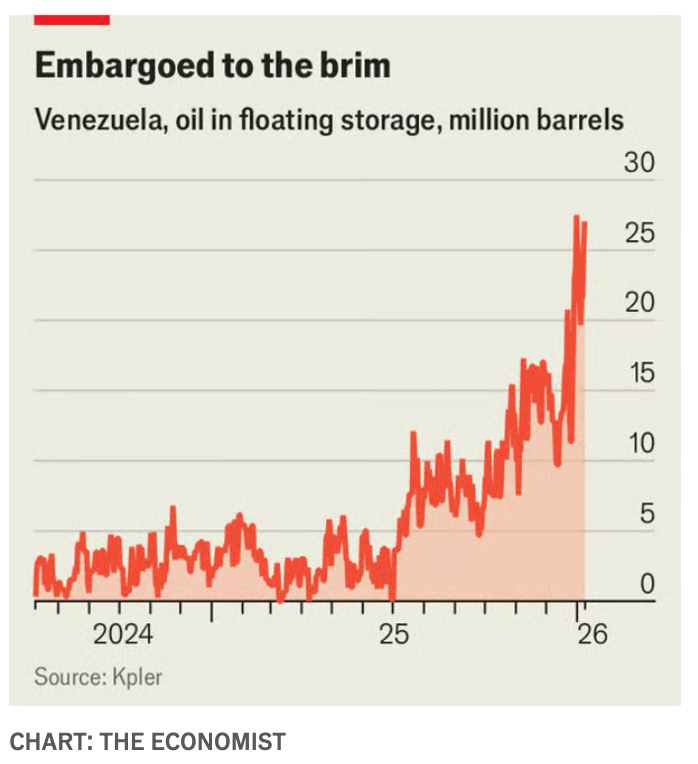
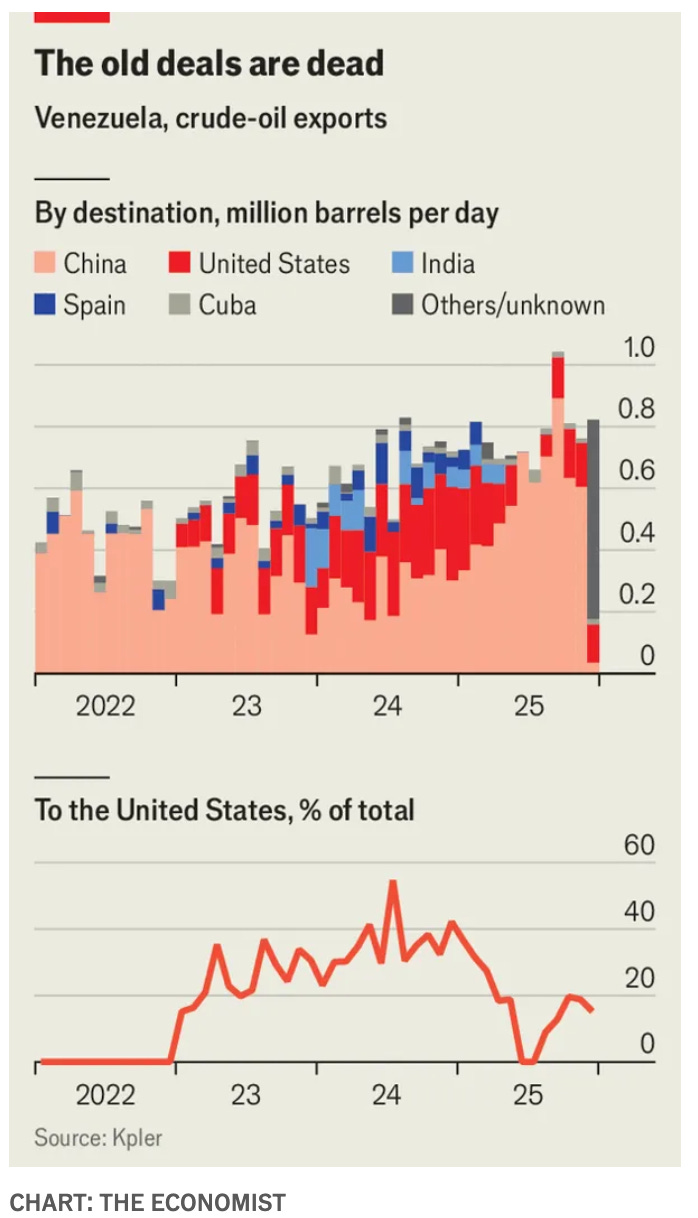
4. Donald Trump’s Venezuela oil deal is already up and running (Economist)
In early January, the U.S. dramatically reshaped relations with Venezuela after American forces captured Nicolás Maduro and the Trump administration moved quickly toward a negotiated oil arrangement with the regime’s new leadership under Delcy Rodríguez. The deal would allow the U.S. and licensed firms like Chevron, Vitol, and Trafigura to purchase and market up to 30–50 million barrels of Venezuelan crude, relieving Venezuela’s storage glut and preventing a shutdown of oil production. Payments would flow through escrow accounts under U.S. oversight, with limited funds reaching the Venezuelan state and strict controls on spending.
For the United States, the arrangement offers another source of heavy crude and commercial opportunities for oil firms, though it is not transformative. For Venezuela, it promises desperately needed dollar inflows, higher oil prices than under sanctions-era shadow trading, and relief from an impending currency crisis. At the same time, Washington retains leverage through sanctions, pricing power, and control over investment and spending.
5. Germany’s Military Recruitment Drive Has a Gen Z Problem (WSJ)
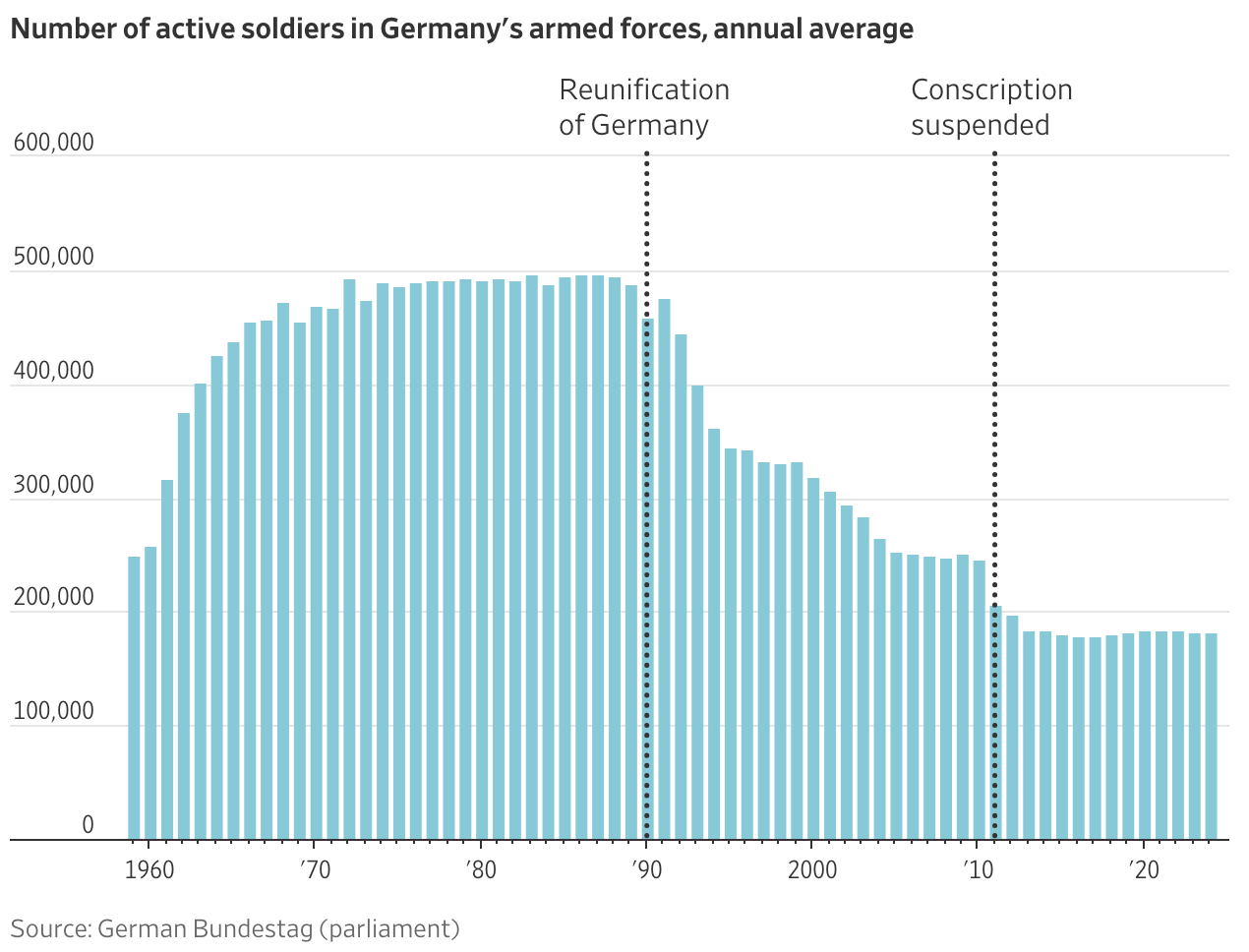
As Europe accelerates rearmament in response to the threat from Russia, Germany is struggling to recruit enough young people for military service. Resistance is driven less by pacifism than by economic resentment: many young Germans question why they should sacrifice for a state they feel prioritizes pensions for older generations while offering them limited economic security. Protests against Germany’s new voluntary military service, which includes mandatory questionnaires for young men, reflect frustrations over high living costs, weak job prospects, and lingering fatigue from pandemic-era sacrifices.
Despite broad public support for the military and defense spending, willingness to personally serve is at a record low. Recruitment gains from marketing campaigns have not offset retirements, leaving Germany far short of its troop targets. The government has raised pay and added incentives, but critics argue only a return to mandatory conscription would meet staffing needs. The debate highlights a growing generational divide over obligation, economic fairness, and what young people feel they receive in return for defending the state.
6. What Xi Jinping’s purge of China’s most senior general reveals (Economist)
China’s sweeping military purges have reached their most dramatic point with the investigation of General Zhang Youxia, the country’s most senior uniformed officer and a longtime confidant of Xi Jinping. Zhang and another top commander, Liu Zhenli, were placed under investigation for serious discipline and legal violations, effectively hollowing out the Central Military Commission and leaving Xi as the dominant figure in military leadership. The move marks the largest shake-up of China’s armed forces since Mao’s era and underscores the depth of corruption and factional struggle within the PLA.
The purge may reflect Xi’s frustration with stalled reforms, lingering corruption—particularly in weapons procurement—and concerns that Zhang’s growing power posed a political risk despite their close ties. While Xi aims to build a modern, combat-ready military capable of taking Taiwan, the repeated removal of senior leaders has created instability and leadership gaps. Western assessments warn the upheaval could hurt short-term readiness, even as Xi appears to bet that rooting out corruption will ultimately strengthen the PLA.
EDUCATION & JOBS
7. How the U.S. Is Tightening the Reins on Federal Student Loans (WSJ)
With U.S. student loan debt at a record $1.7 trillion, the federal government is moving to tighten borrowing and increase accountability in higher education. The Trump administration plans to cap graduate student loans starting in July 2026, limit lifetime borrowing, and restrict how much parents can borrow, while also redefining which fields qualify as professional degrees. At the same time, new rules will tie schools’ access to federal loans to whether graduates meet earnings benchmarks, reflecting bipartisan frustration over rising debt and doubts about the value of some degrees.
8. Nurses are still America’s most trusted workers (Sherwood)
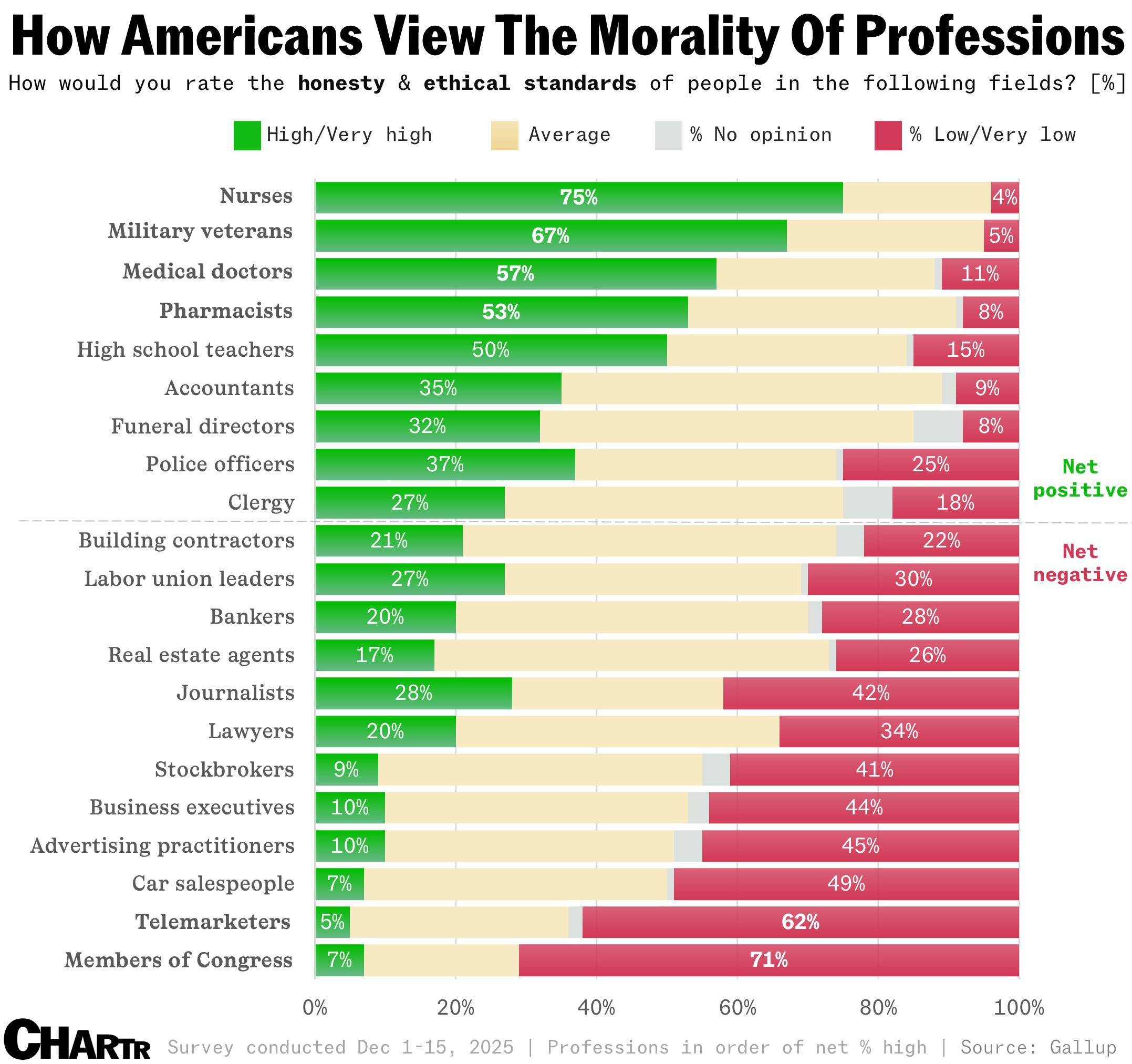
Gallup’s 2025 Ethics Ratings of American Professions show that nurses remain the most trusted occupation in the U.S., a position they have held almost continuously since 1999, with firefighters briefly taking the top spot in 2001. Only four professions—including nurses, other healthcare workers, and military veterans—received majority positive ratings, while telemarketers and members of Congress were again viewed by most Americans as having low ethical standards. Finance- and business-related roles continued to rank poorly, with several hitting record-low trust levels.
Despite nurses’ continued lead, public trust in healthcare professionals has declined sharply since the pandemic. Positive ratings for nurses are down 14 points from their peak, while doctors and pharmacists have fallen 20 and 18 points, respectively. Overall, Gallup found that trust across major professions has eroded, with the average positive rating reaching a historic low, signaling a broad decline in confidence in professional ethics.
9. Why people are flirting on LinkedIn — and job hunting on Tinder (Sherwood)
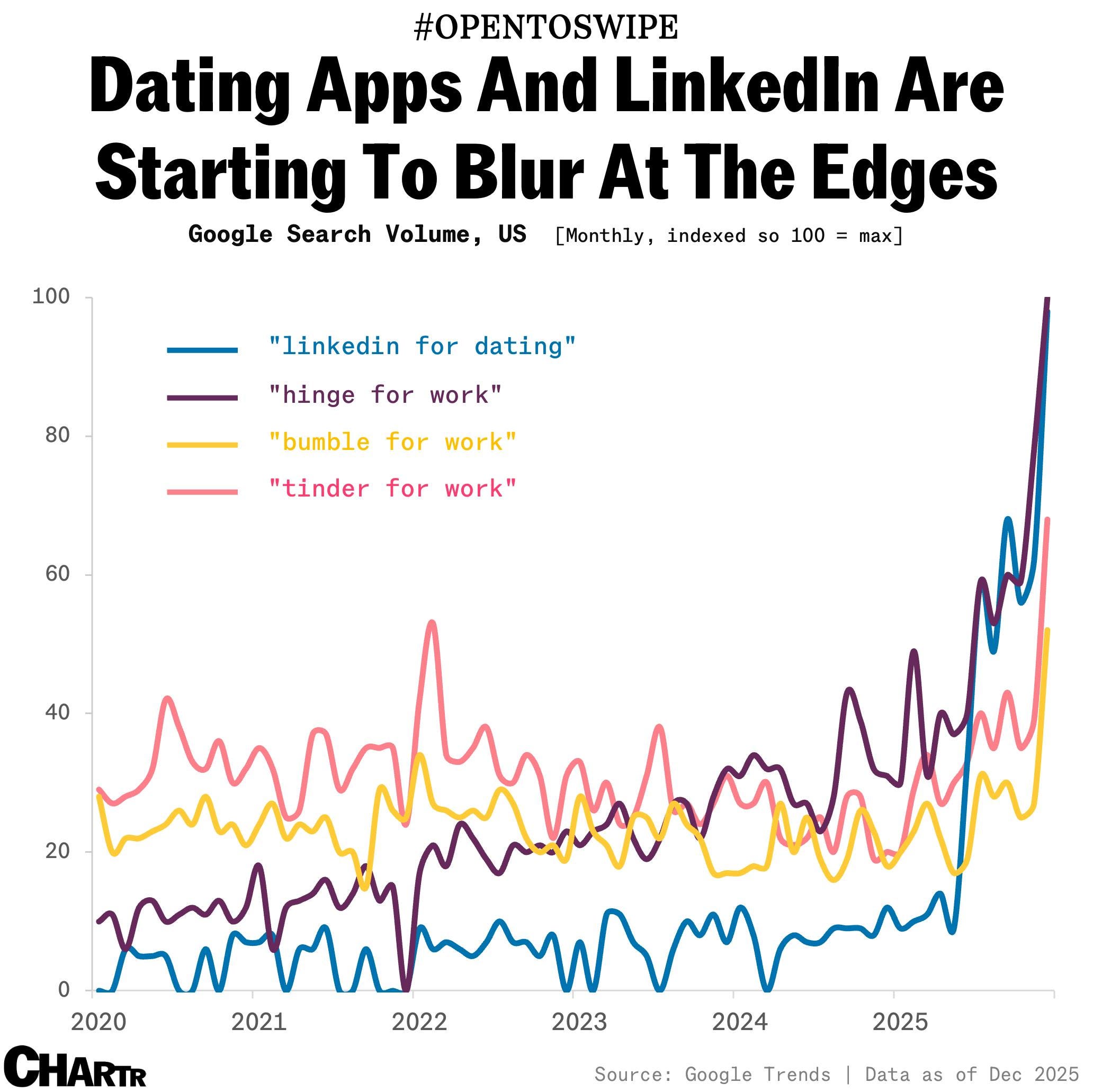
The internet makes it easy to find information, but work and love still depend largely on matchmaking rather than instruction, and the platforms built for each are increasingly overlapping. LinkedIn has become a massive global professional hub, while dating apps remain major revenue generators, yet search trends show rising interest in using LinkedIn for dating and dating apps for work. Surveys suggest this crossover is real: more than half of young adults report having gone on a date via networking platforms, while many LinkedIn users—especially women—report receiving unwanted romantic advances.
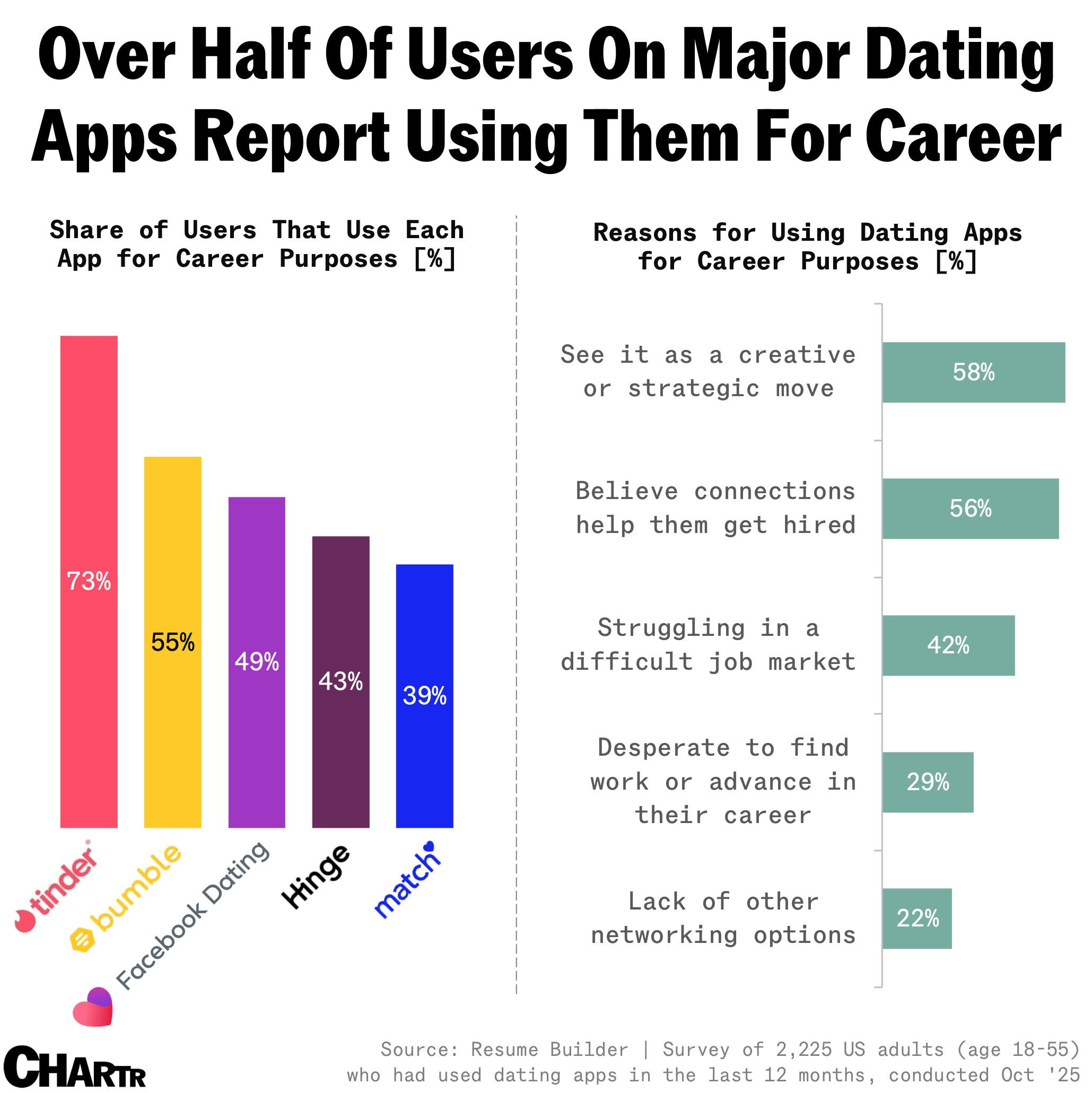
Burnout and distrust on dating apps, where users frequently encounter ghosting or dishonesty, appear to be pushing some people toward LinkedIn, which offers more verifiable personal information. At the same time, a tightening job market has driven users to repurpose dating apps for professional networking. Large shares of Tinder, Bumble, and Hinge users say they’ve used the platforms to expand their careers, reflecting how economic pressure and platform fatigue are blurring the boundaries between professional networking and romantic matchmaking.
ECONOMY & HOUSING
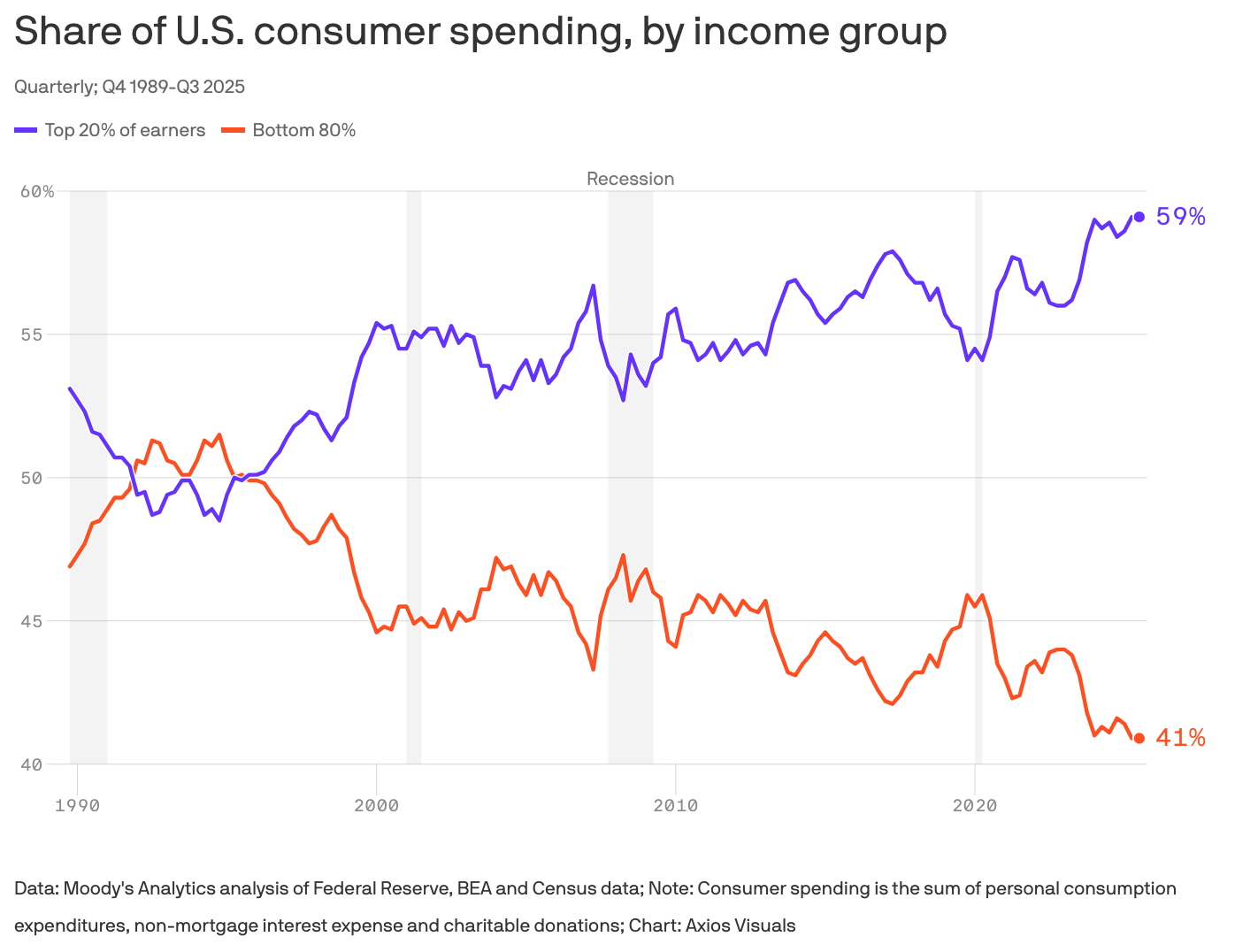
10. Share of U.S. consumer spending, by income group (Axios)
U.S. economic growth is increasingly reliant on spending by wealthy households, making the system more fragile. The top 20% of income earners now account for 59% of all consumer spending—a near record—while the bottom 80% contribute a record-low 41%, reflecting a widening “K-shaped” divide where higher earners continue to pull ahead as everyone else treads water.
With inflation and a weak job market constraining most households, spending growth is being sustained largely by affluent consumers benefiting from stock-market gains and rising wealth concentration. Economists warn that this leaves the economy vulnerable: a market downturn that hits the rich could quickly tip the U.S. into recession, worsening job losses for lower-income workers and deepening social and political tensions.
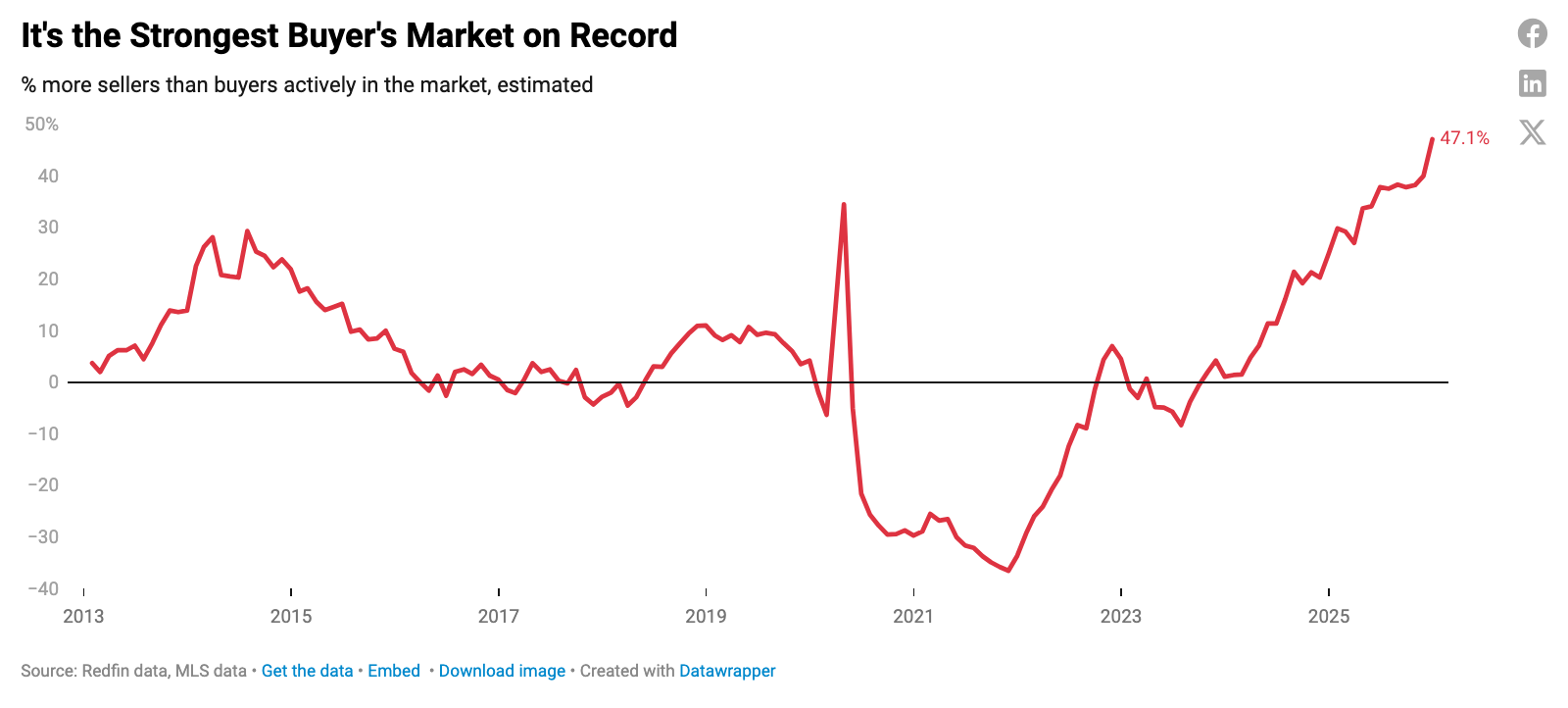
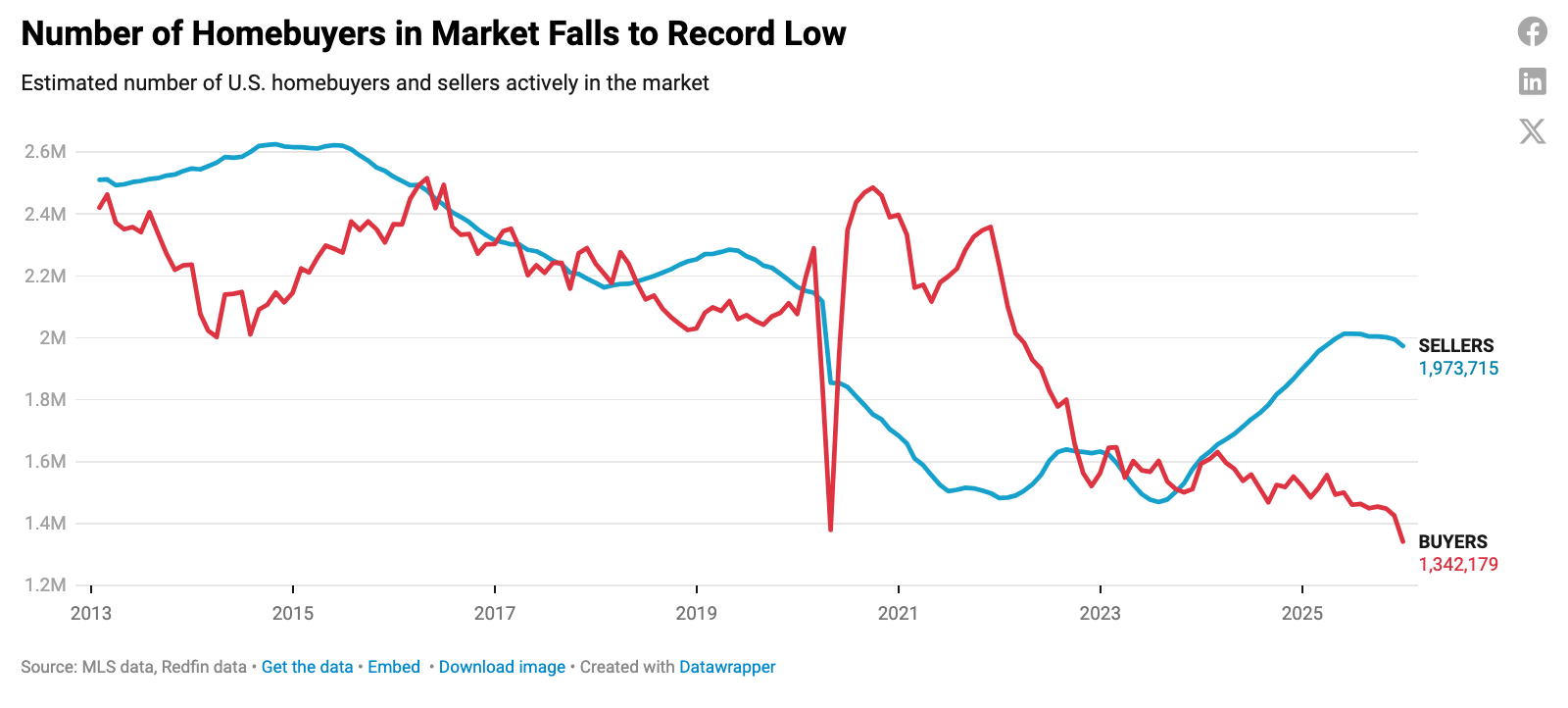
11. Home Sellers Outnumber Buyers By a Record Margin, Upping Buyers’ Bargaining Power (Redfin)
The U.S. housing market has shifted sharply in buyers’ favor, with sellers outnumbering buyers by 47.1% in December—the largest imbalance since records began in 2013. This gap is being driven primarily by a steep drop in buyers, whose numbers fell to a record low amid high mortgage rates, elevated home prices, and economic uncertainty. While sellers have also pulled back, they have done so more slowly, leaving buyers with greater negotiating power in many markets.
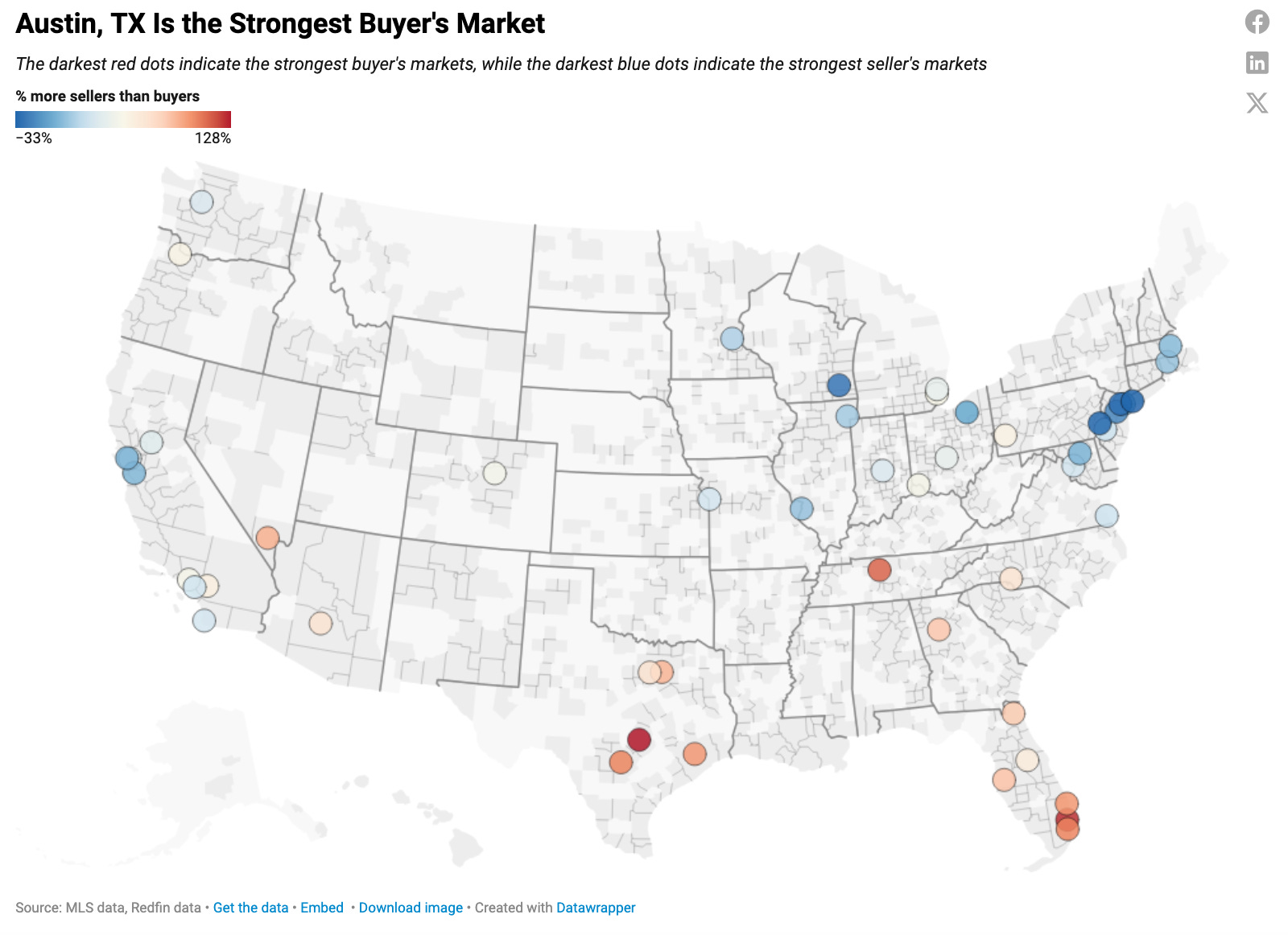
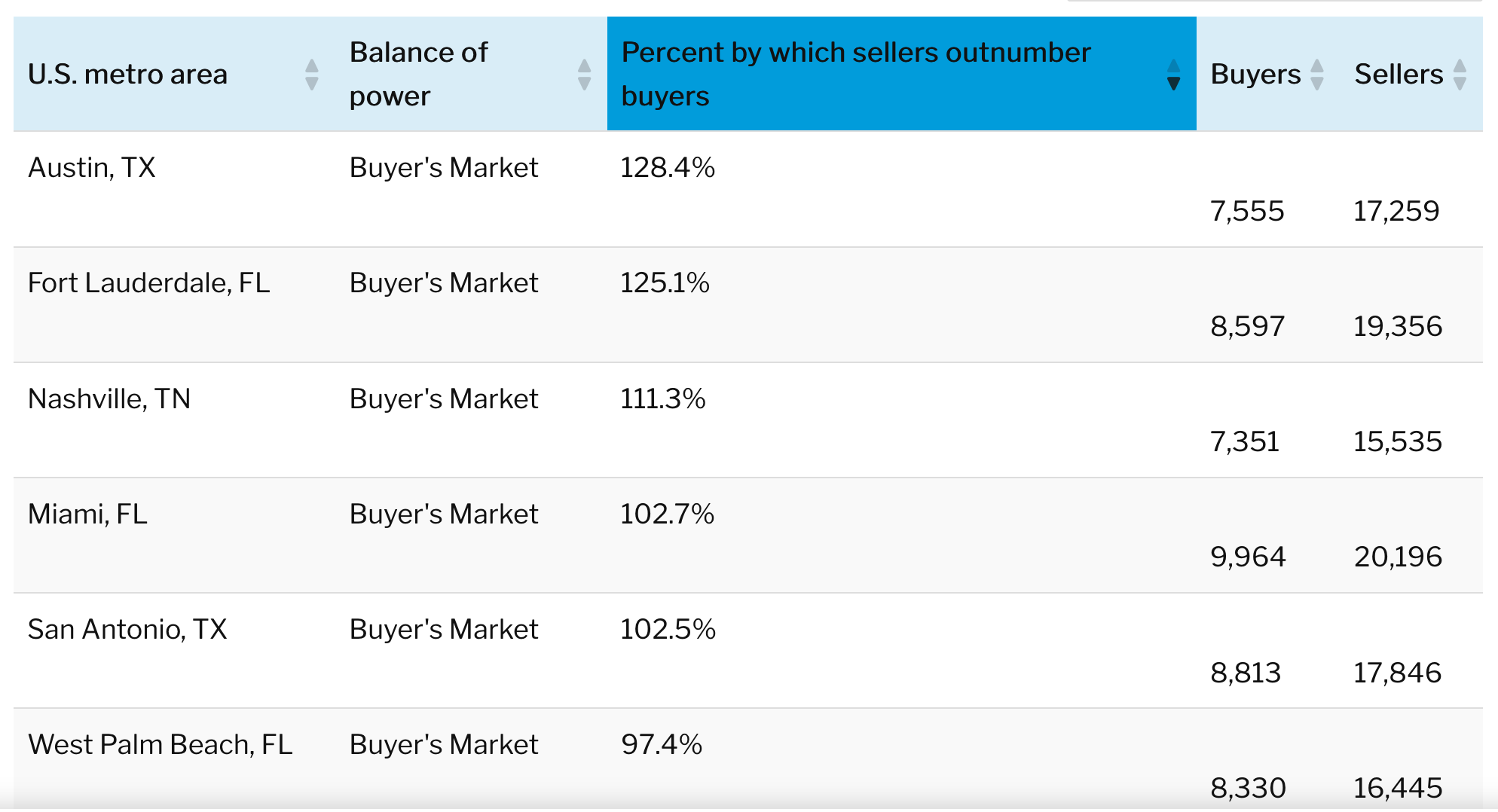
Buyer’s markets are most pronounced in the Sun Belt, especially in cities like Austin, Dallas, San Antonio, and parts of Florida, where heavy homebuilding during the pandemic has created excess supply. In contrast, parts of the Northeast and Midwest remain seller’s markets due to tighter supply. As a result, home prices are barely rising nationally and are falling in some oversupplied metros, underscoring how shifts in supply and demand are reshaping regional housing conditions.
12. Homebuyers Are Canceling Deals at the Highest Rate on Record (Redfin)
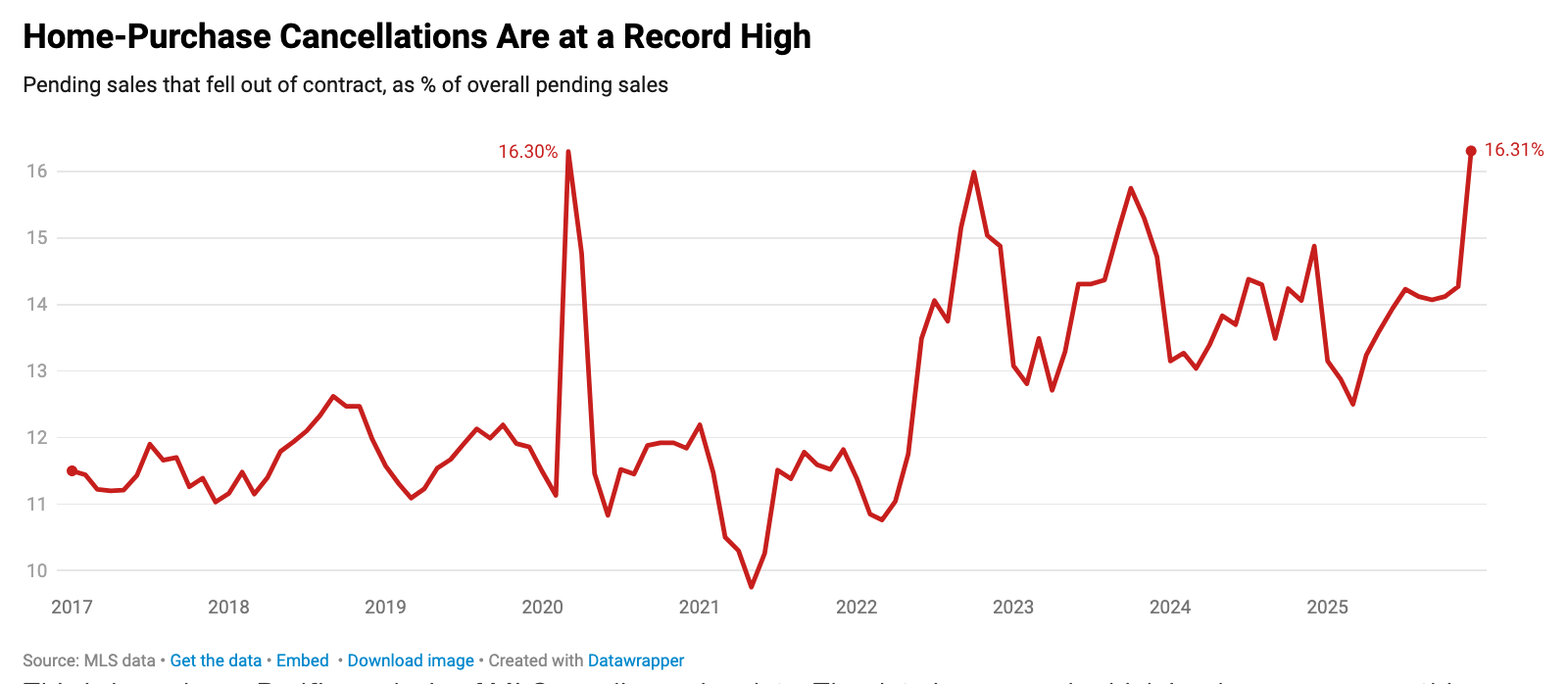
Home-purchase cancellations hit a record high in December, with about 16.3% of U.S. homes under contract falling through—the highest December rate since records began in 2017. Buyers are increasingly backing out as high home prices, affordability concerns, and a growing supply of listings give them more leverage and more alternatives. Inspection contingencies are often the trigger, though underlying cost pressures frequently drive the decision.
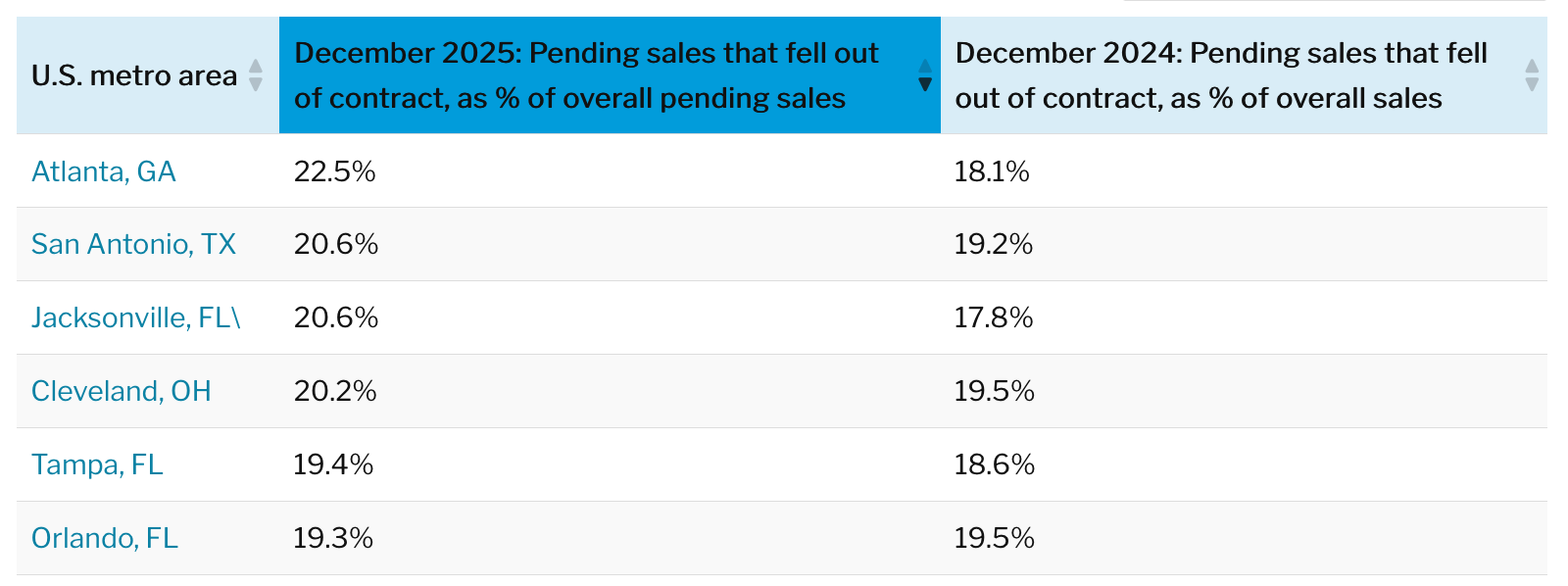
Cancellations were most common in fast-cooling Sun Belt markets such as Atlanta, Jacksonville, San Antonio, and Tampa, where sellers now far outnumber buyers. In contrast, cancellations remained relatively rare in tighter markets like Nassau County, NY, and parts of the Bay Area, despite some year-over-year increases there. Overall, the trend reflects a shift toward buyer-friendly conditions as demand softens and affordability slowly begins to improve.
13. To Make Homes Affordable Again, Someone Has to Lose Out (WSJ)
U.S. housing policy is trapped between conflicting interests: renters want prices to fall so they can buy homes, while existing homeowners and builders want values to stay high. The Trump administration has floated headline-grabbing ideas—such as 50-year mortgages, lower borrowing costs, restricting institutional investors, and allowing 401(k) withdrawals for down payments—but these measures mostly boost buyers’ purchasing power without addressing the underlying housing shortage and could even push prices higher.
Analyses suggest that restoring 2019-era affordability would require one of three difficult outcomes: a massive rise in household incomes, a return to ultra-low mortgage rates, or a 35% drop in home prices. Policymakers are reluctant to pursue solutions that would significantly lower prices, given the $34 trillion in housing equity held by homeowners and the risk to economic growth. With supply constrained by local zoning rules and political resistance to falling home values, meaningful reform remains elusive, leaving housing affordability a largely zero-sum problem.
BUSINESS
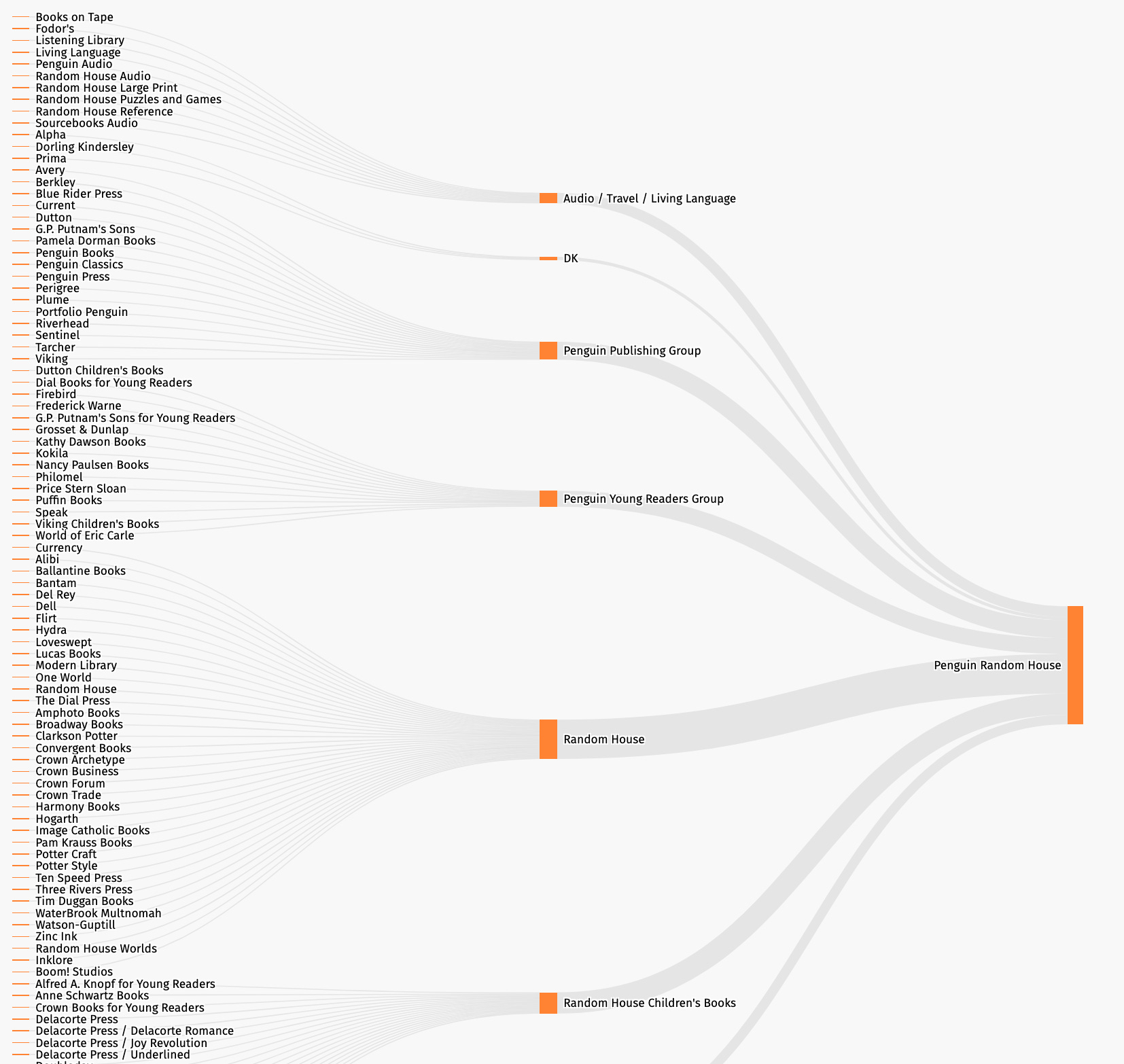
14. The Big Five US Trade Book Publishers
NOTE: The image below is only a snippet of a very large image on this website showing just how much consolidation there is in the publishing industry. Quite amazing.
15. Amazon Joins the Big-Box League With Its Largest-Ever Store (WSJ)
Amazon is planning its largest-ever physical retail store, a roughly 230,000-square-foot big-box location in the Chicago suburb of Orland Park, Illinois—larger than an average Walmart. About half the space will function as a traditional store selling groceries and household goods, while the other half will be dedicated to fulfilling online and in-store orders, keeping digital operations separate from in-person shopping. The concept blends kiosks, digital ordering, curbside pickup, and back-of-house fulfillment, reflecting Amazon’s effort to merge e-commerce efficiency with physical retail convenience.
The move marks Amazon’s most ambitious attempt yet to crack brick-and-mortar retail after years of mixed results, including store closures and scaled-back experiments like Amazon Go. While in-store purchases still account for most U.S. retail spending, Amazon faces stiff competition from entrenched big-box rivals like Walmart, Costco, and Target. Analysts say success will depend on whether Amazon can leverage its Prime data and logistics strengths to offer a compelling reason for shoppers to change long-standing habits in an already crowded market.
TECHNOLOGY & AI
NOTE: I missed this when it came out last year:
16. WiFi routers now tracking motion: Xfinity’s new feature sparks privacy concerns (Cyber News)
Xfinity has introduced WiFi Motion, a free feature that turns up to three WiFi-connected household devices into motion sensors by detecting disruptions in WiFi signals between them. Designed as a basic home-awareness tool rather than a professional security system, it can sense movement across rooms and floors, send push alerts, and allows users to adjust sensitivity and notification schedules, though it does not pinpoint exact locations and does not work with phones, tablets, or WiFi extenders.
The feature has sparked privacy concerns, as Xfinity’s policy allows collection of motion data and its potential disclosure to third parties, including law enforcement, under certain circumstances. Critics worry this could enable ISPs to infer household activity, while others note that similar inferences are already possible through internet traffic analysis. The debate has prompted renewed calls for stronger privacy protections, skepticism of ISP-provided hardware, and suggestions such as using personal routers or VPNs to limit data exposure.
NOTE: Just a reminder, like the streaming services that lured us all in with cheap prices early on, the price we pay for AI is only going to go up…after all, someone has to pay for all the data centers, computer chips, and energy use.
17. OpenAI to Begin Testing Ads in ChatGPT in Push for Fresh Revenue (WSJ)
OpenAI plans to begin testing ads in ChatGPT, marking a significant shift in its business model as it looks to boost revenue to support rapid growth and massive future computing costs. Ads will appear only in the free version and the lowest-priced subscription tier, ChatGPT Go, shown at the bottom of responses and clearly labeled, while higher-tier subscribers will remain ad-free.
Despite past concerns from CEO Sam Altman that advertising could undermine trust, OpenAI says ads will not influence answers, user conversations won’t be sold, and sensitive topics such as politics and mental health will be excluded. Users can opt out of ad personalization, and minors won’t see ads. Led by Fidji Simo, the effort reflects pressure from growing competition and aims to balance monetization with user trust, with OpenAI pledging to adjust the approach based on feedback.
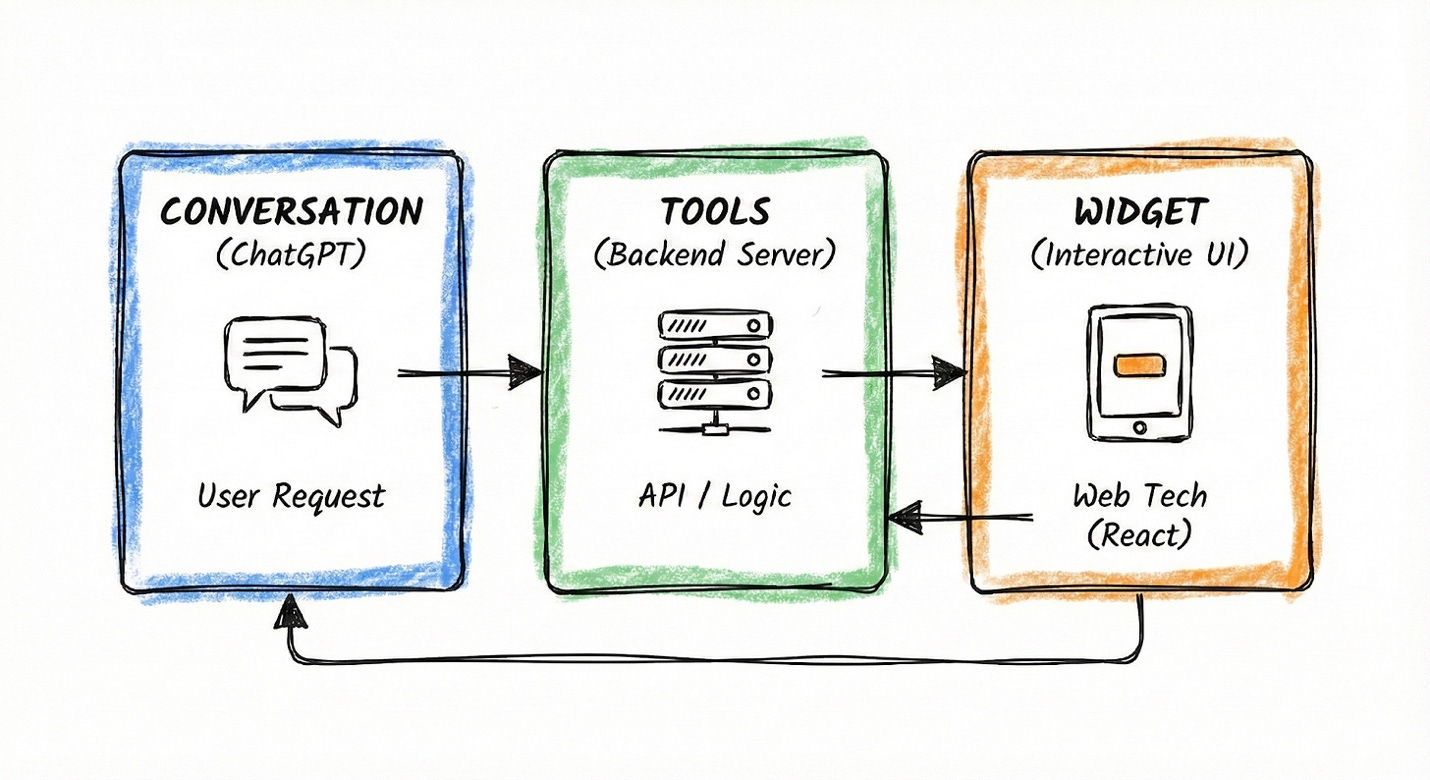
18. ChatGPT apps are about to be the next big distribution channel: Here’s how to build one
ChatGPT is evolving from a text-based assistant into a transactional platform by embedding interactive widgets from third-party apps directly into conversations, allowing users to browse, compare, and complete tasks—such as booking flights—without leaving the chat. Launched at Dev Day, this “ChatGPT apps” ecosystem already includes major partners like Expedia, Canva, DoorDash, and Spotify, and represents a major new distribution channel comparable to the App Store or early SEO. Apps can surface contextually based on user intent, meaning users don’t search for apps; ChatGPT suggests them automatically. Apps can appear inline, fullscreen, or picture-in-picture, and ChatGPT controls when tools are invoked and how users move through tasks. For builders, this creates a low-barrier opportunity to reach massive audiences, from large enterprises to solo developers, as chat becomes a primary interface for discovering and using digital services.
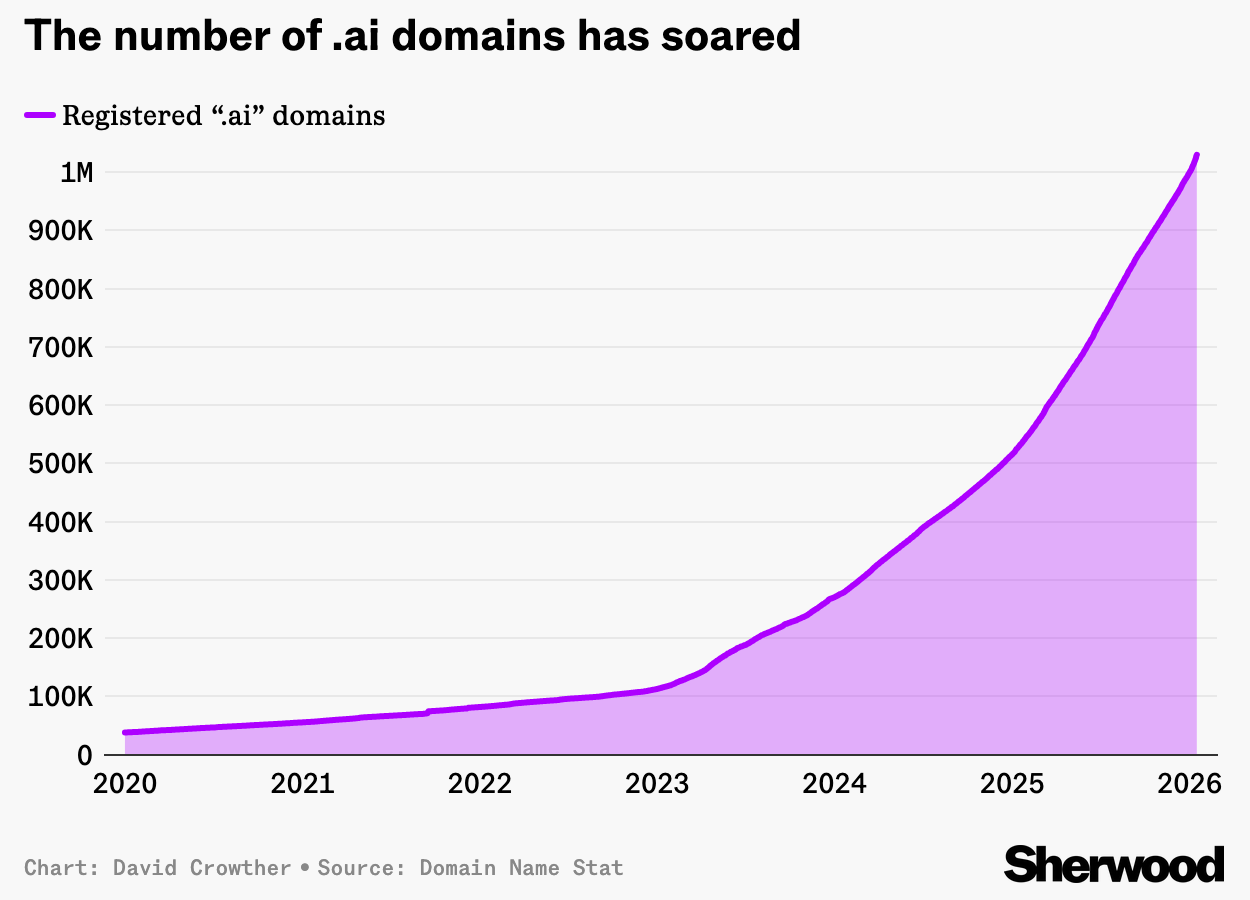
19. There are now more than 1 million “.ai” websites, contributing an estimated $70 million to Anguilla’s government revenue last year (Sherwood)
Anguilla has become an unexpected winner of the AI boom thanks to its control of the “.ai” internet domain. Since ChatGPT’s launch, demand for AI-branded domains has surged, turning domain registrations into a major revenue source for the small Caribbean territory. In 2023, “.ai” domains generated about $32 million—over a fifth of government revenue—and registrations have since topped one million, pushing annual income far higher.
By 2026, Anguilla expects nearly $100 million in revenue from domain-related sales, largely driven by renewals and high-priced auctions of expired names. With standard fees providing steady income and premium domains selling for hundreds of thousands of dollars, the island has effectively stumbled into a digital windfall fueled by the global AI gold rush.
LIFE
20. Millennials spend more time than past generations with their children (Economist)
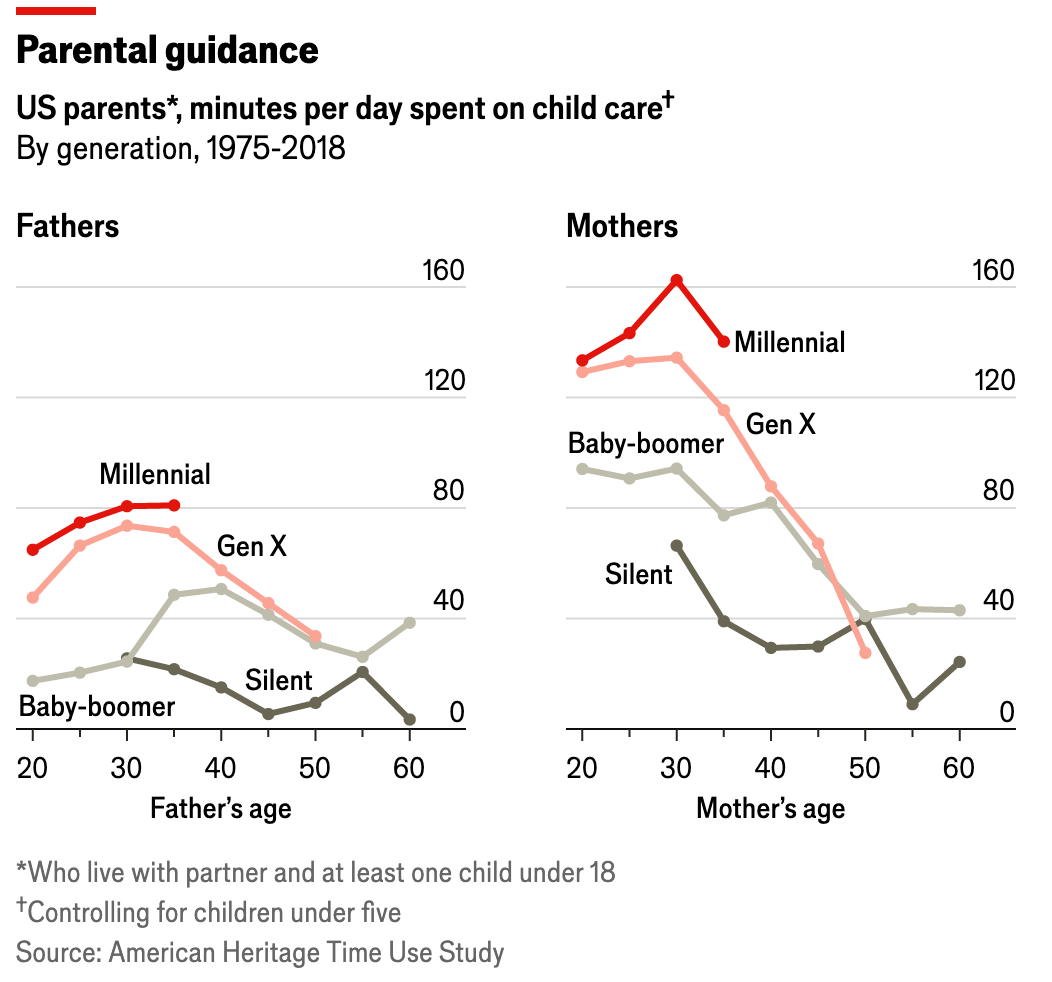
Americans are having fewer children, with the fertility rate falling to 1.6 births per woman in 2024, but parents are spending more time with their children than ever before. Over the past several decades, time devoted to child care has steadily increased across generations, with especially large gains among fathers. Compared with earlier cohorts, millennial parents—particularly dads—spend significantly more time caring for their children, continuing a long-term shift toward more hands-on parenting.
21. Humanity will shrink, far sooner than you think (Economist)
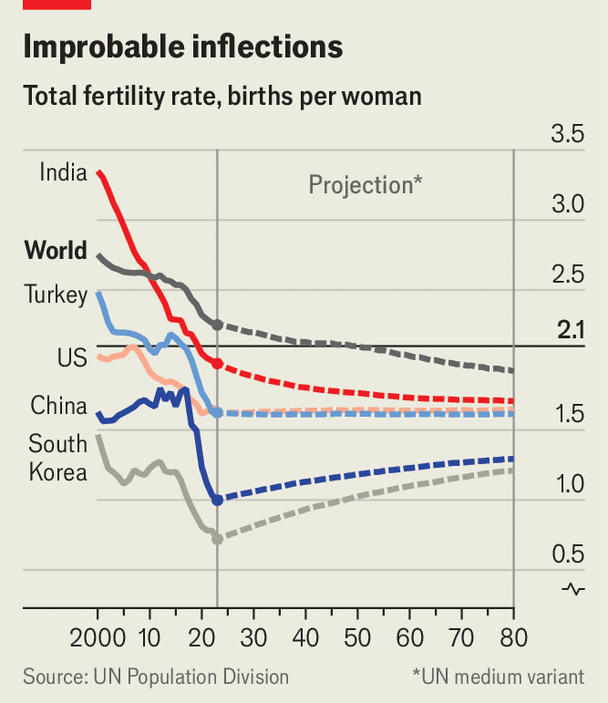
Fertility rates are falling faster and further than demographers expected across much of the world. Turkey’s birth rate has dropped to 1.48 children per woman, well below replacement level, and similar or lower rates are now common across Asia, Latin America, Europe, and even parts of Africa. Countries from Colombia and India to China and South Korea are seeing rapid declines, with some reaching historically unprecedented lows. As a result, only about one-third of the global population lives in countries with fertility high enough to sustain population growth.
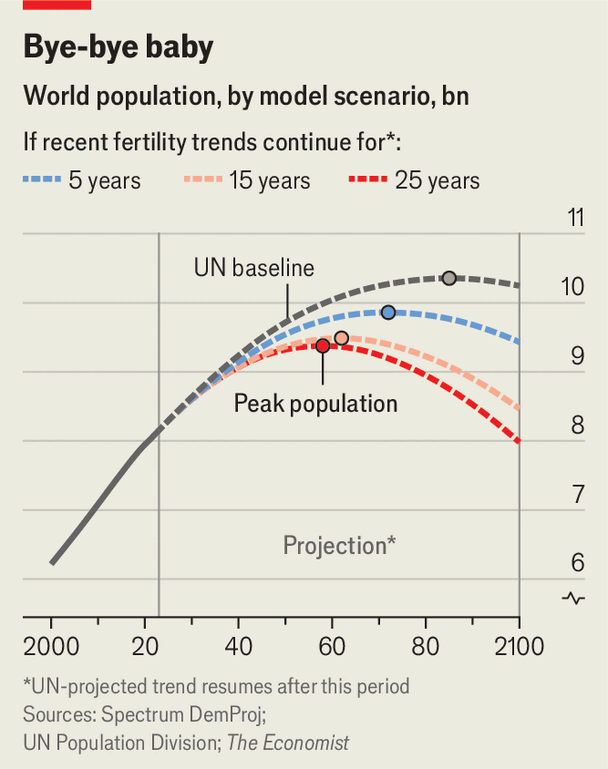
What is most striking is the acceleration of this trend, which is outpacing official projections that assume fertility will soon stabilize or rebound. Many experts now doubt those assumptions, arguing there is little evidence that low fertility is self-correcting. If current declines persist even briefly, the world’s population could peak much earlier and at a much lower level than expected—possibly in the 2050s below 9 billion—triggering profound economic, social, and geopolitical consequences as humanity enters a period of long-term population decline.
22. More Americans are living alone than ever before
A minimalist Chinese app called Sile Me (“Are You Dead?”), which simply requires users to press a button every two days to confirm they are alive or else alert an emergency contact, has become the top paid app in China’s iPhone App Store. Its popularity highlights the rapid growth of people living alone in China, where one-person households could reach 200 million by 2030, driven by both an aging population and younger adults choosing solo living.
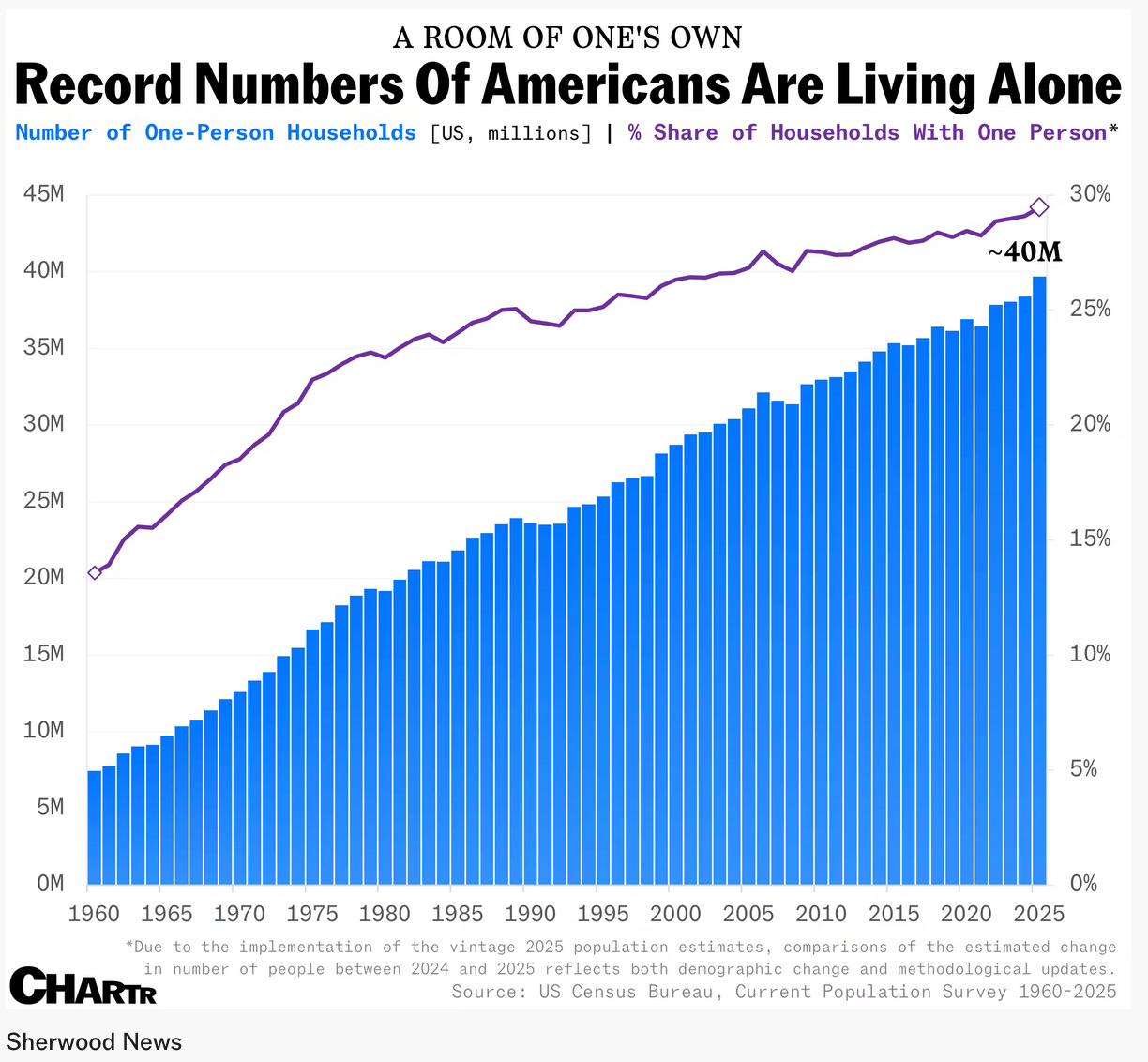
The trend is global. In the United States, nearly 40 million households—about 29% of the total—now consist of just one person, a record high that continues to climb. Similar increases have occurred across most wealthy countries, fueled by declining marriage rates, changing social norms, rising incomes, and the expansion of older age groups most likely to live alone.
NATURE
23. Enormous freshwater reservoir discovered off the East Coast may be 20,000 years old and big enough to supply NYC for 800 years (Live Science)
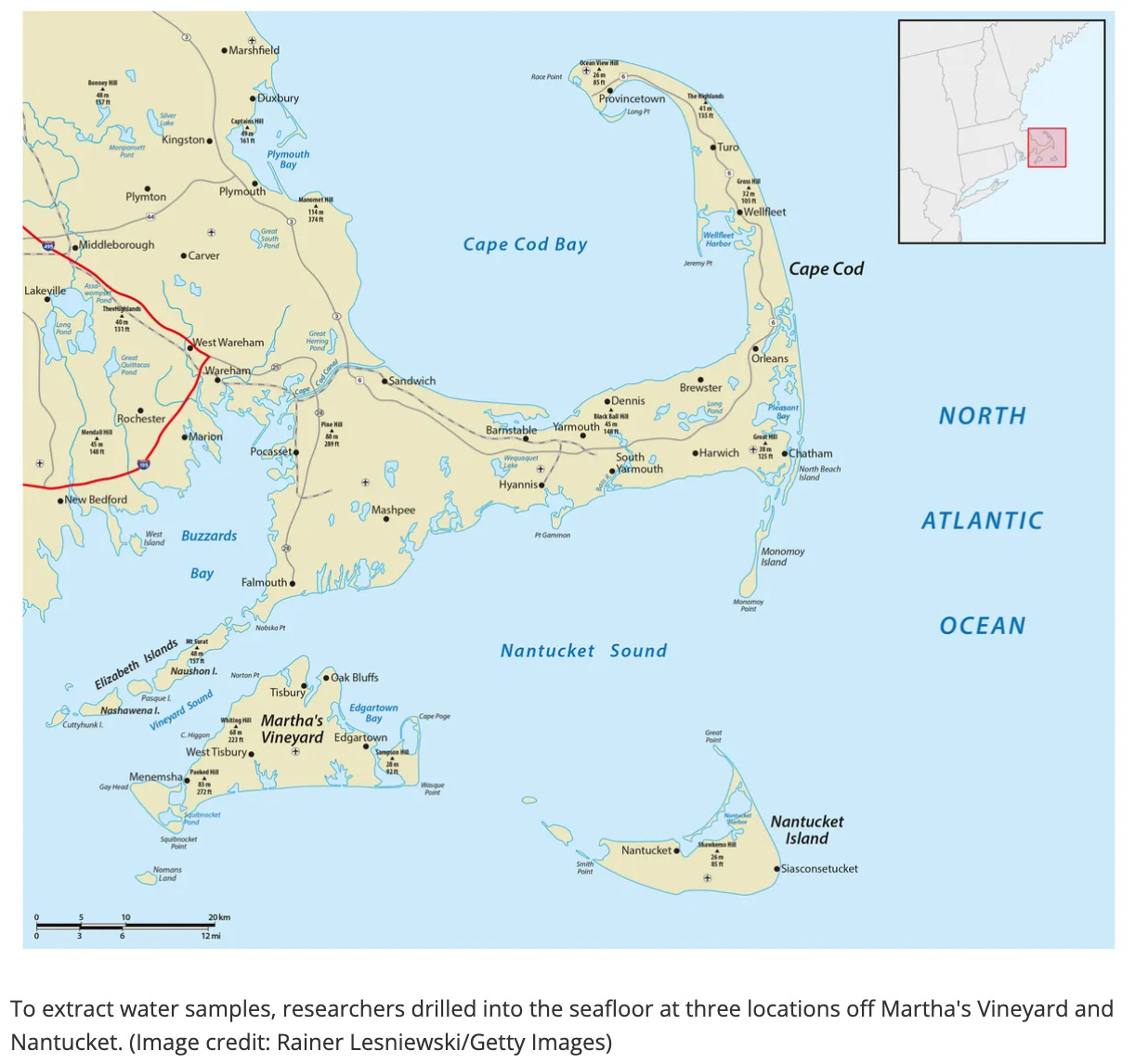
Scientists have confirmed the existence of a massive freshwater reservoir buried beneath the seafloor off the U.S. East Coast, potentially large enough to supply a city the size of New York for hundreds of years. Stretching from offshore New Jersey to Maine, the reservoir appears to have formed during the last ice age, when glaciers pushed meltwater deep into coastal sediments and trapped it beneath layers of clay and silt. Recent drilling off Nantucket and Martha’s Vineyard recovered tens of thousands of liters of water, showing far lower salinity than seawater and suggesting the reservoir is larger than previously believed.
Preliminary analyses indicate the water is primarily glacial in origin, possibly mixed with rainfall, and was emplaced around 20,000 years ago. The freshwater is sealed beneath salty sediment, remaining isolated from the ocean above, though its salinity increases farther offshore. Researchers are now analyzing the samples to better estimate the reservoir’s size, age, and composition, aiming to provide reliable data in case the resource is ever considered for future use.
FOR FUN
24. Washington, DC, looks set to get America’s second Sphere (Sherwood)
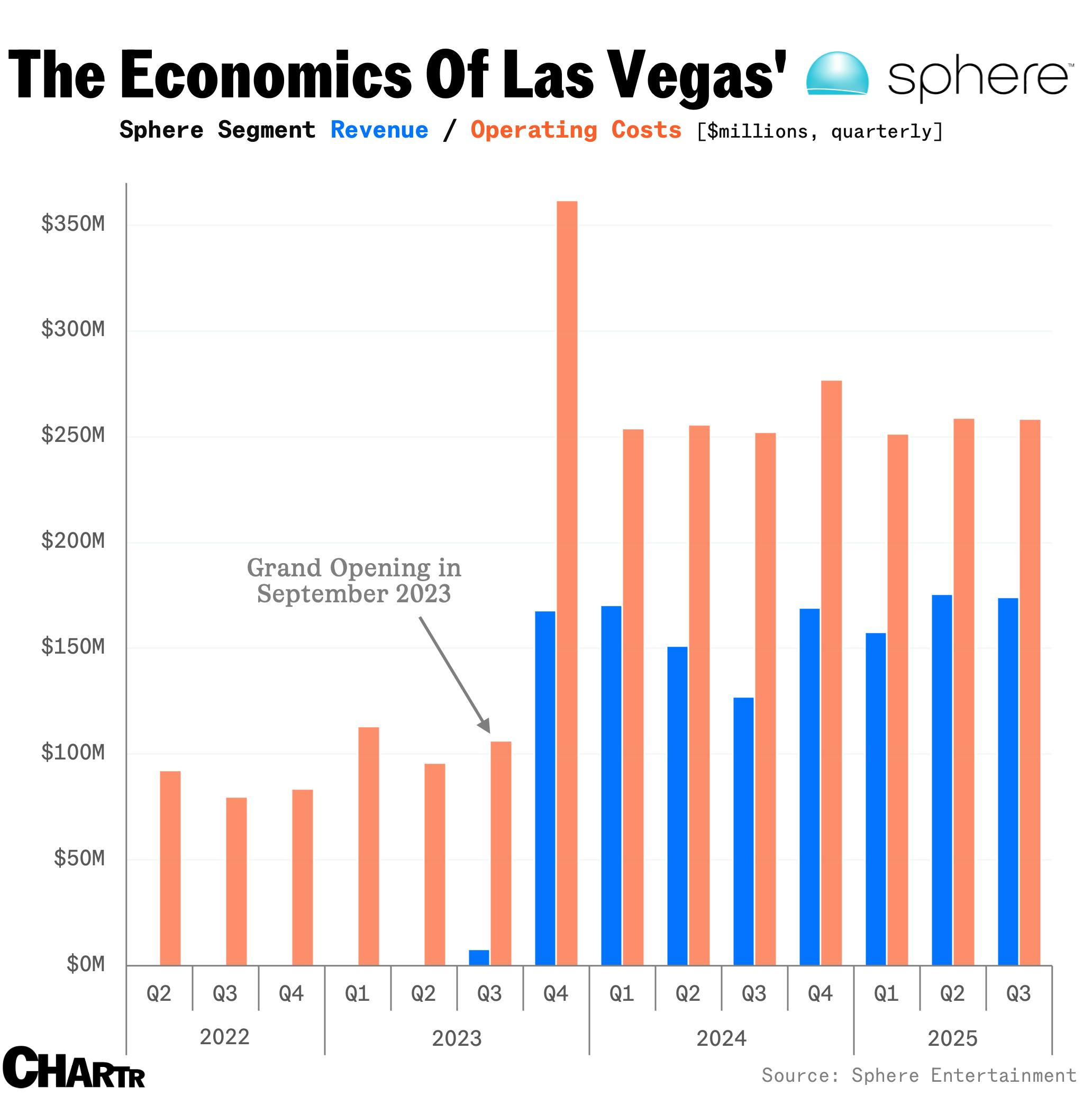
Las Vegas’s Sphere has quickly become a major entertainment attraction, driving strong revenue growth through concerts, advertising on its massive LED exterior, and sponsorships. Its success has encouraged Sphere Entertainment to expand, with plans announced for a second U.S. location near Washington, DC, at National Harbor, as well as a smaller 6,000-seat format and an international Sphere planned for Abu Dhabi.
Despite rising revenue, the Sphere remains financially challenging. High-profile performances helped generate $156 million in quarterly revenue, with additional income from exterior advertising and suites, but operating costs still far exceed earnings. As a result, the glowing venue has proven popular and eye-catching, yet remains a costly and unprofitable venture even as the company pushes ahead with expansion.
25. Jumping the Tallest Cliff in the Solar System
The tallest vertical cliff on Earth is Mount Thor in northern Canada, which drops about 4,100 feet in a single sheer face. A fall from the top would last nearly 20 seconds, with a dropped object reaching speeds over 150 miles per hour, making it an extraordinarily dangerous plunge.
An even more extreme cliff exists off Earth on Miranda, a moon of Uranus. Verona Rupes rises roughly six miles (about 33,000 feet), making it far taller than Mount Everest or the Grand Canyon. Because Miranda’s gravity is only a tiny fraction of Earth’s, a fall from this cliff would take about eight minutes, with a maximum speed of around 90 miles per hour, making the descent far slower and potentially survivable with advanced equipment.

BONUS ITEM - Series Graph
NOTE: Hadn’t seen this before—a cool website that shows you the IMDB ratings of TV series episodes in one chart. Example below for The Office.