

Economy
NOTE: First off, something I was not expecting:
1. The Robin Hood state is coming for the rich (Economist)
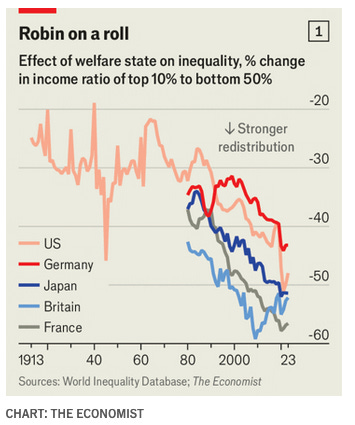
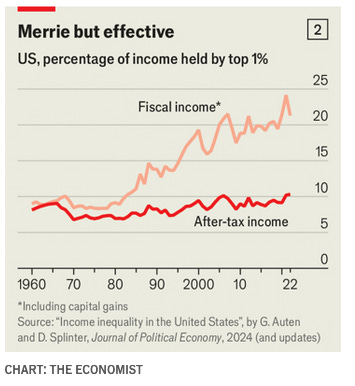
Income inequality has risen sharply across rich countries since the 1980s, with the top 1% capturing a growing share of pre-tax income—especially in America. Yet at the same time, tax-and-benefit systems have become significantly more progressive. In most G7 countries, increased redistribution has offset or even reversed rising inequality in post-tax incomes. In America, while pre-tax inequality is near record highs, post-tax inequality is lower than in many recent decades, and the top 1%’s effective tax rate remains close to historical peaks.
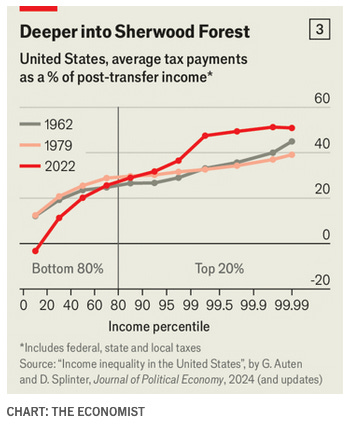
Contrary to the popular narrative that “neoliberal” tax cuts dismantled redistribution, effective tax rates on high earners are generally higher today than in the mid-20th century, when widespread avoidance meant the rich often paid far less than headline rates suggested. Although corporate-tax cuts and certain loopholes (such as capital gains treatment or “buy, borrow, die” strategies) may benefit the ultra-wealthy, most evidence suggests that top earners still pay a large—and growing—share of total tax revenue. In countries like America, Britain, and South Korea, the top 1% now fund a striking portion of income-tax receipts.
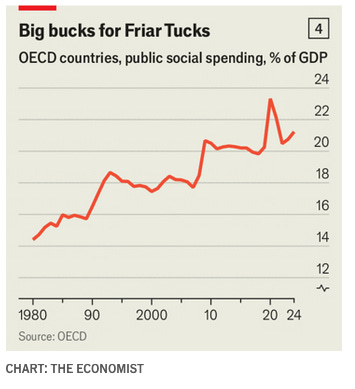
Governments have used this revenue both to reduce tax burdens on lower earners and to expand social transfers, including pensions, healthcare subsidies, and means-tested benefits. As a result, redistribution as a share of GDP has increased, and many working- and middle-income households now receive more in public spending than they pay in taxes.
The central policy debate is whether tax systems have become too dependent on the wealthy. Some argue further increases are needed—especially if technological change widens inequality—while others warn that ever-higher rates risk discouraging work, investment, and entrepreneurship, or prompting capital flight. So far, there is limited evidence that high earners are reducing effort in response to higher effective rates. But as calls grow for wealth taxes and top marginal rates above 80%, the sustainability and economic consequences of the modern “Robin Hood” state remain an open question.
2. In 2025, Trade Deficit in Goods Reached Record High (NYT)
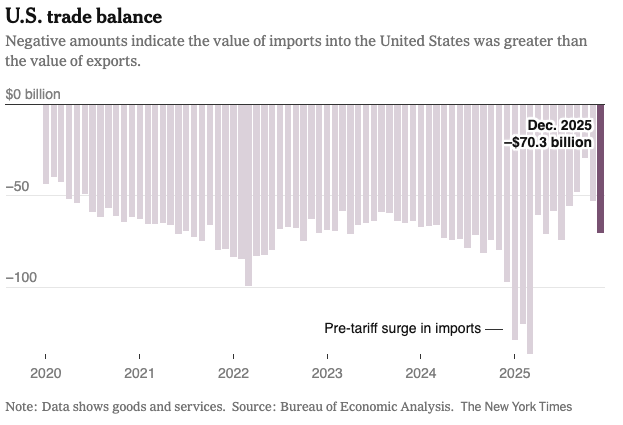
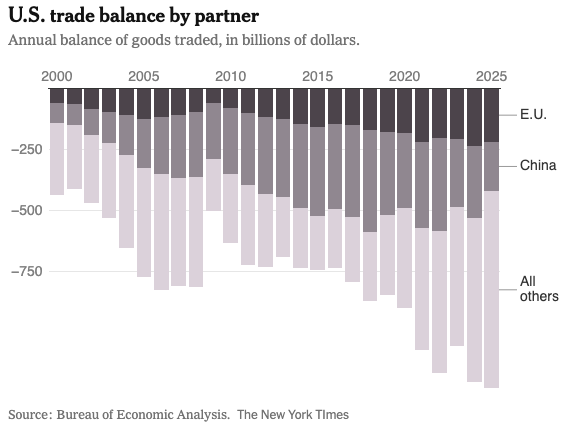
President Trump’s tariffs were intended to reduce imports, shrink the trade deficit, and revive U.S. manufacturing. Instead, imports rose 4.7% in 2025, the goods trade deficit reached a record high, and American manufacturers cut more than 80,000 jobs. While the overall trade deficit dipped slightly to $901 billion, that improvement was driven entirely by a growing services surplus; the deficit in physical goods—the administration’s main concern—actually widened.
Tariffs significantly reshuffled trade flows but did not substantially reduce reliance on foreign production. Imports from China fell nearly 30%, shrinking the bilateral deficit to its lowest level in decades, yet deficits with Vietnam, Mexico, India, and other countries hit record highs as companies rerouted supply chains. In many cases, Chinese firms shifted production to Southeast Asia to avoid tariffs. Retaliation also hurt U.S. exporters, particularly soybean farmers, whose exports to China dropped sharply before a late-year trade truce. Overall, economists say it remains unclear whether the long-term effect will be reduced dependence on imports or simply a reorganization of global trade patterns.
3. Supreme Court Strikes Down Trump’s Global Tariffs (WSJ)
The Supreme Court ruled 6–3 that President Trump’s sweeping global tariffs were illegal, rejecting his claim that a 1977 emergency law (the International Emergency Economic Powers Act) gave him authority to impose them without explicit congressional approval. Writing for the majority, Chief Justice John Roberts said the president’s assertion of power was “extravagant by any measure,” marking the first time the Court has definitively struck down a major second-term Trump policy.
The decision removes a central tool Trump used to reshape trade policy and collect tens of billions in tariff revenue, though the Court did not address whether previously collected funds must be refunded. In response, Trump signaled he would press ahead, signing a new order imposing a 10% global tariff under different legal authorities, with exemptions for qualifying goods from Canada and Mexico under the USMCA.
4. Tariff Ruling Sends CEOs Back to Company War Rooms (WSJ)
The Supreme Court’s decision striking down President Trump’s tariffs briefly reassured some business leaders, but uncertainty quickly returned. The ruling did not clarify whether companies will receive refunds for previously paid tariffs, and Trump has already announced a new 15% global tariff under different legal authority. Executives are now weighing whether refunds are realistic, whether new tariffs could offset any relief, and how to respond without disrupting pricing or supplier relationships.
Trade groups are calling for swift refunds, but legal experts warn companies may need to pursue litigation, with outcomes uncertain and potentially slow. Some firms have already sold claims to hedge funds or built financial models to simulate various tariff scenarios. Smaller businesses worry about customer refund demands and supplier noncompliance, while others say the ruling comes too late to reverse supply-chain shifts, production cuts, or even business closures. Overall, the decision has resolved one legal question but left companies navigating continued policy volatility and financial ambiguity.
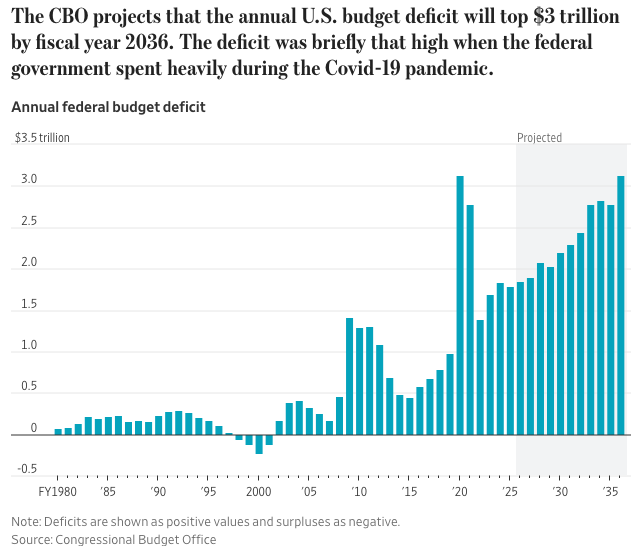
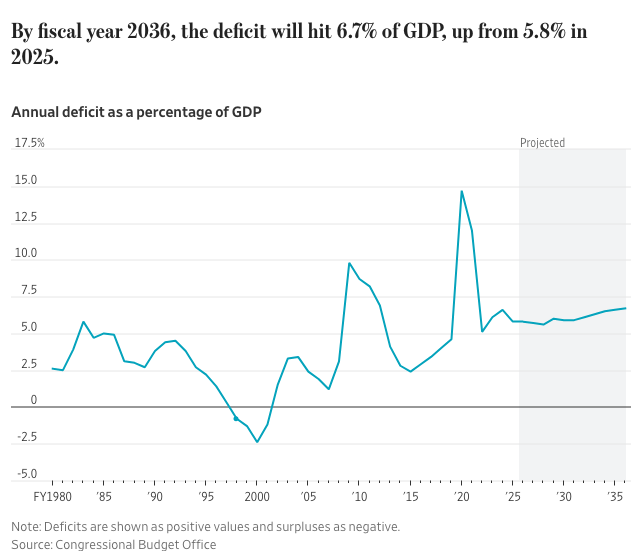
5. Why the Federal Deficit Is Projected to Surge, in Five Charts (WSJ)
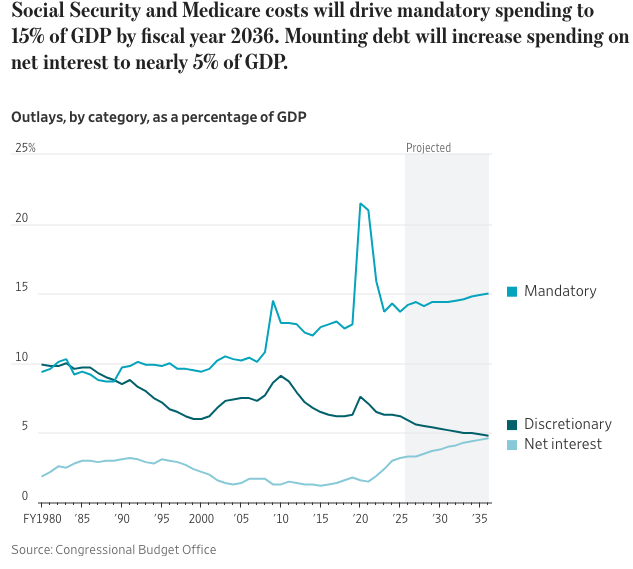
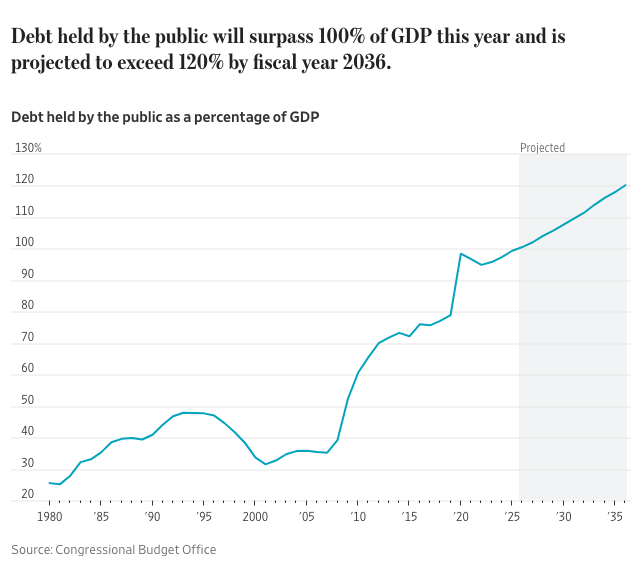
Debt held by the public will balloon to more than $56 trillion by 2036 as annual deficits continue to mount, according to the latest projections from the Congressional Budget Office. By later this year, the federal debt held by the public is expected to surpass the size of the entire U.S. economy.
The main drivers: increased spending on entitlement programs as the nation’s population ages as well as rising costs related to paying interest on the debt itself. Republicans have taken issue with the projections, saying the CBO’s assumptions on economic growth are too low.
6. Healthcare Jobs Have Become the Engine of America’s Labor Market (WSJ)
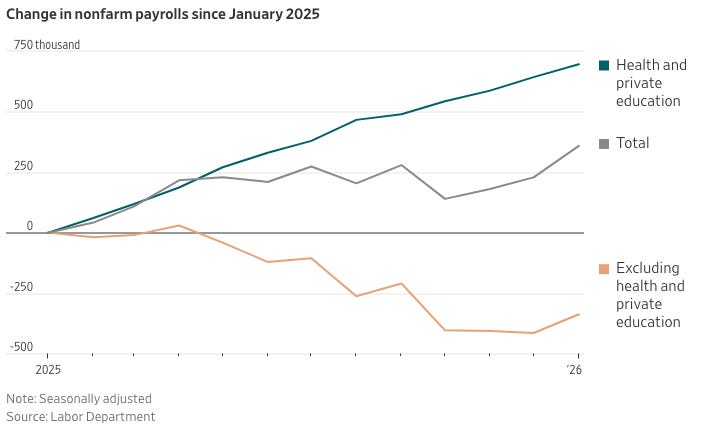
The U.S. added 130,000 jobs in January, with nearly all of the gains concentrated in healthcare and healthcare-related roles. As immigration restrictions tighten, questions are emerging about who will fill labor-intensive positions in sectors that rely heavily on foreign-born workers. Immigrants make up a disproportionate share of healthcare and construction workers—including large percentages of home health aides, physicians, drywall installers, roofers, and general laborers. Raids and deportations are already straining construction labor supply, raising costs and slowing projects, while healthcare employers are offering large signing bonuses to compete for scarce nurses.
Healthcare demand continues to rise as the population ages, driving sustained hiring even as other parts of the economy weaken. Job growth has slowed or declined in sectors such as finance, information, retail, and professional services, and federal employment has dropped sharply. The result is an economy increasingly dependent on healthcare for job creation, with labor shortages intensifying in key industries amid tighter immigration policy.
7. Wall Street’s Latest Bet Is on ‘HALO’ Companies With AI Immunity (WSJ)
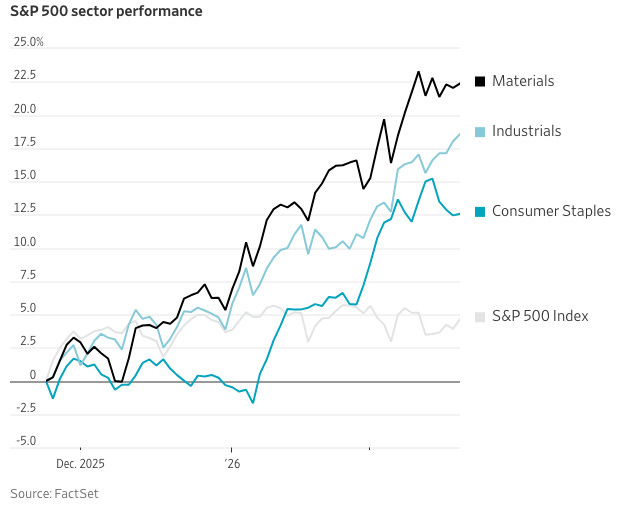
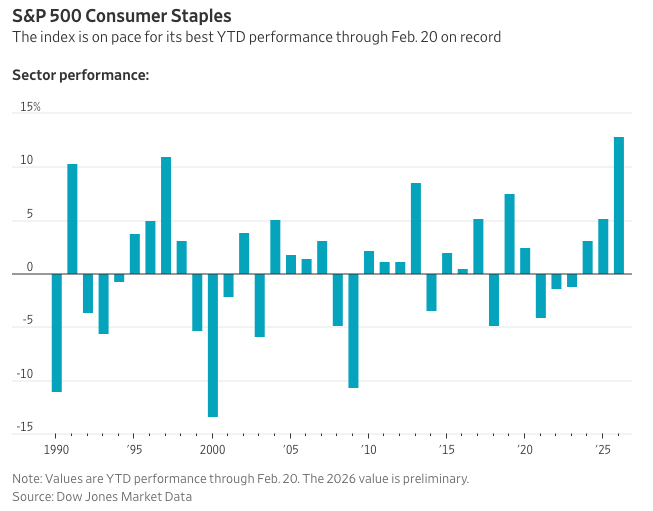
After years of piling into artificial-intelligence stocks, U.S. investors are rotating into what some call the “AI immunity” or “HALO” trade—companies with heavy physical assets and low risk of technological obsolescence, such as McDonald’s, Exxon Mobil, and Deere. In recent weeks, sectors like industrials, materials, utilities, and consumer staples have outperformed, while technology stocks and the “Magnificent Seven” have lagged. Investors appear to be favoring businesses that AI is unlikely to disrupt, amid growing uncertainty about who the long-term winners and losers of the AI boom will be.
The shift has triggered sharp market swings, with AI-related announcements wiping out billions in value from software, financial, and other sectors seen as vulnerable to automation. While some tech stocks have rebounded and individual investors continue buying major AI names, the broader mood has become more cautious. Market participants say the AI trade is entering a new phase in which companies must prove real earnings power, as hype alone is no longer enough to sustain valuations.
Technology
8. Arthur Brooks: Why Are Young People Choosing OnlyFans over Love? (FP)
Americans now spend more on OnlyFans than on subscriptions to The New York Times and ChatGPT combined, with the platform generating $7.2 billion in 2025 from 378 million users. Much of that revenue comes from paid private chats, suggesting that users are seeking not just explicit content but a sense of personal connection. At the same time, loneliness—especially among Gen Z—is rising sharply, alongside declining rates of dating, marriage, and sexual activity.
Fear of failure appears to be a central driver. Younger adults report higher levels of anxiety about rejection and risk, leading many to avoid real-world dating in favor of safer, more controllable online alternatives. A growing culture of expansive “red flags” further narrows romantic possibilities. A healthier approach to relationships mirrors entrepreneurship: manage risk rather than eliminate it, accept heartbreak as instructive, and pursue the potentially transformative rewards of lasting love instead of retreating into isolating digital substitutes.
9. From Paris to New Delhi, the Push to Ban Teens From Social Media Is Going Global (WSJ)
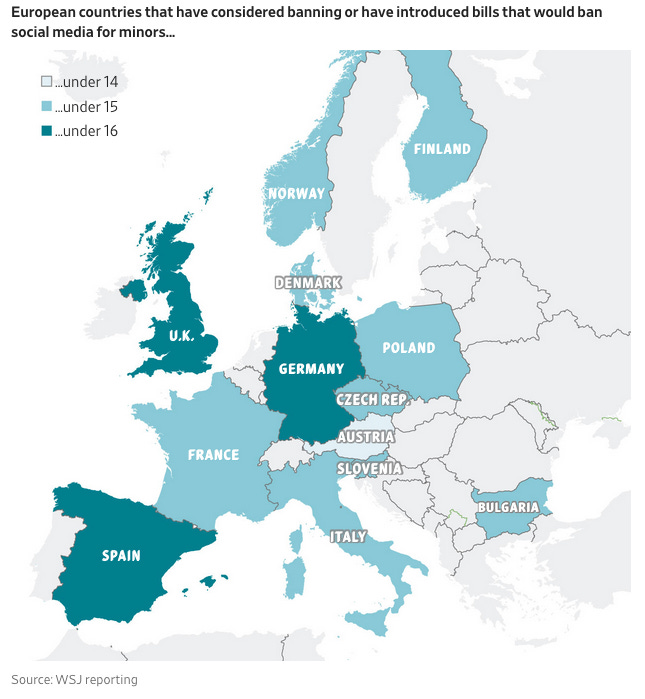
Governments across Europe, Asia, and parts of the U.S. are moving to restrict or ban social-media access for younger teens, following Australia’s decision to block platforms for users under 16. France has passed a ban for those under 15, Spain and Germany are advancing similar measures, the U.K. is launching consultations, and India is discussing age-based limits. Supporters argue that endless scrolling, algorithm-driven content, and smartphone overuse contribute to rising teen anxiety, depression, and screen addiction, and say stricter rules are needed to protect children.
Social-media companies and some digital-rights advocates argue that blanket bans are blunt tools that could backfire by pushing teens to less regulated platforms or cutting them off from connection and learning. They maintain that causal links between social media and mental-health problems remain debated and point to existing safety features and parental controls. While the immediate financial hit to companies may be limited, broader age bans could disrupt the pipeline of young users who often become long-term customers.
Business
10. Lenders to Commercial Real Estate Owners: Pay Up Now (WSJ)
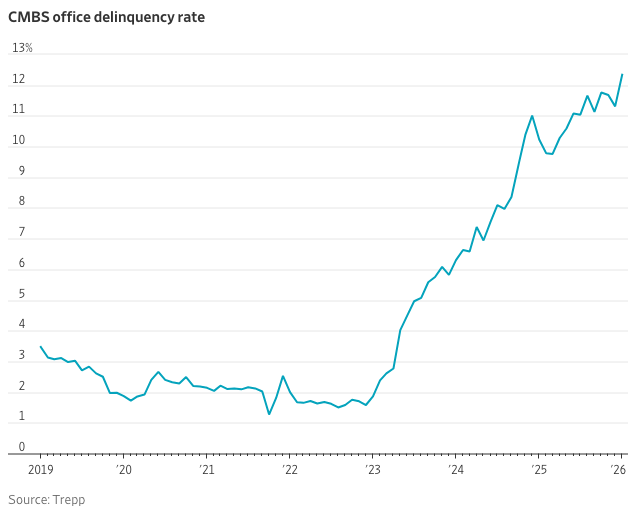
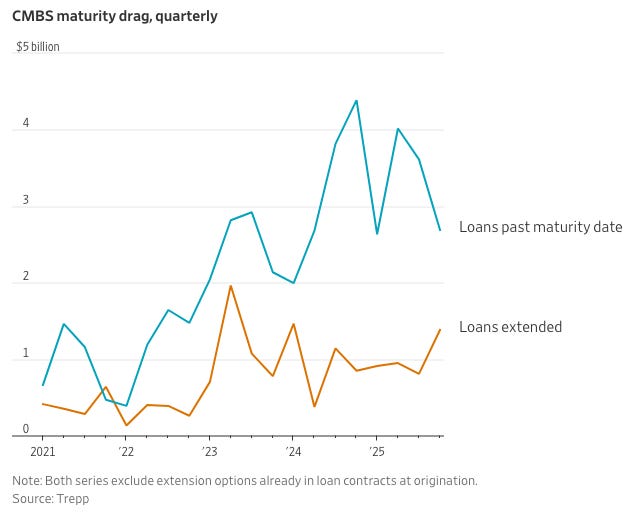
Commercial real-estate lenders are increasingly calling in troubled loans as refinancing becomes harder in a higher-rate environment. After years of “extend and pretend”—granting extensions in hopes that rates would fall or property income would recover—defaults are rising sharply. The delinquency rate on office loans packaged into commercial mortgage-backed securities (CMBS) hit a record 12.34% in January, and more than half of the roughly $100 billion in CMBS loans maturing this year are unlikely to be repaid on time.
Lenders now believe that both higher interest rates and structural shifts—especially reduced demand for office space due to hybrid work—are long-lasting rather than cyclical. Nearly $25 billion in CMBS loans are past maturity without resolution, and distressed debt levels are approaching post-2008 crisis highs. The strain is spreading to regional banks with heavy commercial real-estate exposure, though some property sectors such as industrial and grocery-anchored retail remain resilient, and new CMBS issuance has rebounded. Overall, the office sector remains the epicenter of mounting financial stress.
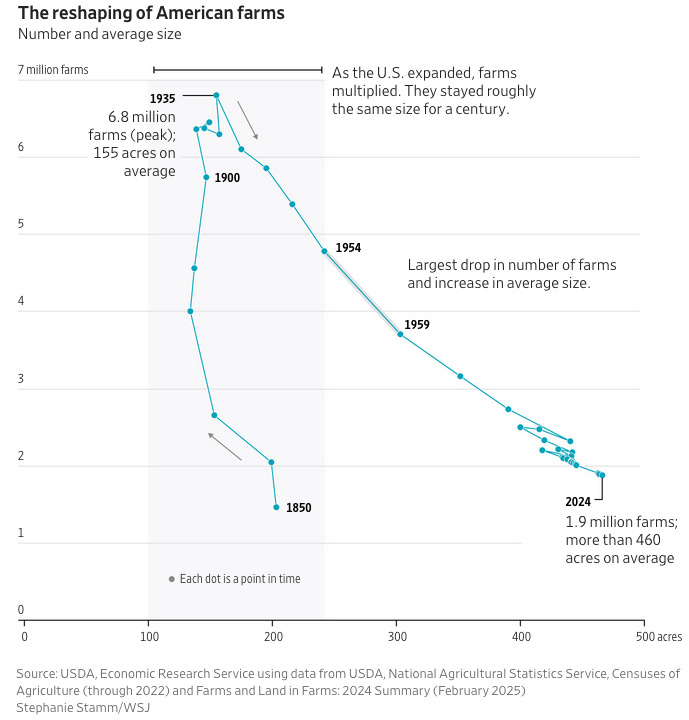
11. Farmers Are Aging. Their Kids Don’t Want to Be in the Family Business.(WSJ)
Rising costs, weak crop prices, mounting debt, and a surge in farm bankruptcies have intensified pressure on aging farmers nationwide, with more operators now over 75 than under 35. Despite government bailouts and disaster aid, many growers expect continued losses. Reliance on federal aid underscore the fragile economics facing multigenerational farms and the gradual erosion of family-based agriculture in rural America.
International
12. How China’s Xi Purged His ‘Big Brother’ to Achieve Absolute Power (WSJ)
China’s top general, Zhang Youxia—a longtime ally of Xi Jinping—was abruptly detained in January in what appears to be the most dramatic military purge of Xi’s tenure. Security forces intercepted Zhang en route to a high-level party meeting, detained him and his son, and later accused him of leaking nuclear secrets, forming political cliques, and corruption. While the allegations remain unverified, analysts say the move underscores Xi’s deepening consolidation of power and growing distrust within the military leadership.
Zhang’s ouster caps a sweeping purge that has removed most members of the Central Military Commission since 2023, effectively transforming it into a body dominated solely by Xi. Observers argue the crackdown reflects Xi’s determination to ensure absolute political loyalty—particularly after witnessing instability in Russia—and his fear of internal military networks that could challenge his authority. The episode signals a new phase of one-man rule, in which even close allies with revolutionary pedigrees are not immune from suspicion or removal.
13. Iranian Students Protest as Anger Grows (WSJ)
A renewed wave of unrest is spreading across Iran, with university students staging antigovernment rallies and families turning mourning ceremonies into acts of protest. The anger follows a bloody crackdown on demonstrations that began in late December, during which thousands were killed and tens of thousands arrested. Despite repression, students at major universities in Tehran have chanted against the Islamic Republic and Supreme Leader Ali Khamenei, with some protests leading to clashes with security forces.
Public dissent has also taken new forms. Nightly rooftop chants of “Death to Khamenei,” politically charged 40-day mourning ceremonies for slain protesters, and school strikes labeled “Empty Desks” have become symbols of resistance. The unrest is unfolding amid rising tensions with the United States over Iran’s nuclear program, adding further strain to an already volatile political environment.
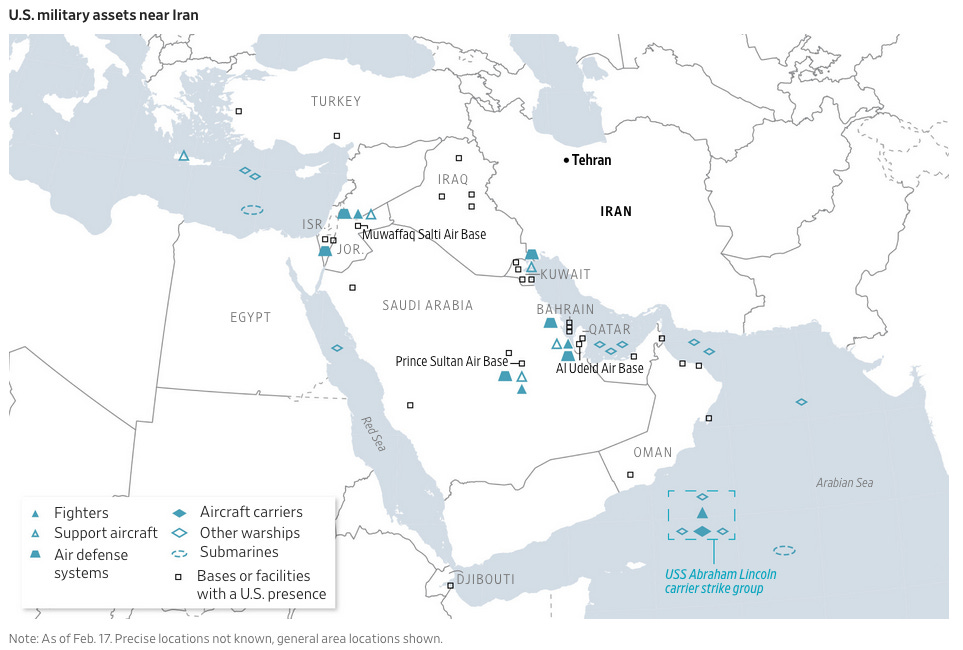
14. The U.S. Military Hardware Pouring Into the Middle East (WSJ)
The U.S. has deployed a major buildup of air and naval forces across the Middle East, positioning dozens of advanced fighters, support aircraft, and warships within range of Iran should President Trump order a strike. Stealth F-22s and F-35s, along with F-15s, F-16s, electronic-warfare planes, and long-range bombers, are staged at bases including Jordan and Saudi Arabia, though Gulf states have restricted use of their airspace for strikes on Iran. The USS Abraham Lincoln carrier strike group is already in the region, with a second carrier, the USS Gerald R. Ford, en route, alongside destroyers capable of launching missile defenses and Tomahawk strikes.
The buildup also includes submarines, aerial refueling tankers, early-warning aircraft, heavy cargo planes, and missile-defense systems such as THAAD and Patriot batteries to protect U.S. assets and allies. While smaller than the 1991 Gulf War deployment, it represents the largest concentration of U.S. airpower in the region since the 2003 Iraq invasion, signaling significant readiness amid heightened tensions with Iran.
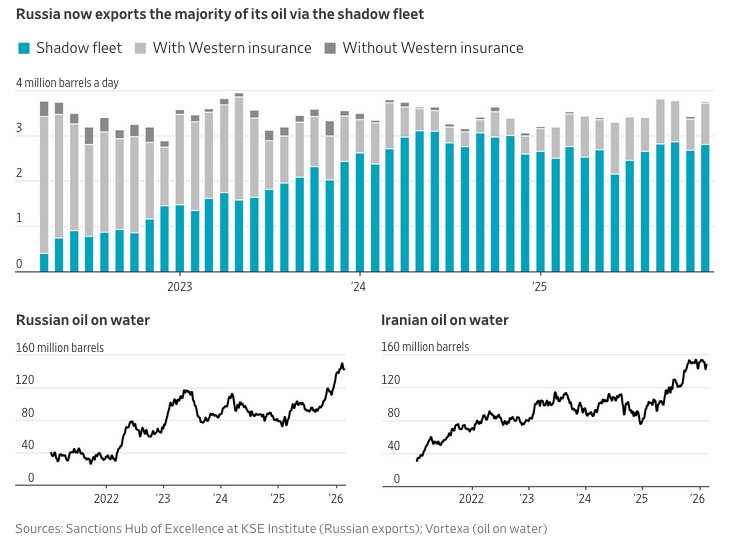
15. The U.S. Is Hunting the Shadow Fleet. This Is What It’s Up Against. (WSJ)
A vast “shadow fleet” of roughly 1,300 sanctioned tankers is transporting Russian, Iranian, and Venezuelan oil across global markets, often to buyers in Asia. These aging vessels, frequently sailing without Western insurance and under false flags, now account for an estimated 6–7% of global crude flows. Russia relies on them for about 80% of its seaborne oil exports. Western sanctions and recent seizures—stretching from the Atlantic to the Indian Ocean—have increased costs and risks for operators, leaving an estimated 300 million barrels of Russian and Iranian oil at sea as traders struggle to find buyers amid mounting restrictions.
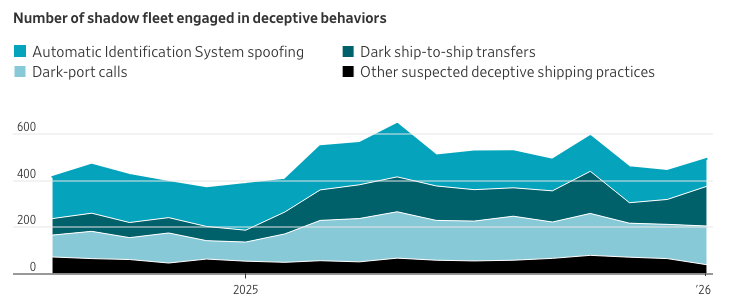
Operators use increasingly elaborate deception tactics to evade enforcement. Ships disable or spoof their Automatic Identification System (AIS) signals, conduct mid-ocean ship-to-ship transfers to obscure cargo origins, make “dark-port” calls without transmitting locations, repaint names and flags mid-voyage, and operate through shell companies that mask true ownership. Despite tougher enforcement, fully dismantling the network would be difficult: Russia and Iran together produce more than 11% of global oil, and removing their supply from markets could drive up crude prices and inflation.
NOTE: Article has many other great infographics.