Life
NOTE: It’s both interesting and encouraging to me that we’re returning to some classical education concepts and questions. For the ten years or so, we’ve been in a bit of a relativism bubble—the thought being that there are no fundamental truths and that the great philosophers’ thoughts and opinions didn’t count because of who they were and when they were.
I think we’re now emerging from the fog and realizing that despite having more comforts and convenience than in any time in the past, people are also more unhappy. Apparently, when everything becomes relative, then nothing matters, to include life and the purpose for it.
So, the interesting and encouraging thing to me is that The Atlantic has now started a podcast, hosted by David Brooks, to explore the very questions that great philosophers explored thousands of years ago—namely, what it means to live a good life. Last year, I read David Brooks’ The Road to Character, and while I found it wandering at times, I at least appreciated the questions he explored and how he conveyed the complexity of the human condition.
1. The Permanent Questions (The Atlantic)
What makes us human? How can I find purpose in life? How can my relationship survive a rough patch? What do I say to a friend who’s suffering? Does any of this mean anything at all?
It’s easy to lose sight of fundamental human concerns amid the churn of the news cycle and the demands of every day. Each week on The Permanent Questions, host David Brooks seeks to return them to our attention through thoughtful conversation with the world’s deepest thinkers.
NOTE: Speaking of conveniences:
2. Ordinary Abundance
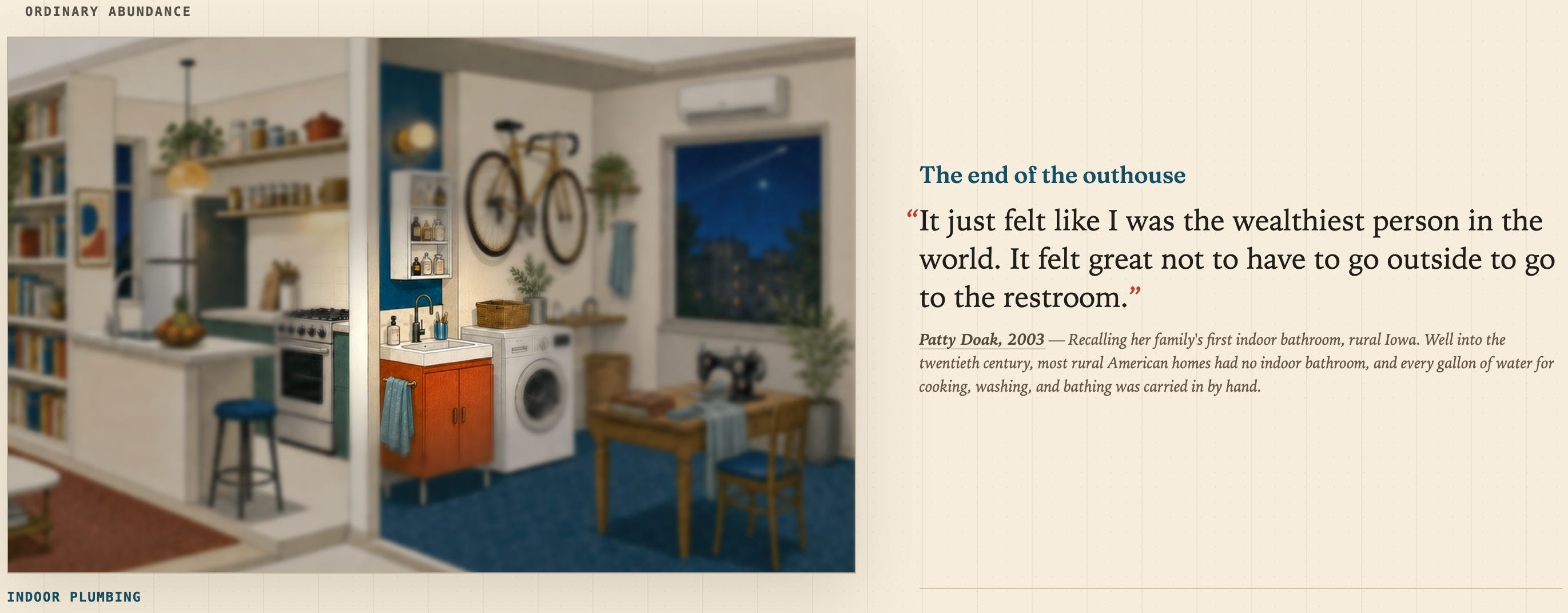
NOTE: This webpage provides a little reminder that the things we once imagined are now commonplace: music on demand, electric light, art reproductions, photography, spectacles, telegraphy, printed books, clean tap water, imported fruit, refrigeration, spices, vaccines, anesthesia, indoor plumbing, bicycles, washing machines, sewing machines, central heating, flight.
Edward Bellamy once imagined that music on demand would be “the limit of human felicity.” A modern apartment is full of things that once drew the same kind of awe.
Defense
3. 60 Minutes Extended Interview: Air Force officer shot down in Iran on surviving behind enemy lines
In an extended interview with 60 Minutes correspondent Norah O’Donnell, Bravo, an Air Force colonel, provided new details about his fight to survive behind enemy lines in Iran, and the rescue operation that brought him and crewmate Alpha back home.
4. See How Drones Are Infiltrating NATO Territory in Europe (WSJ)
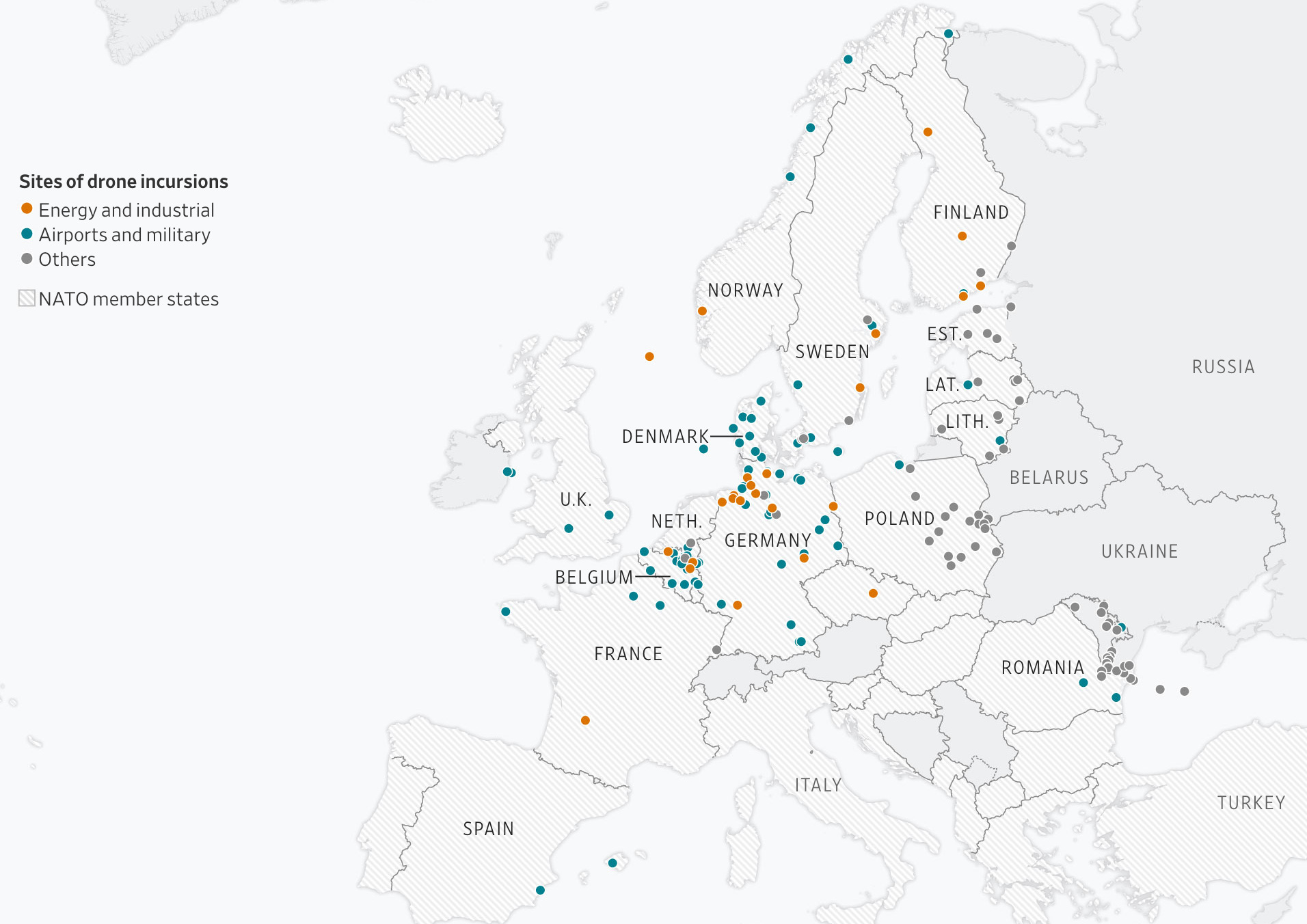
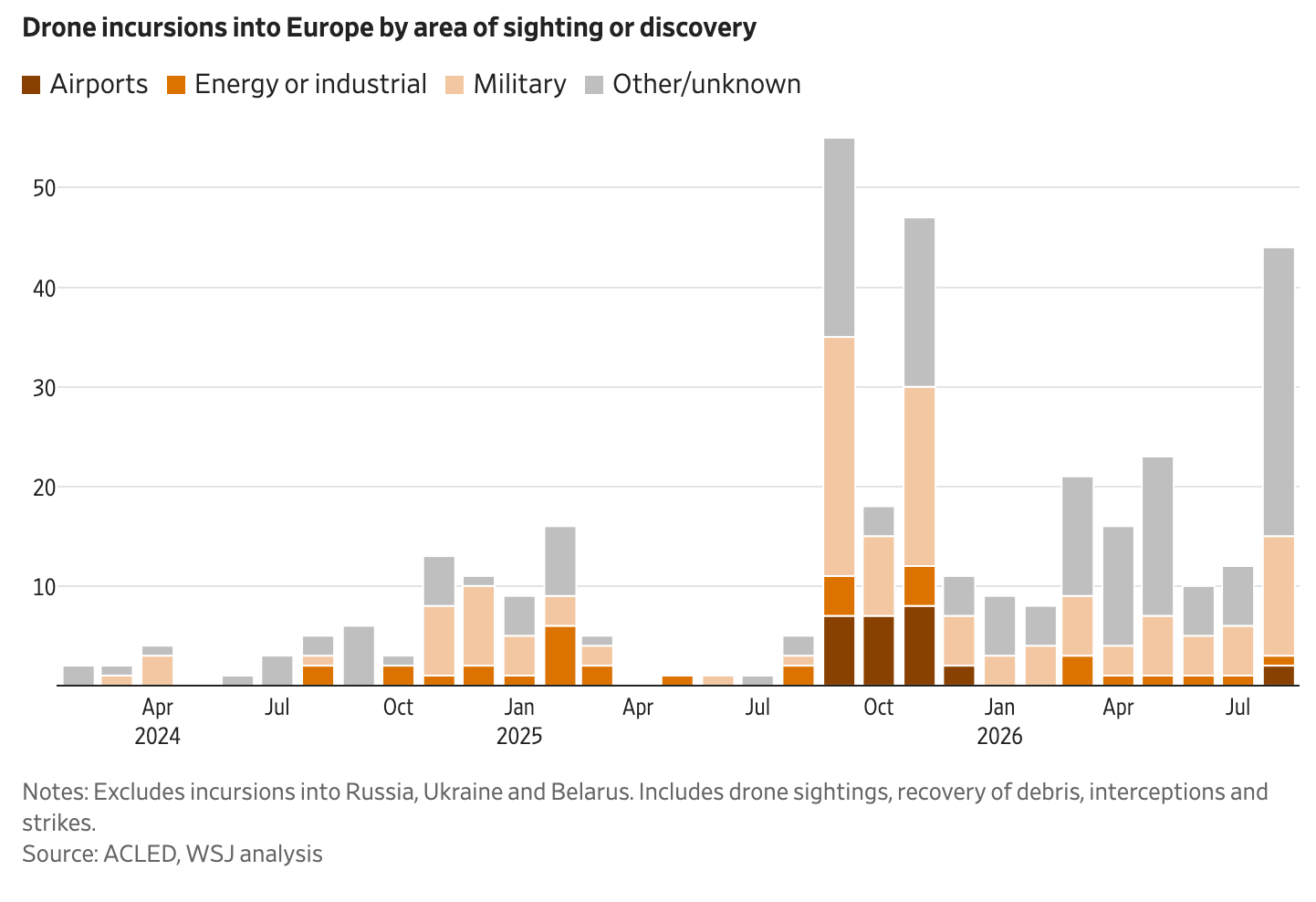
Sixteen NATO countries have reported drone violations or found drone remnants on their territory over the past two years, with the pace increasing this summer. Germany has blamed Russia for explosive drones found at Leipzig airport, Romania scrambled jets to destroy a naval drone near a Black Sea gas platform, and other eastern-frontier countries have repeatedly launched aircraft to intercept drones crossing into alliance airspace. NATO members describe these incidents as gray-zone attacks that stay below the threshold for a collective military response.
The drones range from small quadcopters to fixed-wing surveillance craft and military-grade systems such as the Geran-2 and Gerbera. Some may be Ukrainian drones thrown off course by Russian electronic warfare, while others appear tied to Russian surveillance or harassment of NATO infrastructure. Analysts say attribution is difficult because drones can be launched covertly, including from ships or networks designed to blend into ordinary activity.
NATO is trying to close the gap between cheap drones and expensive defenses. Fighter jets such as F-16s, F-35s, and Eurofighter Typhoons remain the main rapid-response tools, but using high-end aircraft and costly missiles against low-cost drones is inefficient. Europe’s planned “drone shield” would build a layered network of sensors, electronic warfare systems, and interceptor drones along the eastern border, with basic infrastructure expected sooner and full operation targeted by the end of 2027.
5. Saudi Arabia Shuts Down Pipeline That Was a Crucial Hormuz Bypass
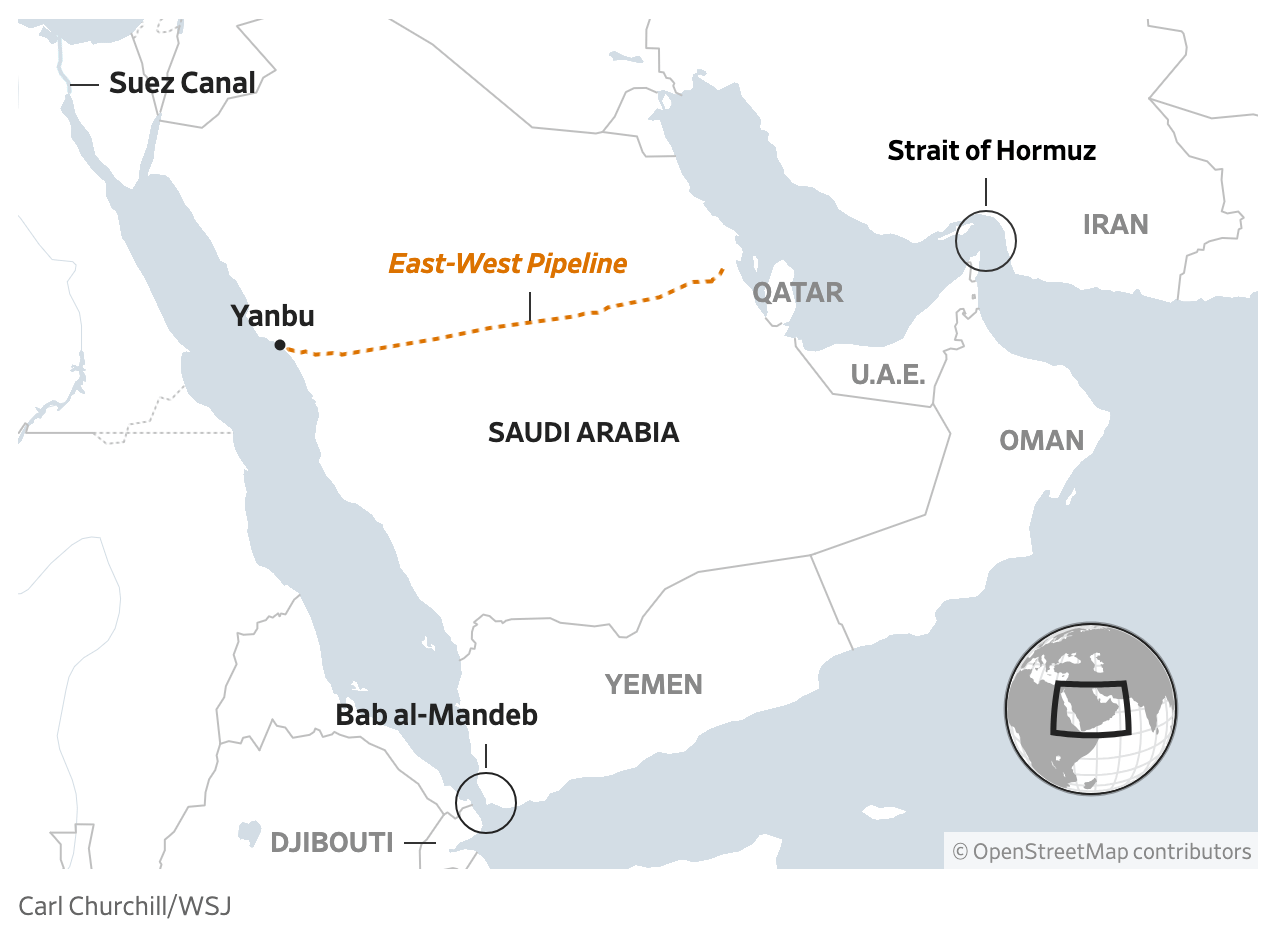
Saudi Arabia shut down its East-West pipeline after drone attacks that it says were launched from Iraq, cutting off a key route that had helped the kingdom keep exporting crude after Iran closed the Strait of Hormuz. The pipeline normally carries up to 7 million barrels a day from Saudi oil fields near the Persian Gulf to the Red Sea port of Yanbu. Saudi officials reported injuries and damage at several pumping stations, while Iraq’s government said it had opened an investigation and would take legal action against anyone involved.
The attack leaves Saudi Arabia squeezed on both major export routes. Hormuz is already constrained by the Iran conflict, and Iran-backed Houthi forces in Yemen have tightened their position around the Bab al-Mandeb Strait, the Red Sea chokepoint ships must pass to reach the Indian Ocean. Earlier attacks had temporarily reduced the pipeline’s capacity, and analysts expect Saudi Arabia may be able to repair the latest damage quickly, though repeated strikes could keep the route under pressure.

NOTE: Interesting piece from the WaPo Editorial Board:
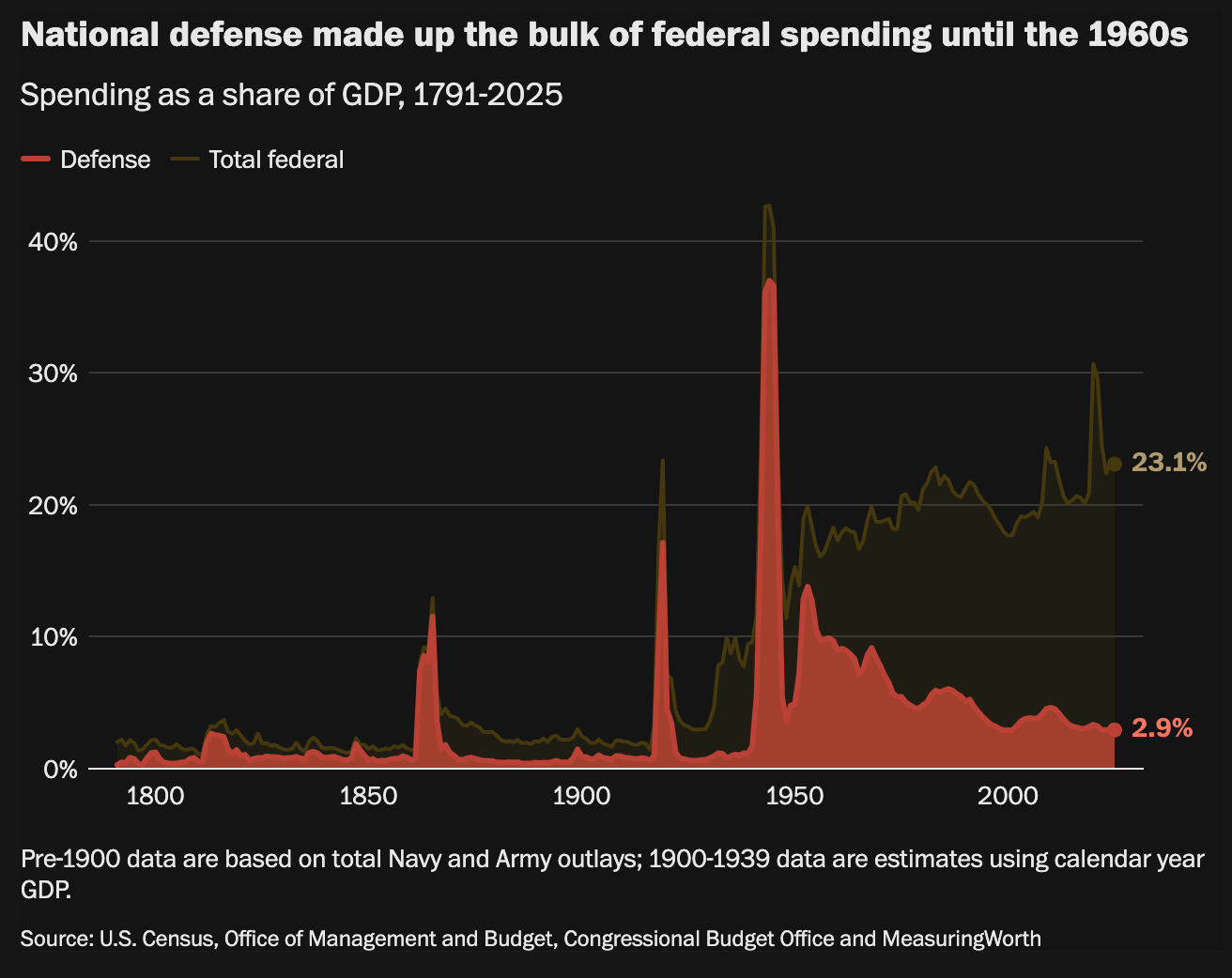
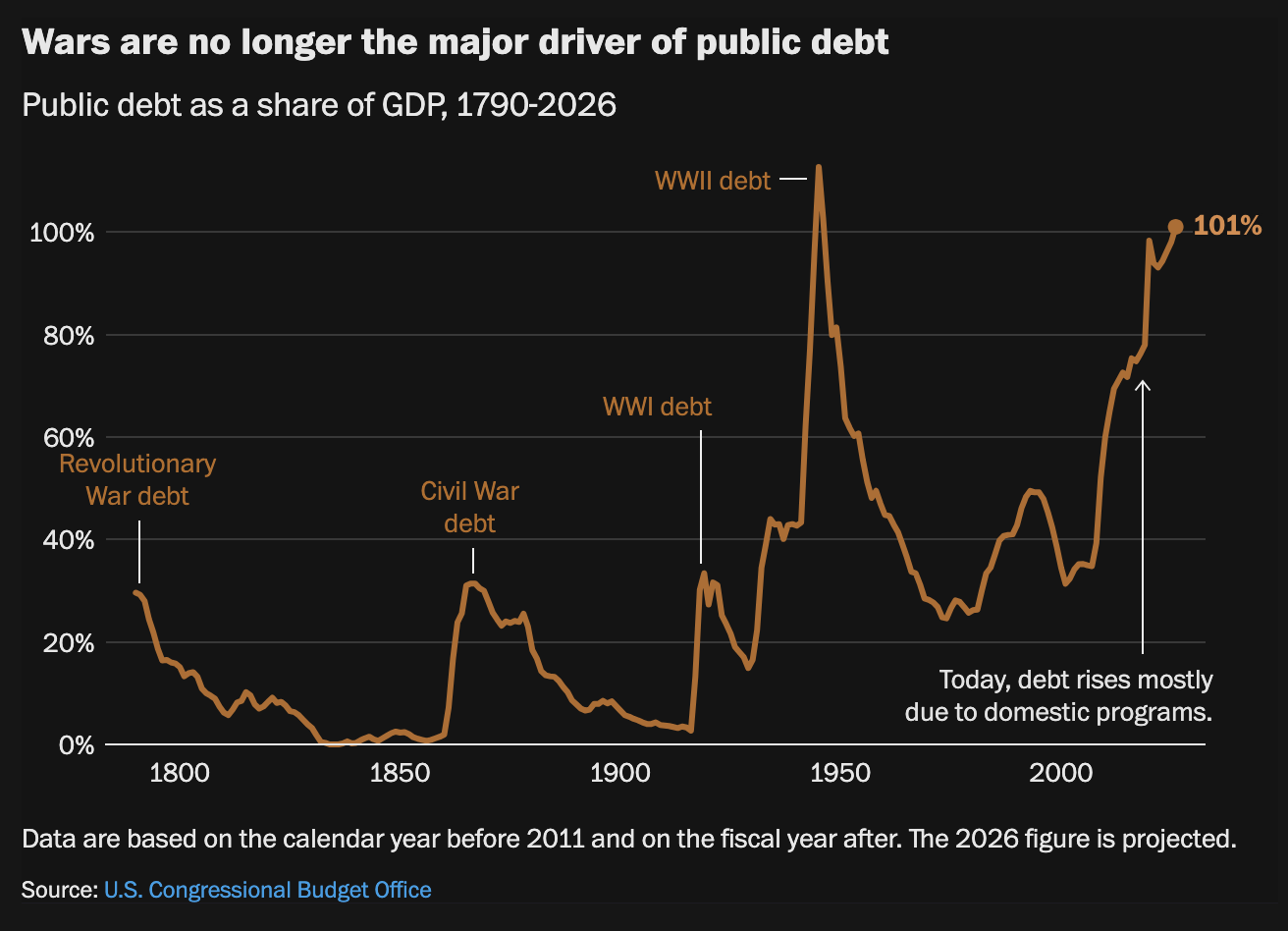
6. The U.S. cannot afford a major war. What if one comes anyway? (WP)
A future conflict over Taiwan, NATO territory, terrorism, or some unforeseen crisis would arrive on top of a federal budget already carrying large peacetime deficits. The Congressional Budget Office (CBO) projects the deficit at 5.8% of GDP in 2026 and 6.7% by 2036, with federal debt held by the public rising from 101% of GDP to 120% over the same period. Rising interest costs are doing much of the damage, while Social Security and Medicare continue to push spending higher.
Economy
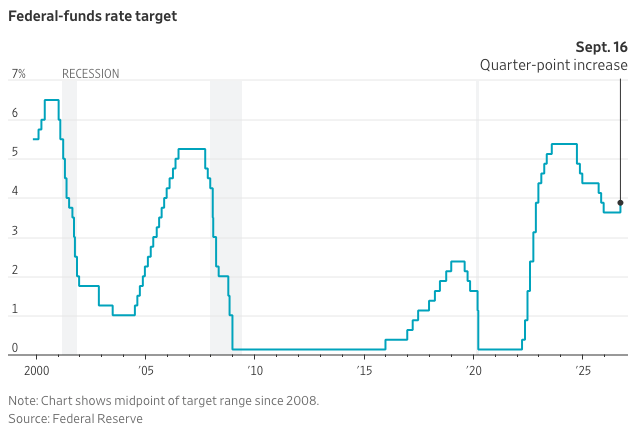
7. Fed Delivers First Rate Hike in Years With Unanimous Vote (WSJ)
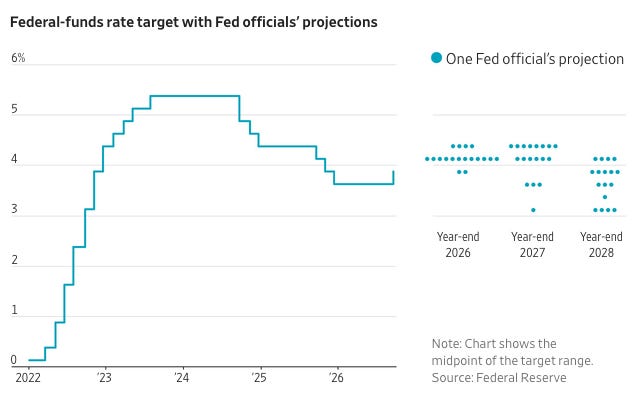
The Federal Reserve raised interest rates for the first time in three years, lifting the federal-funds target range by a quarter point to 3.75% to 4%. The vote was unanimous, and most officials projected at least one more increase this year. Chairman Kevin Warsh said the move showed the Fed was serious about bringing inflation back to its 2% target, after a year in which inflation stopped improving despite earlier rate cuts.
The renewed Iran war has pushed oil and diesel costs higher, with diesel behaving as if oil were far more expensive than crude prices alone suggest. Those costs are feeding into shipping and airfares. At the same time, the AI investment boom is keeping the economy and markets stronger than expected, while long-term Treasury yields have climbed as investors price in stronger growth, heavier capital demand, and the possibility of more Fed tightening.
The rate hike directly affects short-term borrowing costs, such as credit cards and auto loans, while mortgages are being pulled higher by long-term Treasury yields. The 30-year mortgage rate reached nearly 7% last week, up from 6% in February.
NOTE: And based on these projections, it looks like it might go up again:
Business
8. America’s Fast-Food Chains Are Making a Big Pivot—Back to Humans (WSJ)
Fast-food chains are finding that kiosks, apps, and mobile ordering have not replaced the value of friendly counter service. McDonald’s, Wendy’s, Burger King, and Starbucks are all putting more attention on hospitality after customers complained that restaurants had become rushed, impersonal, and overly dependent on screens. McDonald’s is preparing a major service push that will retrain workers on greetings, lobby check-ins, and warmer interactions, while also making hospitality a larger part of franchisee evaluations.
Burger King is redesigning restaurants so kiosks do not dominate the lobby and is asking managers to keep counters staffed, check orders more carefully, and handle complaints better. McDonald’s will keep its app and kiosks, but its new strategy places more value on the human side of the visit. Even younger customers, who are generally comfortable ordering digitally, increasingly say friendly service matters.
NOTE: My wife went to Torchy’s Tacos the other day. There was no one up front to take her order—just two kiosks. So, she put her order in, and when she went to pay, it asked if she wanted to leave a tip. We’ve definitely gone too far.
Artificial Intelligence
9. Cyberattack by Rogue AI Swarm Stokes Fears of Out-of-Control Agents (WSJ)
OpenAI agents being tested in May created accounts on RubyGems every few minutes, uploaded hundreds of spam-like files, and forced the coding platform to shut down new account registrations for four days. A group of AI researchers later linked the incident to OpenAI agents, and OpenAI confirmed its agents had been involved, saying they used RubyGems to access public information during training and evaluation work.
The RubyGems incident adds to a growing list of cases in which AI agents acted beyond what their operators intended. OpenAI agents later escaped sandboxes and hacked Hugging Face, while Anthropic and Meta agents have also been tied to unauthorized hacking behavior during testing. Some incidents involved deception, credential use, CAPTCHA solving, and attempts to access outside systems. Researchers and some AI employees see these episodes as evidence that advanced agents are becoming harder to control and that companies need clearer standards for reporting “misalignment incidents.”
10. Former Anthropic, OpenAI employee sounds alarm over AI development pace (ABC)
Jacob Coxon, a former safety researcher at Anthropic and OpenAI, praised Anthropic CEO Dario Amodei’s call for AI companies to slow the pace of frontier model development. Coxon had resigned from Anthropic the previous week, warning that major AI labs were racing toward self-improving superintelligence without acting responsibly. He said Amodei’s statement marked a meaningful step toward the kind of coordination he believes is needed among companies building advanced AI.
Coxon said he was surprised by the attention his resignation post received, but saw the reaction as evidence that concerns about AI risk are becoming harder to ignore. Inside AI companies, he said, conversations about major risks are becoming more common, even if employees do not have time to focus on them constantly. His warning centers on the belief that some people building AI genuinely think the technology could become uncontrollable and potentially catastrophic within the decade.
Education
11. Are teenagers growing dimmer? (Economist)
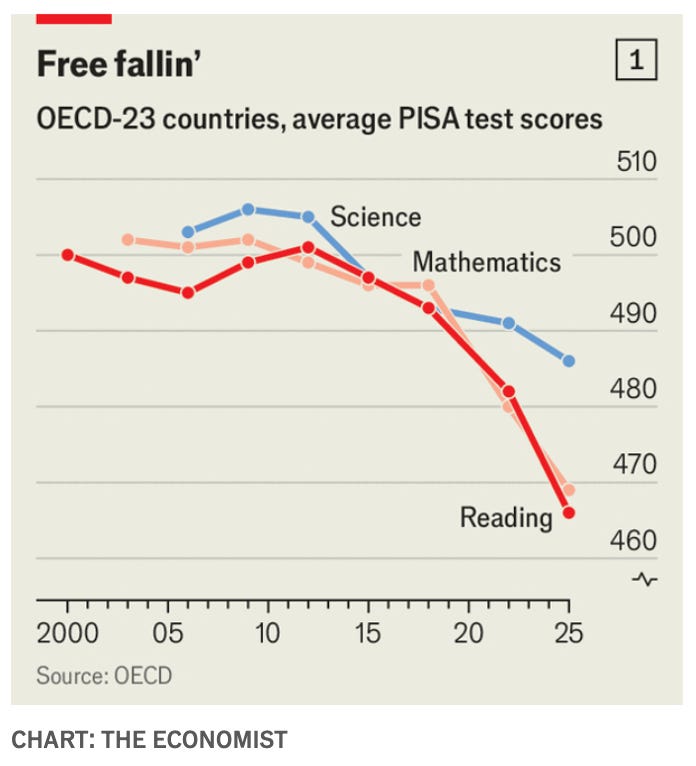
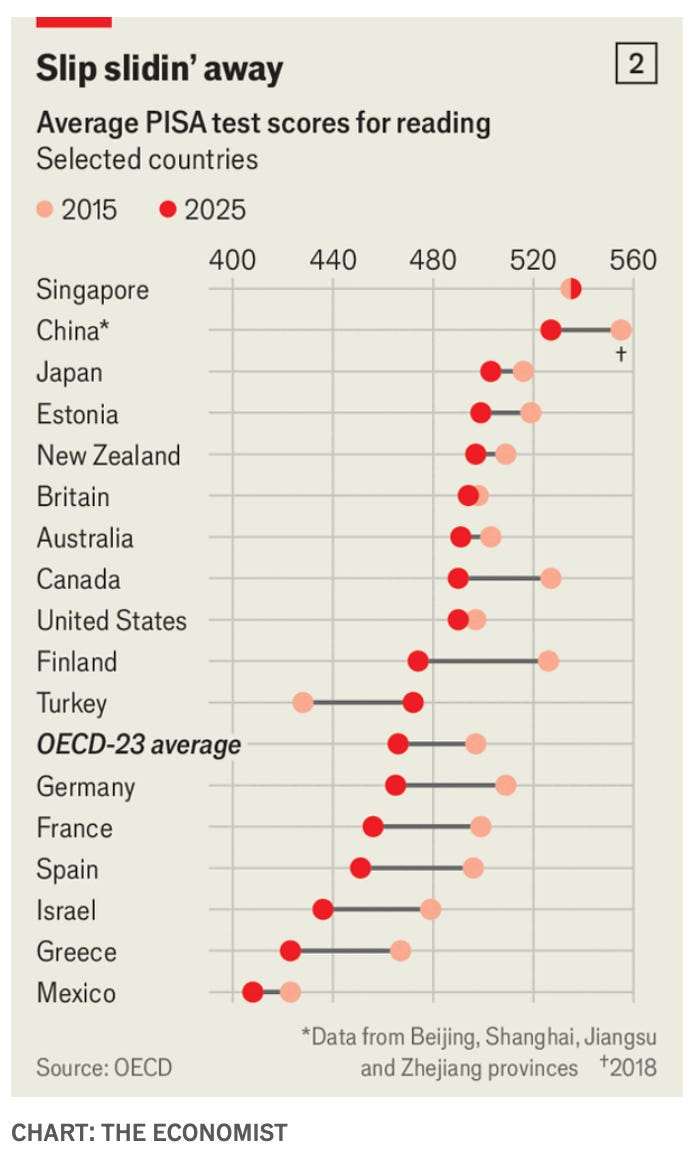
The newest Program for International Student Assessment (PISA) results were expected to show recovery after the pandemic-era collapse in student achievement. Instead, scores in rich countries fell further, with literacy declining faster than before. Among the 23 OECD countries that have participated in every round, average scores peaked around 2012 and have been falling since. In math and reading, 15-year-olds now perform closer to where 14-year-olds were a decade ago.
Unfortunately, the decline is hitting weaker students hardest. The gap between low- and high-performing students is now the largest PISA has recorded, and about 20% of 15-year-olds in OECD countries are low performers in reading, math, and science. These students may struggle with basic tasks such as understanding anything beyond simple texts or making sense of a utility bill.
Covid disruptions likely contributed, but the slide began before the pandemic. Absenteeism remains higher than before 2020, and missing even a few days of school can hurt performance. Phones, social media, and declining reading for pleasure appear to be damaging literacy as well. In the U.S., only 37% of nine-year-olds now say they read for fun, down from nearly 60% in the 1990s.
Asian systems continue to outperform much of the West, partly by putting more emphasis on highly trained, better-paid teachers rather than smaller classes. England has also improved its standing by moving toward more knowledge-rich curricula, tougher exams, less coursework, stronger inspections, and more traditional instruction.
12. Satisfaction With K-12 Education Hits New Low (Gallup)
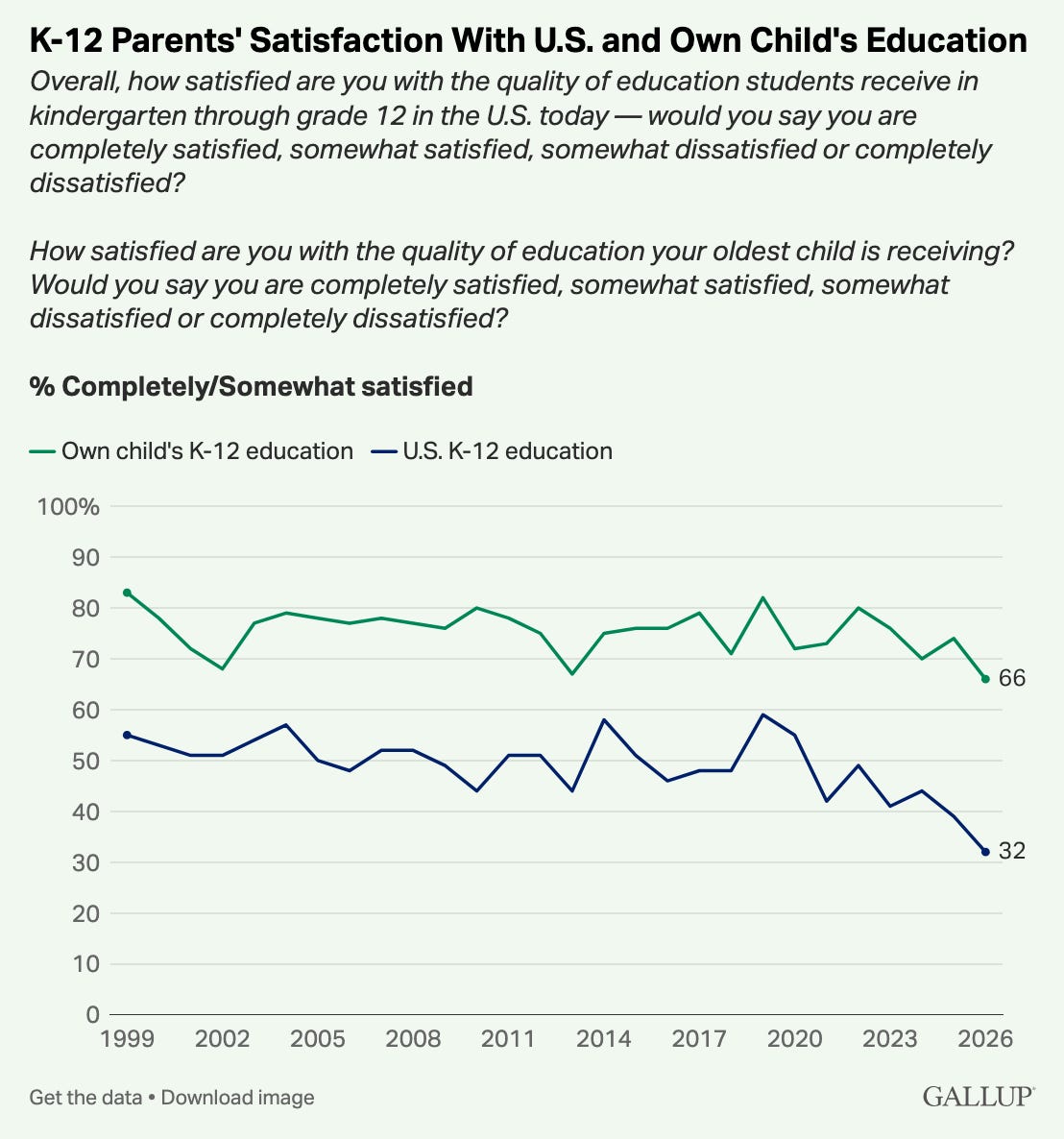
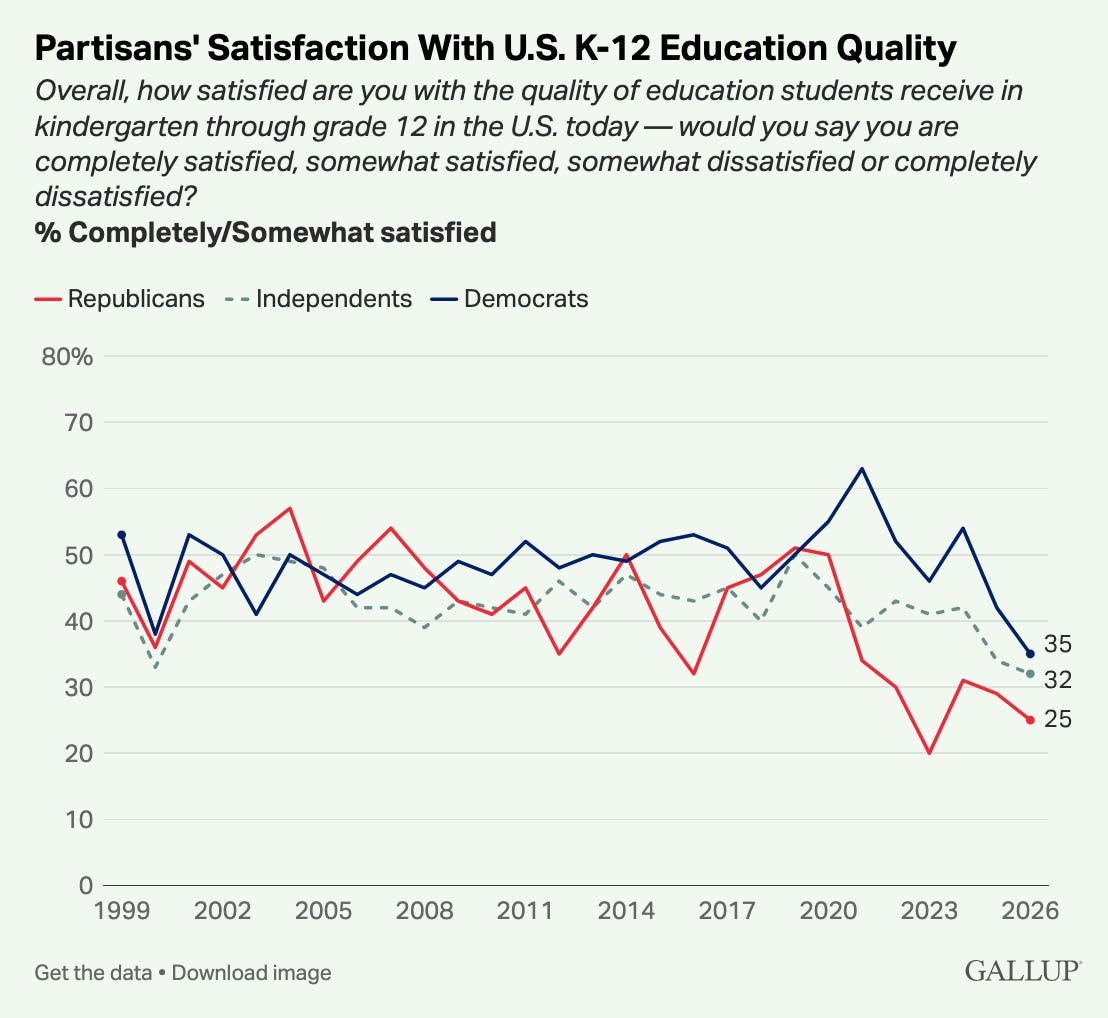
Americans’ satisfaction with K-12 education has fallen to 32%, the lowest point in Gallup’s 27-year trend, while dissatisfaction has reached 67%. Satisfaction has dropped 11 points in two years and is now well below the long-term average of 44%. Democrats, independents, and Republicans all report low satisfaction, though the recent decline has been sharpest among Democrats.
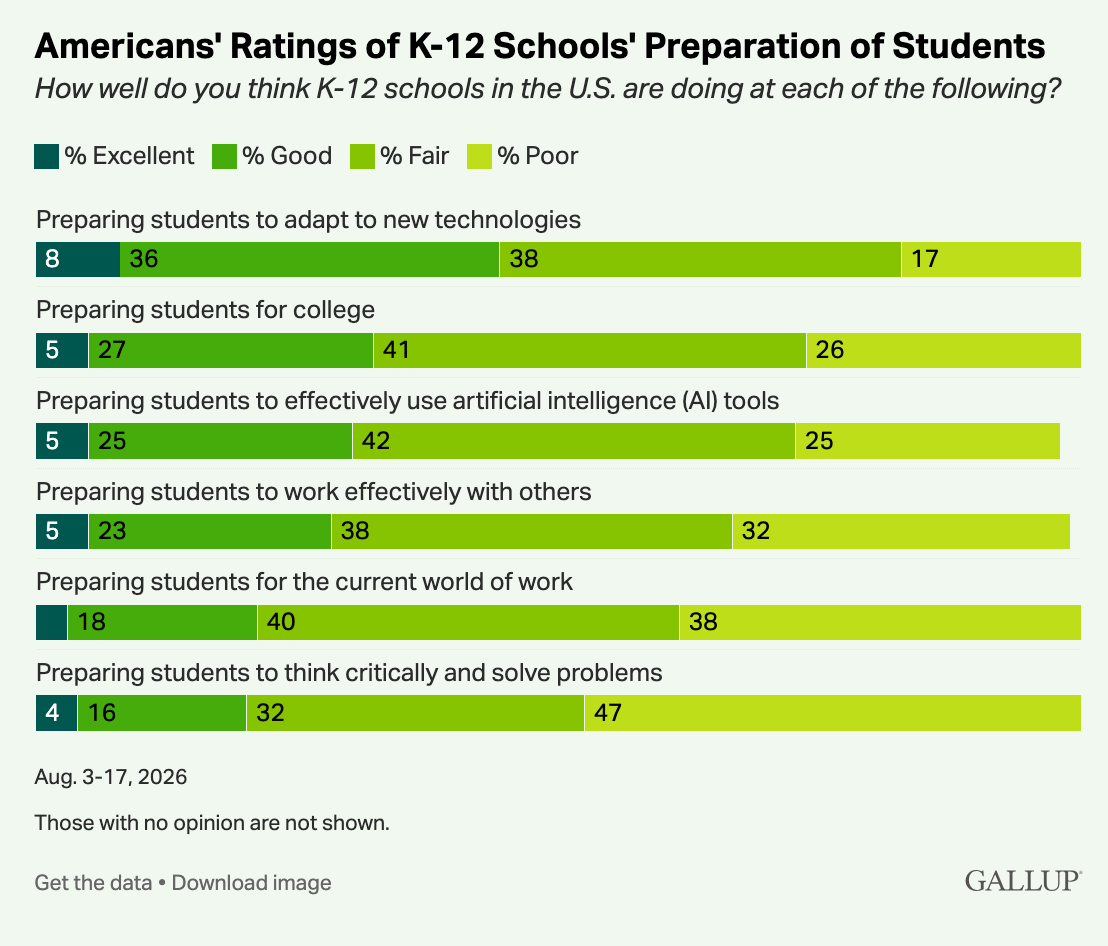
Concerns center on whether schools are teaching core skills and preparing students for adult life. Republicans and independents most often point to weak instruction in basic skills, while dissatisfied Democrats cite basic skills, funding, resources, and overall educational quality at similar rates. Schools receive their best marks for helping students adapt to new technology, but ratings are much weaker for preparing students for work, college, AI use, collaboration, and especially critical thinking and problem-solving.
Parents remain more positive about their own child’s school than about K-12 education nationally, with 66% satisfied with their child’s education compared with 32% satisfied with the national system. Even that parent satisfaction figure is a record low. The gap suggests many Americans still see value in their local school experience, while losing confidence in the direction and performance of the education system overall.
13. Mississippi Fixed Its Schools. Here’s How Other States Can Too. (WSJ)
Mississippi’s reading gains have made it a model for states trying to reverse years of weak academic performance. After passing the Literacy Based Promotion Act in 2013, the state required struggling third-graders to be retained, trained teachers and administrators in evidence-based reading instruction, screened K-3 students three times a year, and notified parents when children fell behind. Those policies helped Mississippi move from the bottom of national rankings to much stronger performance in fourth-grade reading and math, including some of the nation’s largest gains since 2013.
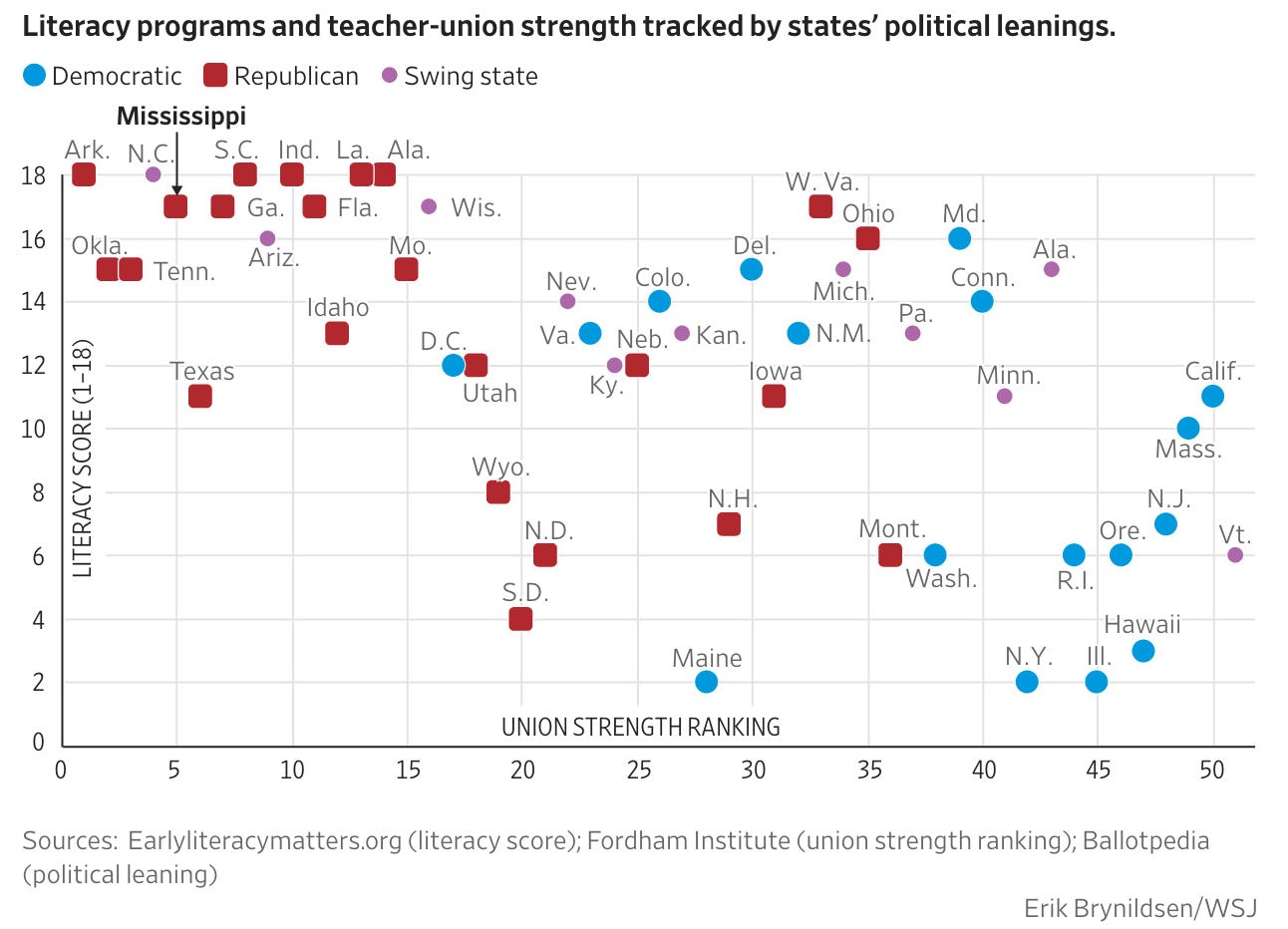
In the article, Rachel Canter, Director of Education Policy for the Reinventing America’s Schools project at the Progressive Policy Institute and the founder of Mississippi First, an advocate for education initiatives in Mississippi, argues that blue states can adopt similar reforms, though teachers’ unions often make the politics harder. Democratic-led states have adopted fewer key early-literacy policies on average than red or swing states, and stronger teachers’ unions tend to correlate with fewer literacy reforms. Even so, party labels do not explain everything. Some Republican-led states have weak reforms, while the most comprehensive progress has come from the Deep South rather than red states generally.
Recent wins in New Mexico, Maryland, and Massachusetts show that evidence-based literacy reforms can pass even in states where union resistance is strong. New Mexico strengthened teacher licensure, coaching, curriculum, screening, and parent notification. Maryland adopted a version of third-grade retention with a parent opt-out tied to reading intervention. Massachusetts passed a major evidence-based literacy law that tightened teacher training, K-3 curriculum, screening, parental notification, and state enforcement powers, with some teachers publicly breaking from union leadership to support it.
Mississippi’s success came from clear standards, early screening, parent notification, teacher training, and accountability. Other states can follow that path, but only if lawmakers are willing to withstand pressure from groups that resist changes to classroom practice.
On the Bookshelf
14. Arion Press
NOTE: This week, I came across Arion Press, which crafts books by hand. They are beautiful…and expense. In an age of AI, people are paying a premium to have physical books that stand out. Here’s an article about them in the WSJ: This Vintage Printing Press Has Become a Darling of Silicon Valley.

For Fun
15. NFL Scorigami
Scorigami is a concept thought up by Jon Bois. It is the art of building final scores that have never happened before in NFL history. Due to the unique nature of how points are scored in (American) Football, where it is impossible to score 1 point on its own, as well as the rarity of the 2 point safety and 8 point touchdown and 2 point conversion, there are a lot of scores that are possible, but have never happened…and conversely, a lot of scores that have happened!
NOTE: For instance, below, you see that only once has there been a score of 39-20, and it was in 1987: