

DEFENSE
1. The Space Force Showed Us Its Weapons Used in Iran and Venezuela (WSJ)
An array of U.S. Space Force electromagnetic warfare systems are playing a key role in protecting American troops and degrading enemy satellites around the world. The WSJ was granted rare access to a Space Force base in Colorado to learn how those systems work, and to speak exclusively with Guardians who flew them overseas to support operations in both Venezuela and Iran.
2. Video Cameras Are Everywhere—and Now They Are Being Hacked for War (WSJ)
Internet-connected security cameras, doorbells, traffic cameras, and baby monitors are increasingly being hacked and turned into intelligence-gathering tools. With an estimated 1.2 billion connected cameras worldwide, intelligence agencies and hacking groups can exploit weak passwords and outdated security to monitor military movements, identify targets, and assess damage from attacks. Artificial intelligence has made these operations considerably more powerful by allowing hackers to find vulnerable cameras and analyze enormous amounts of footage automatically.
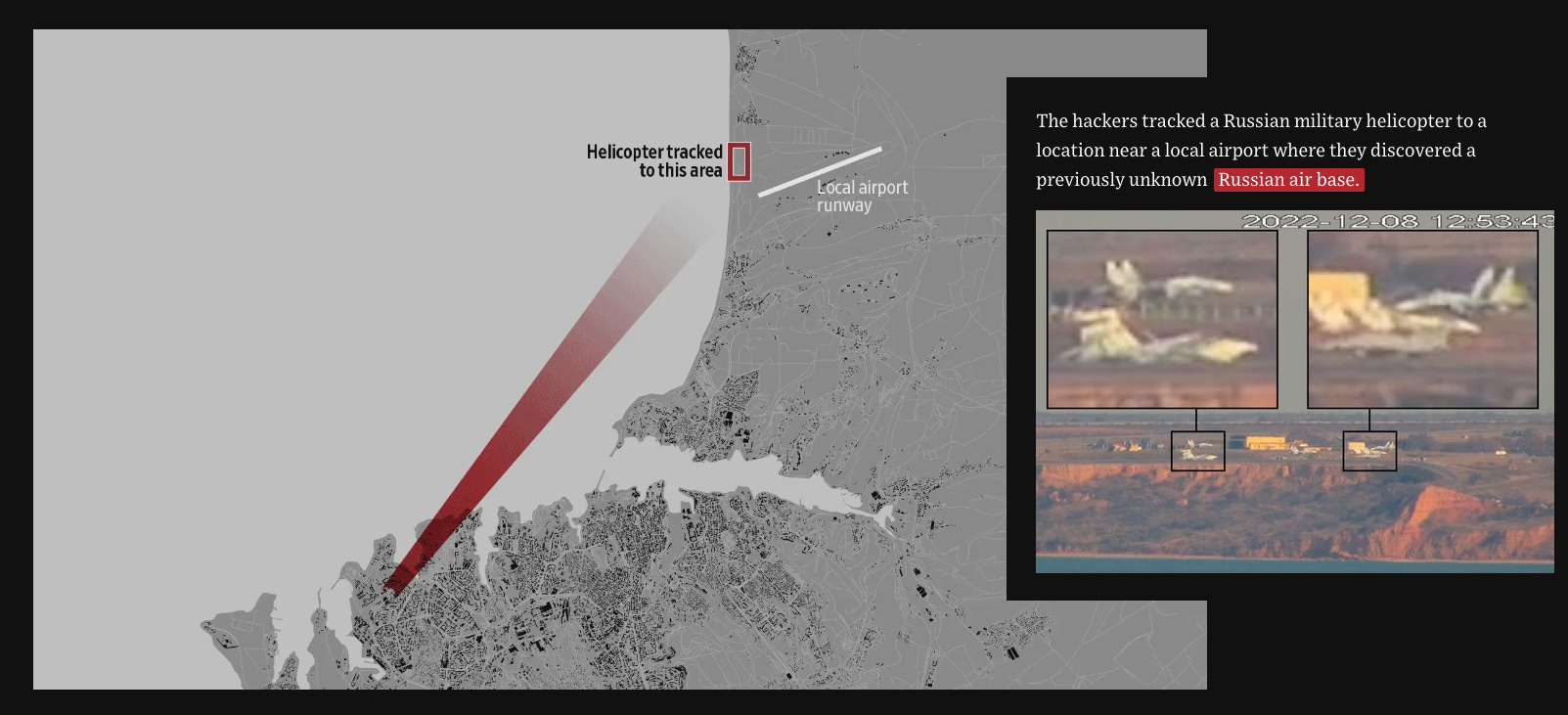
Russia, Ukraine, Israel, and Iran have all used compromised cameras during military conflicts. Ukrainian hackers accessed cameras in Crimea to track Russian helicopters and identify a previously unknown air base that Ukrainian forces subsequently attacked. Russian hackers have used residential webcams in Kyiv to help identify targets and refine missile strikes. Israel reportedly hacked Iranian traffic cameras to gather intelligence before the assassination of Iran’s supreme leader, while Iranian-linked groups have compromised hundreds of Israeli cameras near military facilities and other sensitive locations. European intelligence agencies have also warned that Russia is systematically hacking cameras to monitor military shipments and Ukrainian personnel.
Many cameras have weaker security than computers and smartphones, particularly when installed by facilities managers or homeowners who rarely update their software or change default passwords. Compromised cameras can also provide access to larger networks, exposing files, communications, and other connected devices. Hackers have exploited these weaknesses for espionage, ransomware, propaganda, and intimidation, including intrusions into private baby monitors and government videoconferences.
ECONOMY
3. Why Economists Think Higher Bond Yields Are Here to Stay (WSJ)
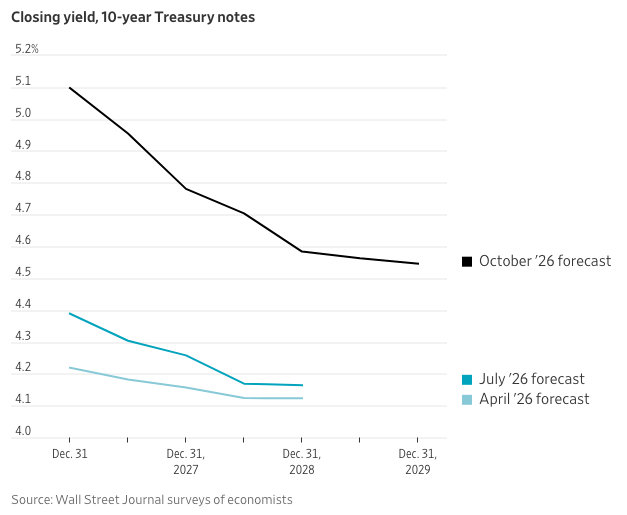
Economists increasingly expect elevated U.S. interest rates to persist through the rest of the decade, even as inflation gradually declines. In the Wall Street Journal’s October survey of 71 forecasters, the projected 10-year Treasury yield at the end of 2026 rose to 5.1%, up from 4.4% in July. Economists now expect yields to remain around 4.8% at the end of 2027. Sustained high yields would keep mortgage rates and corporate borrowing costs elevated while adding to federal interest expenses, which already exceed military spending.
Several forces are driving the shift. Large federal deficits and growing national debt are making investors more cautious about holding Treasuries, while the AI infrastructure boom is increasing demand for capital and supporting economic growth. Higher energy prices from the Iran war have added inflationary pressure, and the Federal Reserve has resumed raising interest rates after earlier cuts failed to bring inflation back toward its 2% target. Even if oil prices retreat, economists expect government borrowing and AI investment to keep pressure on long-term yields.
Despite higher borrowing costs, forecasters remain relatively optimistic about the economy. They raised their 2026 GDP growth estimate from 2.1% to 2.4% and expect growth around 2.1% to 2.2% thereafter. Inflation is projected to decline from 3.5% at the end of 2026 to 2.3% by the end of 2027, while unemployment should remain near 4.2%. The estimated probability of recession over the next year is 24%. Some economists disagree with the higher-for-longer outlook, arguing that weakness in white-collar hiring could eventually force the Fed to cut rates. The prevailing expectation, however, is that borrowing costs will remain substantially higher than previously anticipated, even without a recession or persistently high inflation.
4. See What 71 Economists Told Us About Where Growth and Yields Are Headed (WSJ)
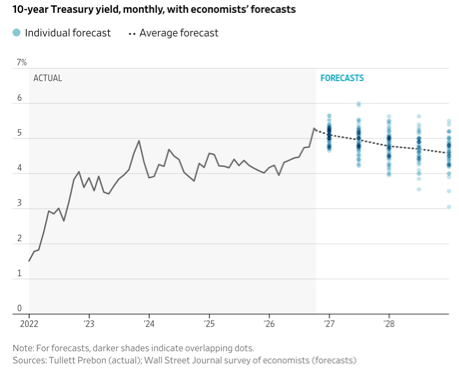
Economists expect U.S. bond yields to remain elevated through 2027, keeping pressure on mortgage rates, business borrowing costs, and federal debt payments. The benchmark 10-year Treasury yield has risen from 4.2% at the beginning of 2026 to 5.1%, with roughly three-quarters of economists surveyed by The Wall Street Journal expecting it to finish the year at 5% or higher. More than one-third anticipate yields remaining at or above 5% through 2027. The outlook reflects stronger economic growth, persistent inflation pressures, Federal Reserve rate increases, and concerns about rising federal debt.
Energy prices remain an important source of inflation. Economists expect U.S. crude oil prices to decline from approximately $101 a barrel to $75 by the end of 2027, still above the $67 level before the Iran war began. Consumer inflation is projected to ease to 2.3% by the end of 2027, although borrowing costs are expected to remain high even as price pressures moderate.
Economic growth has proved stronger than anticipated. Forecasters raised their estimate for third-quarter GDP growth from 2% in July to 3.1% in October, with 60 of 64 economists who participated in both surveys revising their projections upward. The labor market is expected to expand more slowly, adding an average of 56,000 jobs per month over the next year. Together, these forecasts suggest an economy that continues growing despite elevated interest rates, with limited relief in sight for borrowers.
5. More Oil Is Now Coming Out of the Persian Gulf Than Before the Iran War (WSJ)
Persian Gulf oil exports have recovered to above prewar levels despite continued Iranian attacks on shipping in the Strait of Hormuz. Regional oil flows averaged more than 24 million barrels per day in the week ending October 18, compared with 23.3 million before the war. Shipments through Hormuz have recovered to roughly 82% of prewar levels, while expanded Saudi and Emirati pipelines allow more oil to bypass the strait. U.S. military protection, offshore oil transfers, and improvised tanker operations have helped restore shipments, reducing Iran’s ability to disrupt global energy supplies.
However, the recovery comes amid escalating attacks. Roughly 30 ships have been attacked in October, with Iran using drones, missiles, small boats, and other tactics to threaten tankers. Shipowners have responded by using older vessels for short trips through Hormuz, transferring oil to other tankers near Oman, and offering crews substantial bonuses. High profits make the risks worthwhile for some operators, with traders earning as much as $40 million more on a single supertanker shipment of Iraqi crude.
Although oil is moving again, transportation costs have surged. Freight rates for shipping Gulf crude to China have approached $37 a barrel, while war-risk insurance premiums have climbed to as much as 10% of a vessel’s value. Brent crude remains near $108 a barrel as traders worry about renewed fighting, shipping disruptions, and low global inventories. Iran’s ability to restrict exports has weakened, particularly while its own shipments remain constrained by a U.S. blockade, but maintaining the flow of Gulf oil now requires expensive security arrangements and considerable financial incentives. The result is a shift from an outright shortage of oil to the rising cost and danger of transporting it.
6. How New Yorkers Rallied to Answer One Teen’s Cry for Career Help (WSJ)
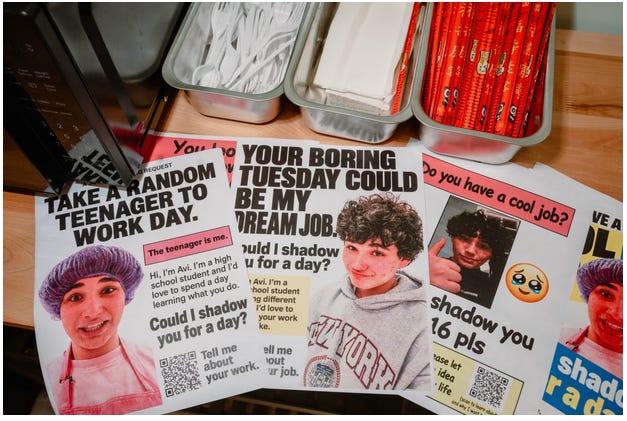
Avi Lichtenstein, a 16-year-old New York City high-school student, spent $500 of his savings posting more than 300 flyers around the city asking strangers with interesting jobs to let him shadow them. Anxious about choosing a career before applying to college, he hopes to shadow one professional each week to explore different occupations and learn what working in those fields is actually like.
His unusual approach has attracted considerable attention. He has shadowed a dog groomer, a radio host, and a ramen shop owner, with opportunities to observe an airline captain, tattoo artist, and marketing executive. The ramen shop experience turned into a part-time job, where he has already contributed marketing ideas, promotional materials, and social media content. His flyers and TikTok videos have generated hundreds of thousands of views and dozens of responses. To address safety concerns, he and his parents screen volunteers through questionnaires, LinkedIn profiles, photos, and video calls.
PREDICTION MARKETS
7. Courts Grapple With Problem of People Betting on the Outcome of Jury Cases (WSJ)
Prediction markets are increasingly allowing people to wager on the outcomes of criminal trials, raising concerns about jury impartiality, insider trading, and the integrity of the justice system. Offshore platform Polymarket has hosted more than $600,000 in bets related to Lindsay Clancy’s murder trial, over $300,000 on the pending trial of Tyler Robinson, who is accused of killing Charlie Kirk, and substantial wagering on cases involving Sean “Diddy” Combs and Nicolás Maduro. Although these markets operate offshore, research suggests that 20% to 40% of their betting volume comes from U.S. participants.
Legal experts worry that jurors or court employees could use confidential information to profit from bets, creating financial incentives to influence verdicts. Publicly available betting odds could also shape prospective jurors’ perceptions before trials begin. Robinson’s attorneys raised these concerns in court, arguing that wagering and livestreamed proceedings could compromise his right to a fair trial. The judge acknowledged the risks but allowed livestreaming to continue, suggesting that jury selection could address potential bias.
Courts are beginning to respond. The federal court in Chicago is updating its insider-trading policies to prohibit employees from using confidential information for prediction-market wagers, while judges are considering how betting activity might affect jury trials. Meanwhile, Polymarket maintains that its markets merely reflect public expectations rather than influence outcomes. The growing popularity of courtroom betting, however, is creating ethical and legal challenges that existing judicial safeguards were never designed to address.
REAL ESTATE
8. US Pending Home Sales Plunged in September to a Record Low (Bloomberg)
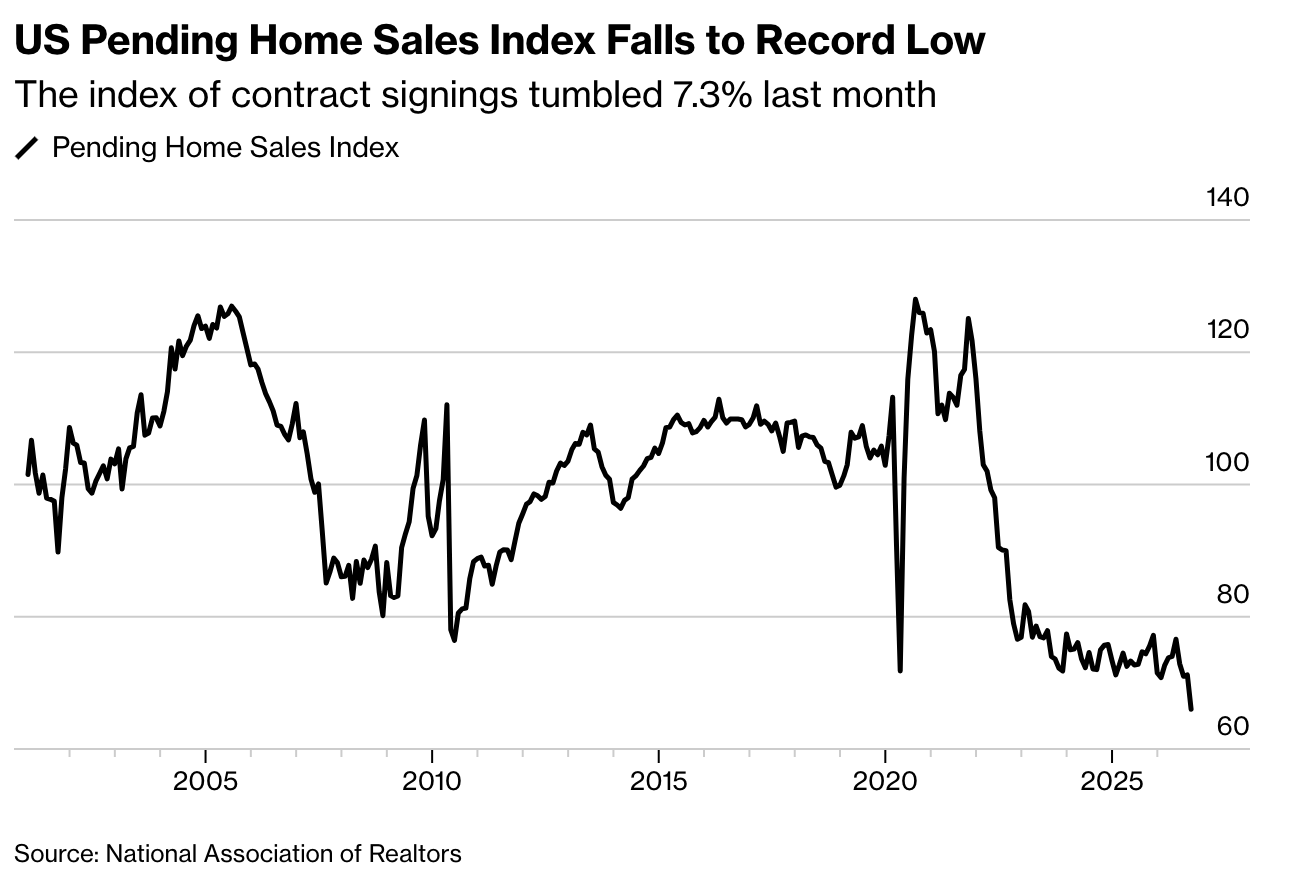
Pending sales of existing U.S. homes fell 7.3% in September, pushing the National Association of Realtors’ index to 66, its lowest level since records began in 2001. The decline exceeded every economist’s forecast in a Bloomberg survey, while contract signings were nearly 13% below year-earlier levels. Rising mortgage rates, now at their highest levels in almost three years, and persistently high home prices continue to discourage buyers and keep sellers on the sidelines.
Sales weakened across every region, with the West recording the largest decline at 9.2%, followed by the South at 8.2%. Pending sales typically precede completed transactions by one or two months, suggesting further weakness in existing-home sales. New-home construction also slowed to one of its weakest levels since 2020. With mortgage rates climbing since the start of the Iran war, buyers and sellers appear increasingly willing to delay transactions until borrowing costs improve.
9. Why Americans have stopped buying new homes (Economist)
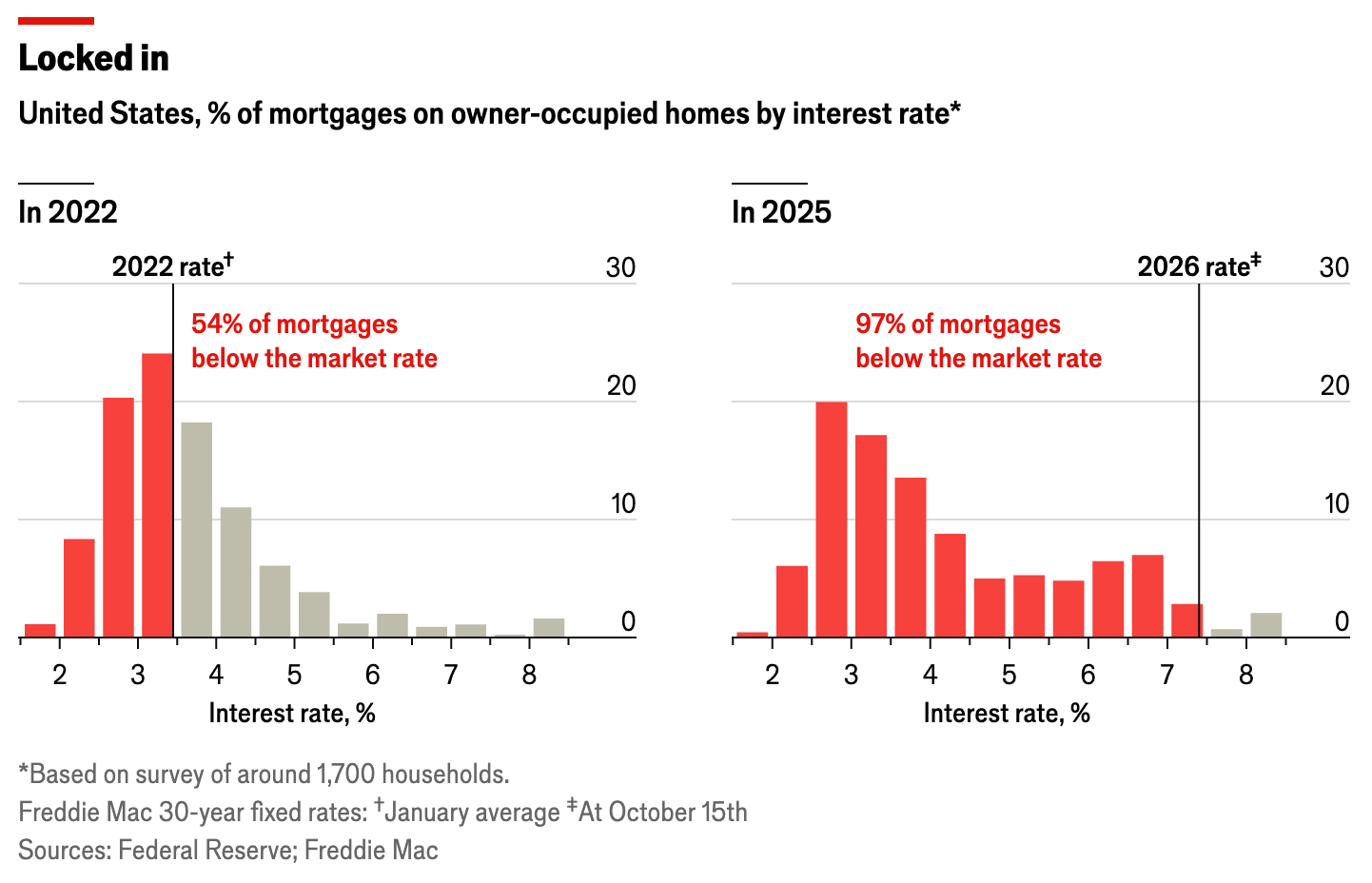
The U.S. housing market remains largely frozen as mortgage rates have climbed to 7.4%, near their 25-year high. First-time buyers now account for roughly 30% of purchases, down from more than 40% in previous decades. Existing homeowners are reluctant to sell because moving would require giving up historically low mortgage rates for much more expensive loans. This “lock-in” effect is particularly pronounced in the U.S., where 30-year fixed-rate mortgages are common and homeowners generally cannot transfer their existing loans to another property.
Unlike previous periods of rising interest rates, when increases were relatively modest and short-lived, mortgage rates have climbed nearly five percentage points and remained elevated for more than four years. Today, 87% of mortgage borrowers have rates at least one percentage point below current market rates, while 76% have rates at least two points lower. Moving to an identical home at today’s rates would cost the typical homeowner an additional $335 per month in interest. Middle-income households face the greatest burden relative to income, with the increase equivalent to 4.4% of their pretax earnings.
The resulting shortage of homes for sale is also keeping prices elevated. Research estimates that mortgage lock-in prevented 1.7 million home sales between mid-2022 and mid-2024. At current rates, it could suppress nearly 1 million sales annually, roughly 20% of transactions that would otherwise occur. Between 2022 and 2024, higher mortgage rates would ordinarily have reduced home prices by an estimated 5.6%, but the resulting supply shortage pushed prices up 7%, producing a net increase.
CYBER
10. Amazon has a hidden shopping profile on you — here’s how to check it and spend less (Consumer Affairs)
Amazon’s “About You” feature, introduced in May 2026, gives shoppers a look at the personal profiles the company builds from purchase histories, searches, reviews, wish lists, and interactions with Alexa for Shopping. These profiles can include assumptions about body type, family circumstances, hobbies, and shopping preferences. Some inferences are surprisingly personal or inaccurate, raising privacy concerns about how much Amazon knows or assumes about its customers. The information also helps Amazon recommend products shoppers might otherwise never consider purchasing.
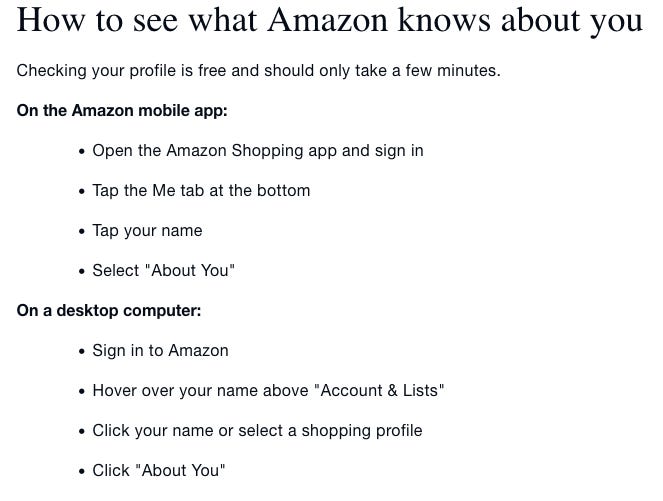
Customers can review their profiles through the Amazon app or website by selecting their name and opening “About You.” Categories include Home and Family, Interests and Hobbies, Brands, and Product Preferences. Individual assumptions can be removed, although doing so does not necessarily delete the purchase or browsing history that produced them. Amazon also does not identify a single setting for disabling the entire feature.
ARTIFICIAL INTELLIGENCE
11. What on earth is going on with AI pricing and packaging? (Elena Verna)
AI companies have made subscription pricing increasingly difficult to understand, leaving customers unsure what they receive for their money or how much they can actually use a product. Companies such as OpenAI, Anthropic, Grok, Lovable, and ElevenLabs rely on vague usage descriptions, multipliers, tokens, and proprietary credits that rarely translate into recognizable amounts of work. A subscription might promise hundreds of millions of tokens or five times more usage without explaining what those allowances mean in practical terms.
Four factors contribute to the confusion. First, proprietary credits and tokens obscure actual costs, much like casino chips or virtual gaming currencies. Second, companies emphasize large quantities rather than the value customers receive. Third, general-purpose AI systems can perform vastly different tasks, making traditional pricing units such as seats, transactions, or storage difficult to apply. Finally, AI providers struggle to predict their own costs because agents can perform multiple steps, use different models, call tools, make mistakes, and retry tasks, consuming unpredictable amounts of computing power.
These pricing models have succeeded partly because early adopters are willing to tolerate complexity in exchange for powerful new capabilities. Reaching mainstream customers, however, will require clearer and more predictable pricing. Usage allowances need to translate into understandable activities or outcomes, allowing customers to estimate costs before committing to a subscription. Companies that can connect pricing to customer value while managing unpredictable computing expenses could gain a substantial competitive advantage as AI adoption expands.
SPORTS & ENTERTAINMENT
12. The Brewers Don’t Hit Home Runs. They ‘Drag Pitchers to Hell.’
The Milwaukee Brewers have built baseball’s winningest team with one of MLB’s smallest payrolls and an offensive strategy that runs counter to the sport’s obsession with home runs. Despite hitting the second-fewest home runs in baseball, Milwaukee finished second in runs scored, becoming the first team since the 1960 Chicago White Sox to rank among the top three in scoring and bottom three in homers.
The Brewers emphasize patience, disciplined at-bats, and wearing down opposing pitchers. They led MLB in walk rate, batting average (.258), and on-base percentage (.341), while swinging less frequently than any team in recent years. Their approach forces pitchers to throw more pitches, extends innings, and creates scoring opportunities without relying on power. In one playoff game, Jake Bauers worked a 12-pitch walk against Dodgers ace Yoshinobu Yamamoto, helping drive him from the game after just 2⅔ innings.
Manager Pat Murphy also emphasizes baserunning, hustle, situational hitting, and manufacturing runs. Milwaukee scored an MLB-leading 155 runs on plays that weren’t hits and even employs a coach dedicated specifically to offensive strategy. Their success reflects a philosophy that values getting on base, exhausting pitchers, and capitalizing on every scoring opportunity.
13. ‘Choosin’ Texas’ Is the Biggest No. 1 Song Ever—and You Might Have Never Heard It (WSJ)
Ella Langley’s “Choosin’ Texas” became the first song to spend 24 weeks at No. 1 on the Billboard Hot 100, surpassing the 22-week record held by Mariah Carey’s “All I Want for Christmas Is You.” Yet many listeners, journalists, and even fellow musicians say they have never heard the song. The disconnect reflects how fragmented popular culture has become. Streaming services, social media algorithms, and declining reliance on traditional radio and television allow songs to achieve enormous commercial success without becoming universally recognizable.
Country and Latin music have benefited substantially from this shift. U.S. annual streams for each genre climbed from roughly 50 billion to 70 billion in 2020 to around 120 billion by 2025. Langley’s song led streaming charts in 11 of the 15 largest American markets this summer, although New York and Los Angeles favored other artists. Country performers such as Morgan Wallen and Zach Bryan, along with Latin artists such as Bad Bunny, can now attract massive audiences without changing their musical styles to appeal to traditional pop markets.
Streaming has also changed how long songs remain popular. Unlike physical album sales, which counted each purchase once, streaming measures repeated listening, allowing devoted fans to keep songs near the top of the charts for months. Before 2020, no song had spent 40 weeks in the Hot 100’s top 10; eight have done so since. Langley’s record reflects both the growing commercial strength of country music and a music industry in which audiences can sustain historic hits that other listeners barely encounter.
NOTE: Not surprisingly, I hear this song on the radio all the time here in San Antonio, Texas. I think the only disconnect is what’s heard in LA and NYC versus what’s heard elsewhere in the country.
As a side note, I love the twist on this line of the song: “I wasn't a match for that kind of spark.” Very clever play on words.