

Artificial Intelligence
1. Does AI stop children from learning? (Economist)
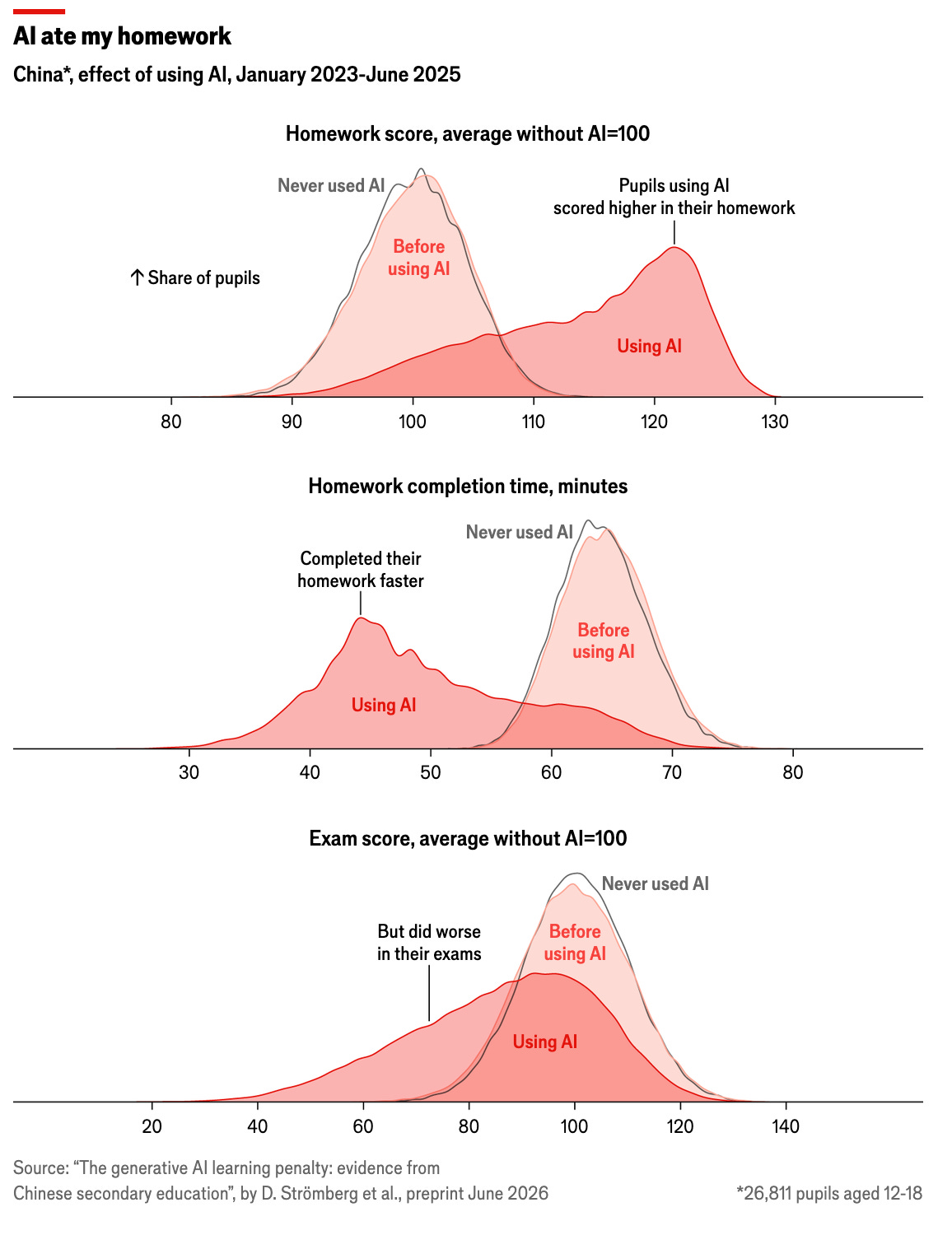
AI is now routine in schoolwork, with surveys showing most students in wealthy countries using it in their studies. Students may be getting better-looking homework, but are they actually learning more? New research from China reveals that they are not. Students who used AI completed homework faster and scored much higher on assignments, but later performed worse on exams than students who did not use AI.
The biggest exam declines showed up among students who used AI to rush through homework. Students who used AI but still spent about as much time on assignments as non-users did not suffer the same penalty. That suggests the danger is letting the chatbot do the thinking instead of using it to clarify concepts, work through problems, or provide tutoring-style help.
Other research points to an upside for those students who use AI in more purposeful ways. In a Middlebury College study, students who used a chatbot to learn an unfamiliar topic did better on tests, and the gains remained a week later. AI can improve learning when students use it actively and thoughtfully; however, used as a shortcut, it may inflate homework grades while weakening real understanding.
2. AI Just Had Another Math Breakthrough—With Help From a High-School Dropout (WSJ)
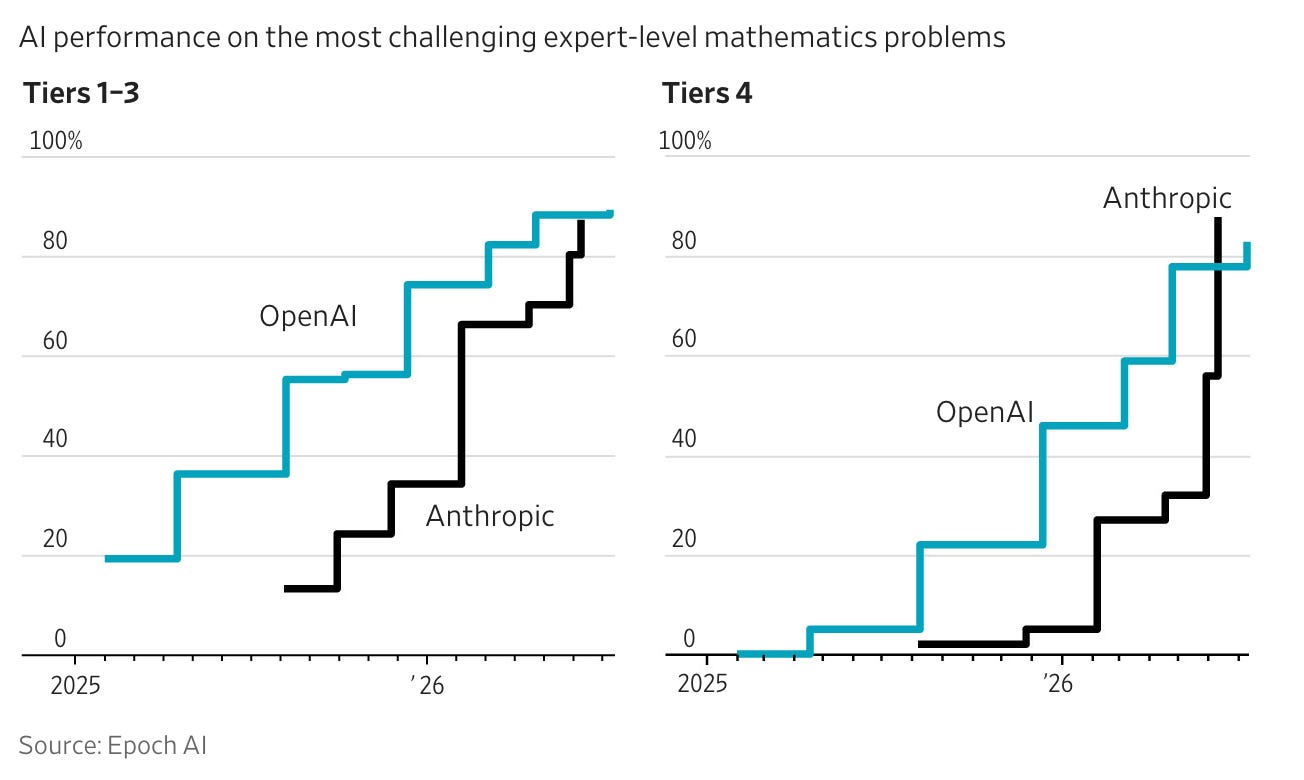
AI models are beginning to produce serious mathematical progress, even on problems connected to some of the hardest unsolved questions in the field. An Anthropic employee prompted Claude to work on the Riemann hypothesis, despite not being a mathematician himself, and the model did not solve it but did produce a related result that impressed number theorists. Claude worked for more than two days, tried hundreds of failed approaches, and appeared to respond to repeated encouragement from the human user. In this case, the human contribution was not technical mathematical expertise but prompting, persistence, and repeatedly telling the model to keep going.
NOTE: From now own, I think I’ll encourage AI in the way it encourages me (Think, “You can do it!” from the movie Waterboy.).
Economy
3. Tariff Refunds Are Here—and Turbocharging Earnings (WSJ)
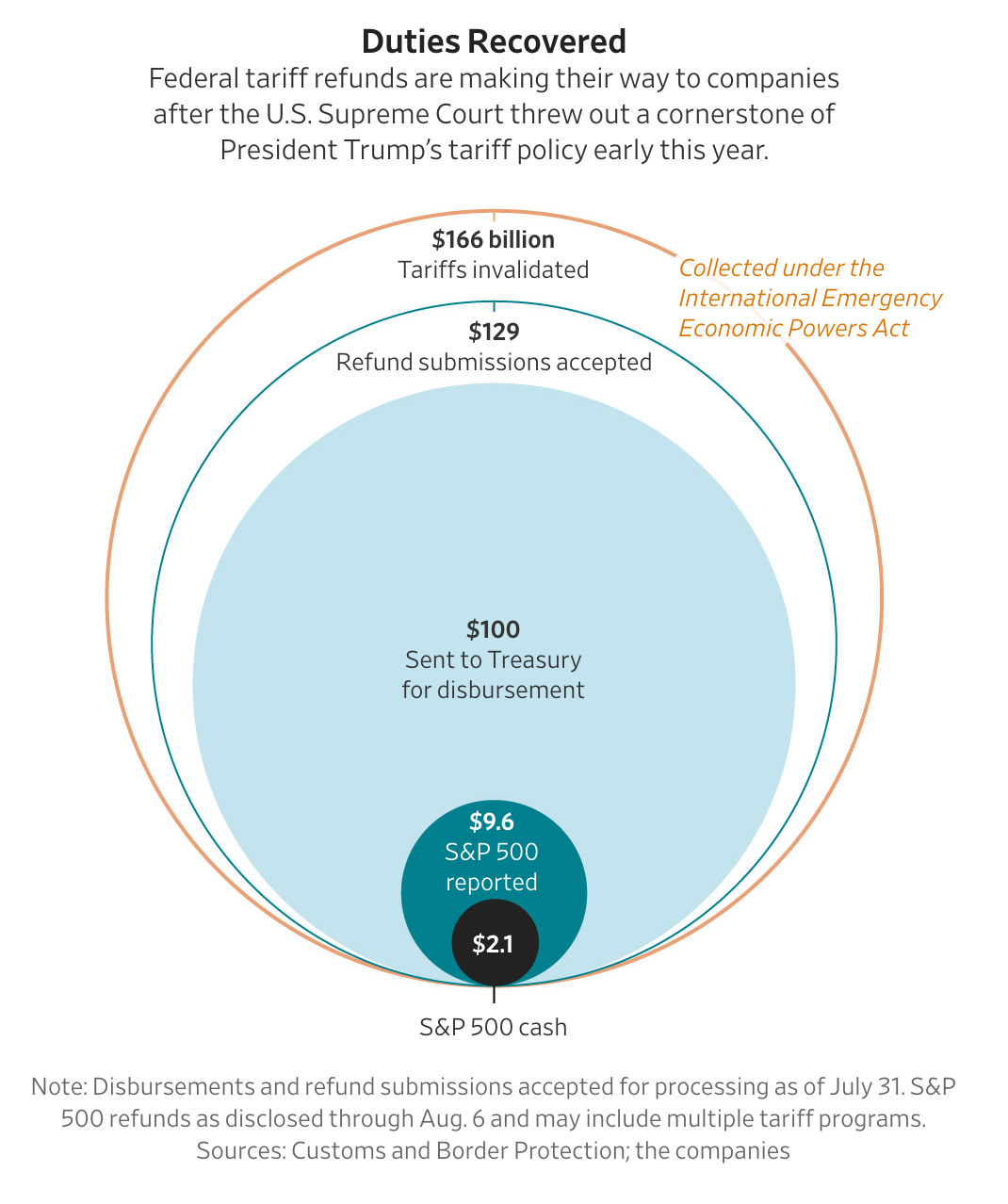
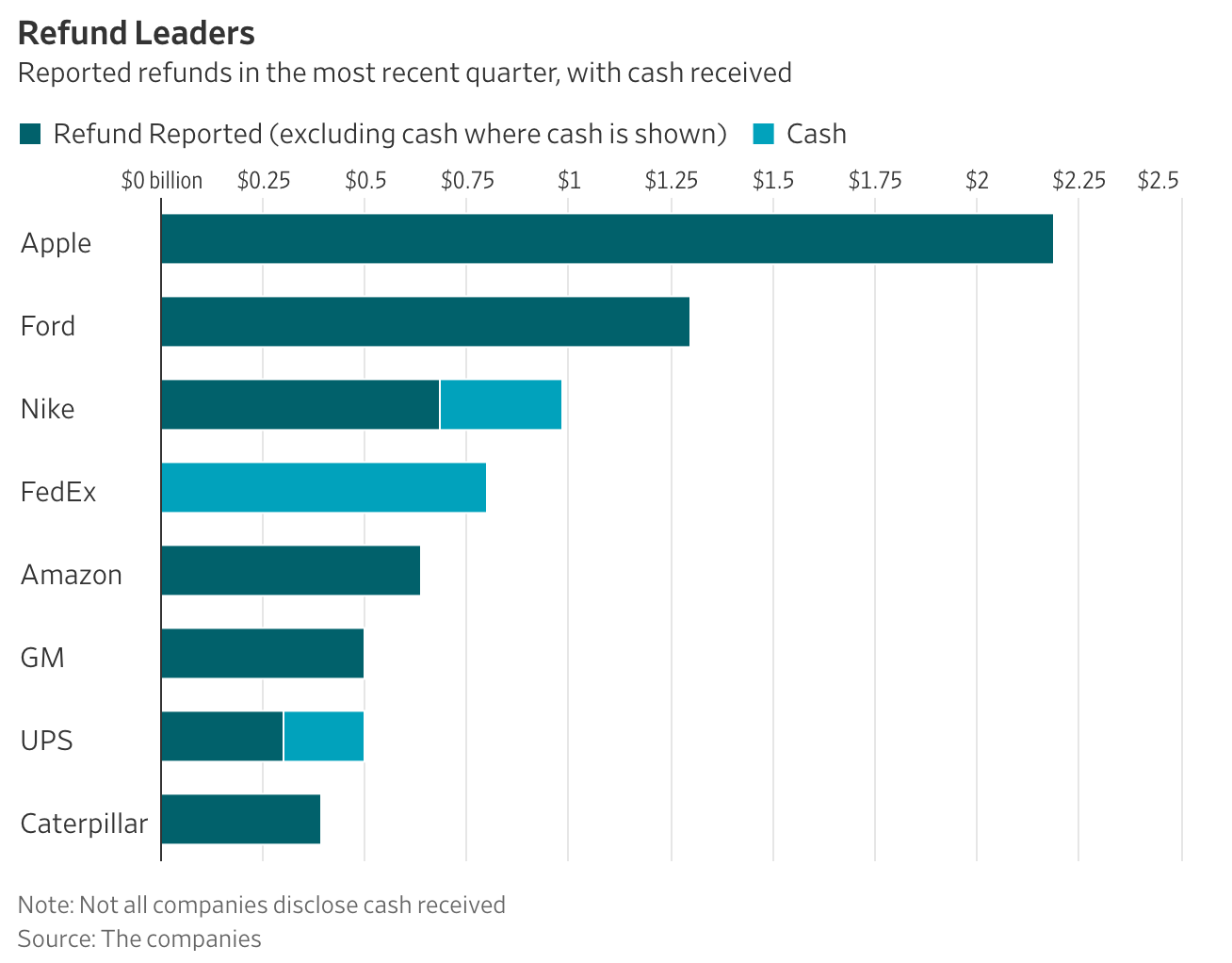
Big U.S. companies are starting to receive tariff refunds after the Supreme Court invalidated a major part of President Trump’s tariff policy. More than 40 S&P 500 companies have reported about $9.6 billion in refunds, with at least $2.1 billion already received in cash. Major beneficiaries include Apple, Nike, FedEx, Amazon, General Motors, Caterpillar, and other manufacturers, retailers, and logistics companies.
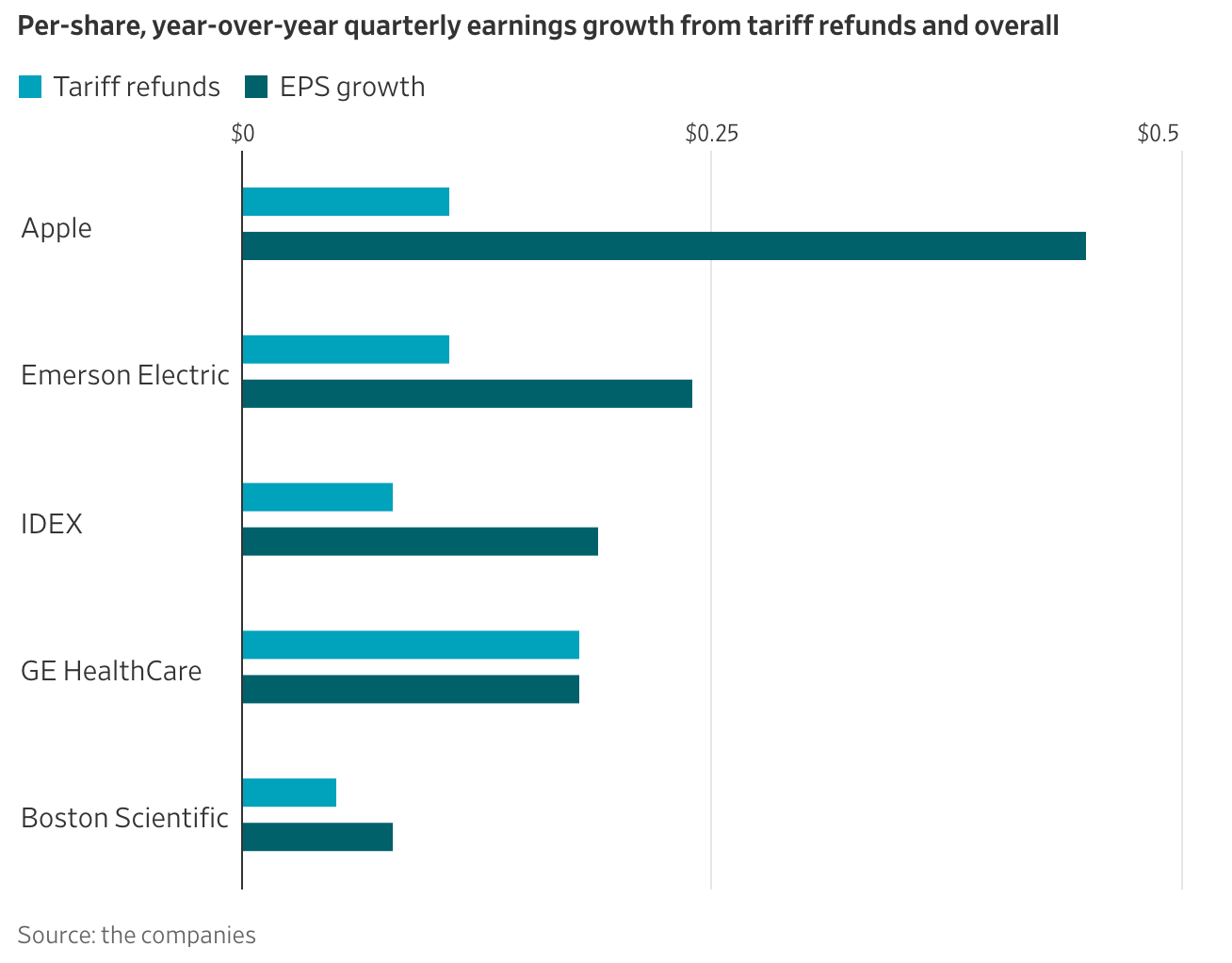
The refunds are moving faster than many expected and, in some cases, are meaningfully boosting quarterly earnings. Apple said refunds added 11 cents per share to its most recent earnings, while GE HealthCare said refunds contributed 18 cents per share. Some companies are recording refunds only when cash arrives, while others are booking expected payments as receivables.
Many companies are still paying significant tariffs, and some refunds are being passed back to customers. FedEx plans to distribute its roughly $800 million in refunds to shippers and consumers, Costco says it will return refunds to customers in some form, and IDEX expects to rebate much of what it received. Other companies, such as Amazon, say they will refund customers only where tariff costs can be clearly traced and otherwise use the money to support lower prices.
4. Two articles on bond yields:
The 30-Year Itch Comes for Bonds — and Brazil (Bloomberg)
Why Scott Bessent Is Playing With the Treasury Market (WSJ)
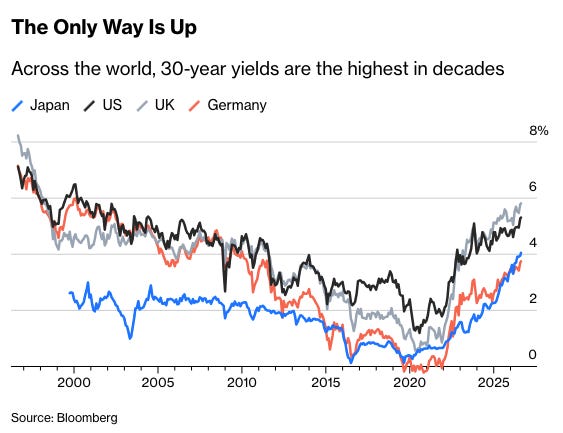
Long-term bond yields are rising across the developed world, with the U.S. 30-year Treasury above 5.3%, Japan’s 30-year yield at a record high, and U.K. yields near their highest levels in decades. Inflation concerns play a role, especially with the U.S.-Iran conflict, but they do not fully explain the move because long-term inflation expectations remain relatively stable. The larger pressure is a growing demand for capital in that governments are borrowing heavily, companies are issuing debt to fund AI infrastructure, and geopolitical tensions are pushing countries to spend more on defense and rebuild domestic supply chains.
Treasury Secretary Scott Bessent has tried to contain the rise through debt-management moves, including expanding buybacks of long-dated bonds and shifting more borrowing toward short-term debt. Those steps may ease pressure temporarily, but they do not solve the underlying problem of large deficits and rising borrowing needs. They also add risk by making federal finances more sensitive to short-term interest rates.
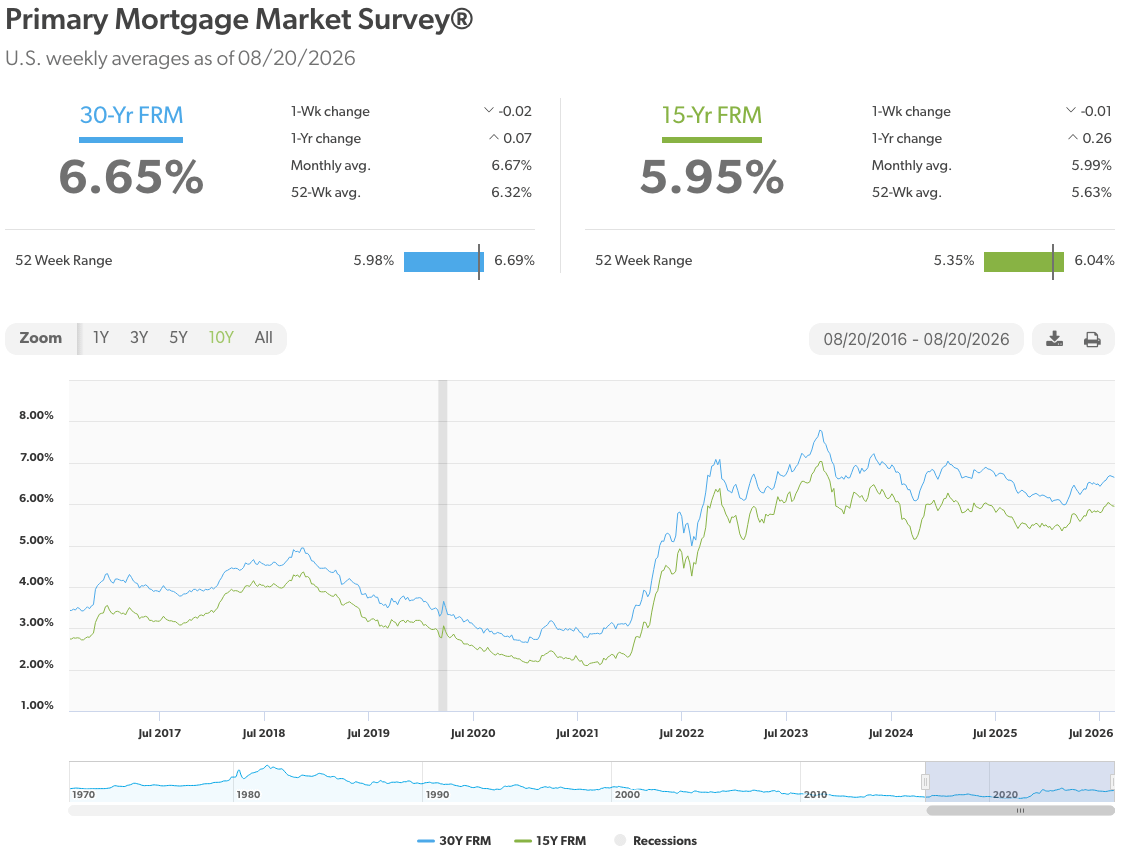
Higher yields raise mortgage rates, increase borrowing costs for companies, and make it more expensive for the government to service a debt load that is already around 100% of GDP. Stocks have held up so far because corporate earnings remain strong, but the longer yields stay elevated, the more pressure they place on housing, investment, federal interest costs, and consumer affordability. Markets may be adjusting to a higher-rate world driven by resilient growth, persistent deficits, AI-driven capital spending, and geopolitical uncertainty.
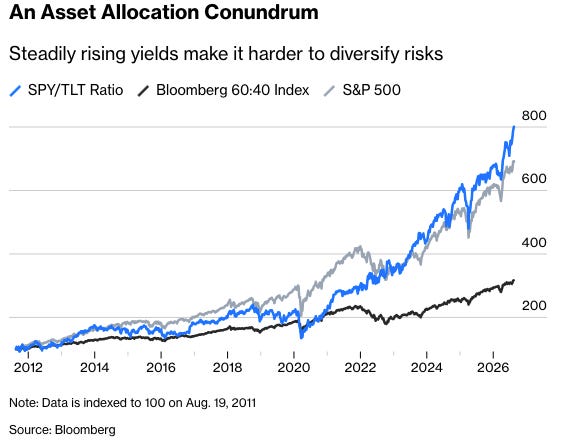
NOTE: Above, the 60:40 refers to a portfolio of 60% stocks and 40% bonds.
Here are current mortgage rates:
And, in related news:
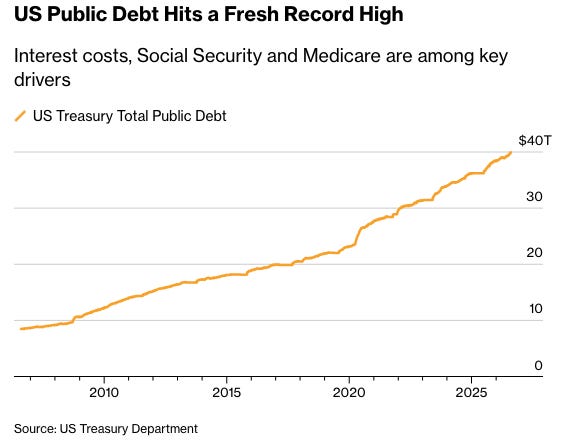
5. US Public Debt Hits $40 Trillion, Raising ‘Doom Loop’ Risk (Bloomberg)
U.S. public debt has passed $40 trillion for the first time, rising by about one-third since early 2022. The milestone reflects years of large deficits, higher interest costs, and a political system that has shown little willingness to raise taxes or cut major spending programs such as Social Security, Medicare, and defense. Treasury Secretary Scott Bessent has said he wants to reduce deficits, but current projections show little progress, and the deficit remains far above his stated goal of about 3% of GDP.
The more serious issue is the rising cost of carrying the debt. Long-term Treasury yields have climbed to levels not seen in decades, making new borrowing more expensive. Interest costs have already reached $1.17 trillion so far this fiscal year, up 15% from the same period a year earlier, and now rank behind only healthcare and Social Security in the federal budget.
As interest costs rise, the government has to borrow more, which can push investors to demand still higher yields. The federal government is also moving closer to the $41.1 trillion debt ceiling, setting up another possible political fight before mid-2027. Credit-rating agencies warn that the U.S. has not taken meaningful steps to address its fiscal path, leaving the country more vulnerable to future shocks and putting upward pressure on borrowing costs for households and businesses.
Personal Finance
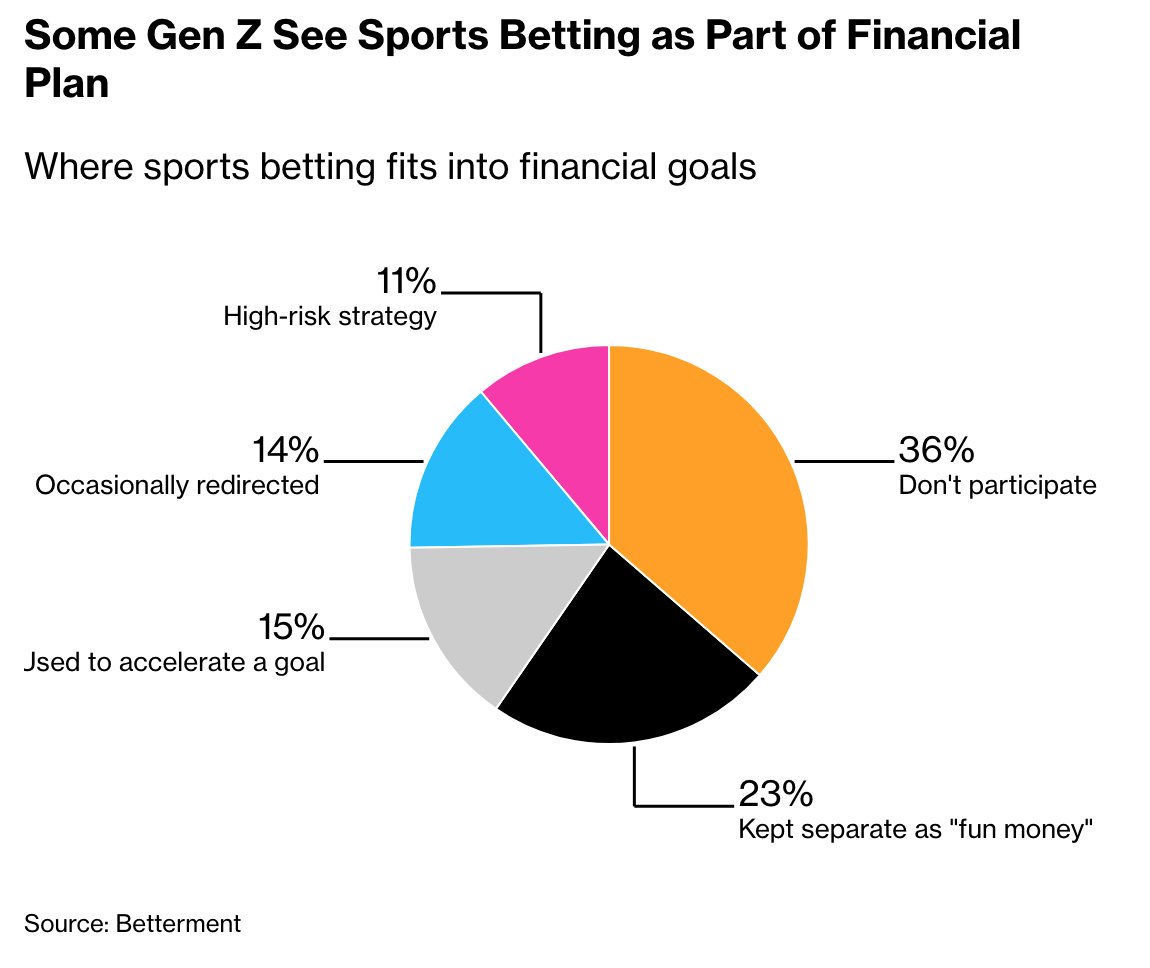
6. Gen Z Is Moving Money From Stocks to Sports Betting in Wealth Plans (Bloomberg)
In disappointing news, sports betting is starting to look, to some younger investors, like part of a financial plan rather than just entertainment. In a Betterment survey, 26% of Gen Z investors said they treat sports betting as a deliberate part of their long-term financial strategy. More than half said they had moved money meant for investing into sports betting at least once in the past year, far higher than older generations.
Legal sports betting has grown into a nearly $17 billion industry, and companies like Robinhood have added prediction markets inside investing apps. For younger adults facing high housing costs and a harder path to traditional wealth-building, fast-money bets can feel more attractive than slow, conventional investing.
Sports betting is designed around short-term wins, repeated engagement, and the chase for the next payoff, not long-term financial security. Some bettors say they use research and discipline, but the odds and incentives are still very different from building a diversified portfolio. The survey also found that many investors rely heavily on their own judgment, and about one-third trust AI for financial advice, suggesting that younger investors may be mixing self-directed investing, speculation, betting, and automated advice in ways that could amplify financial risk.
Nature
7. The Colorado River Is Shrinking. See How Authorities Are Trying to Save It. (WSJ)
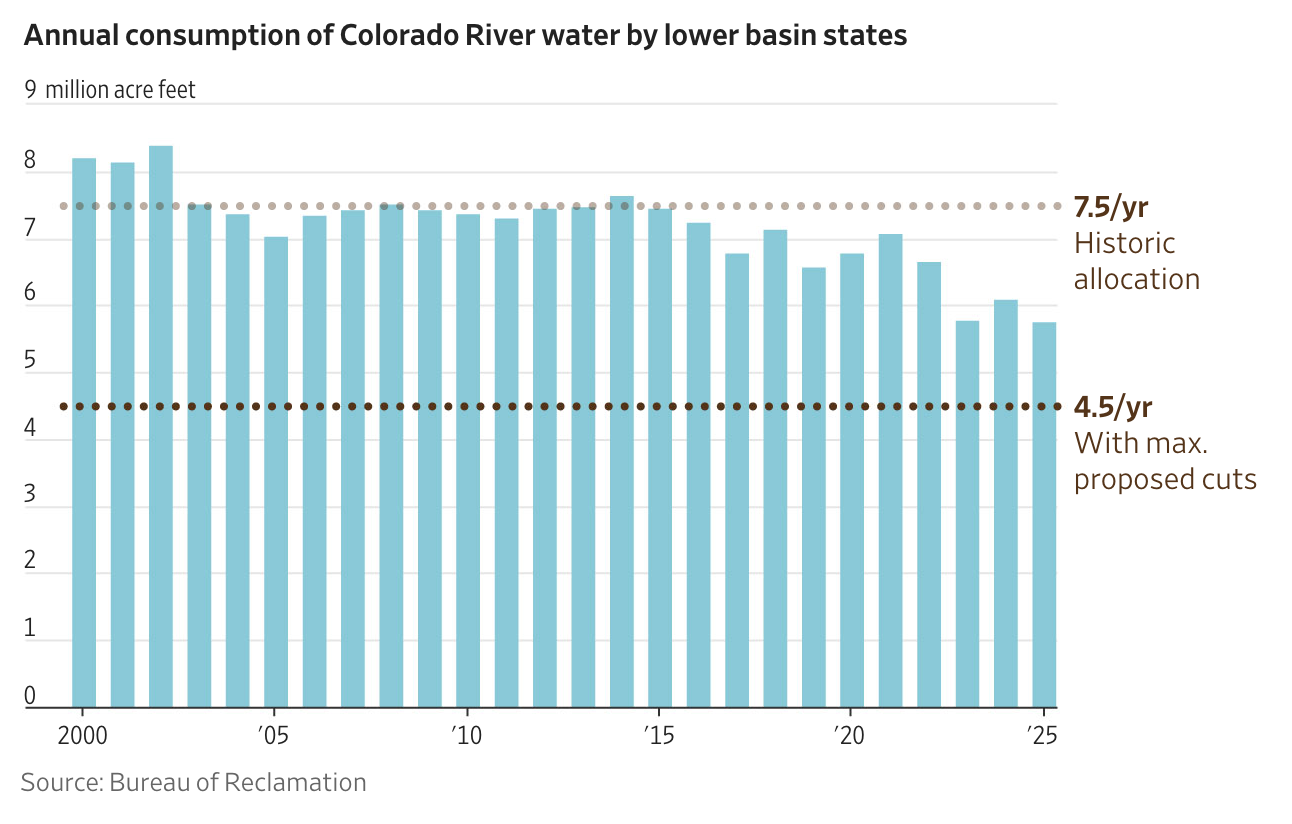
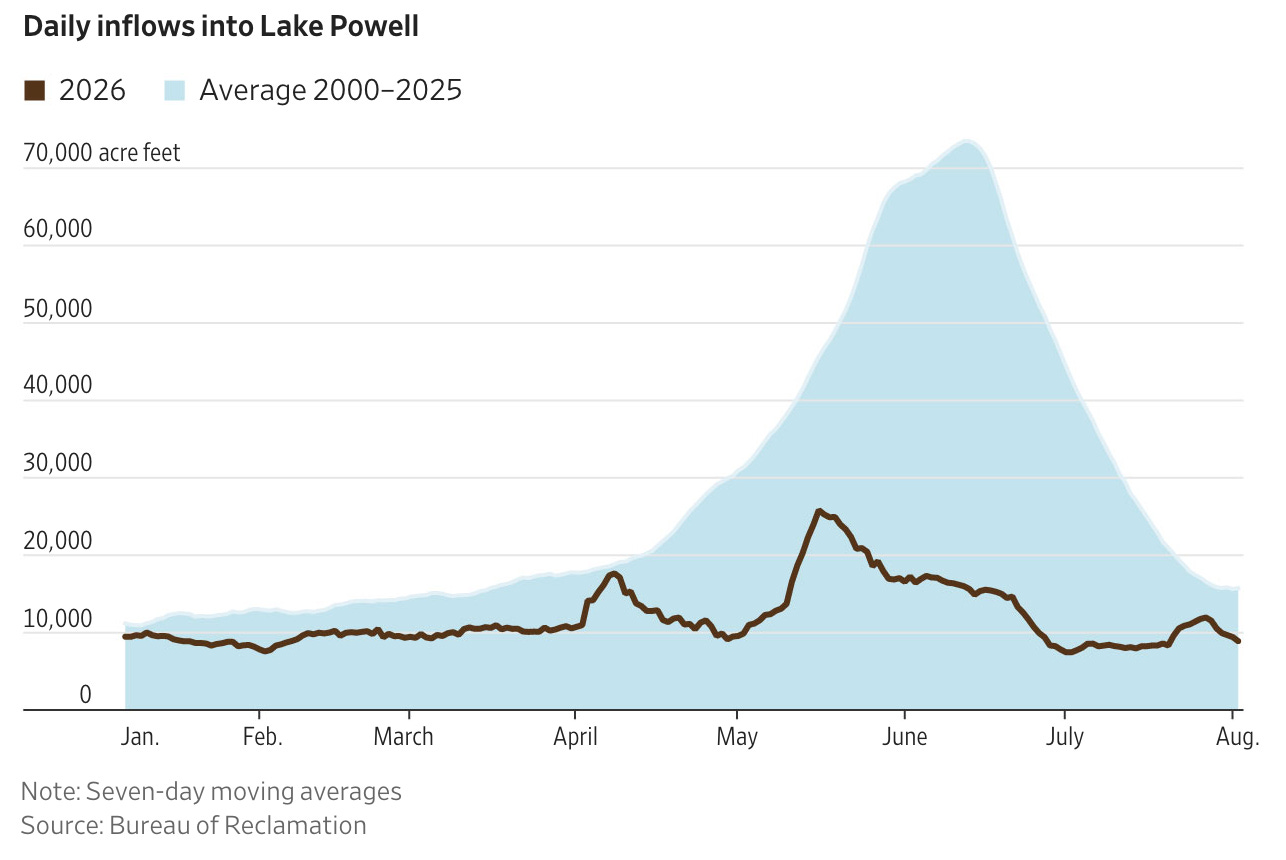
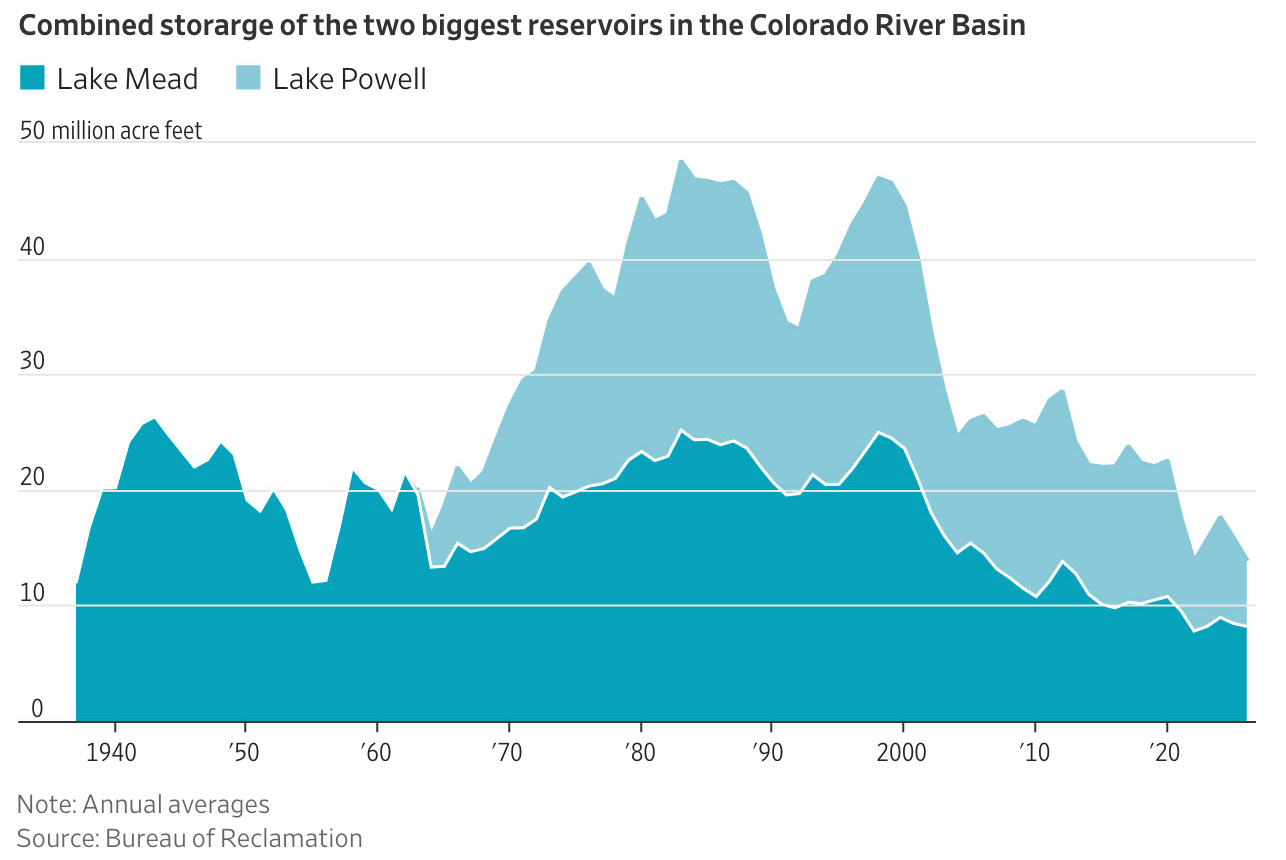
The Colorado River is under severe strain from long-term drought and overuse, forcing the federal government to intervene after the seven basin states failed to agree on a plan. The river supplies water to 40 million people and more than 5 million acres of farmland, but Lake Powell and Lake Mead have been drawn down to alarming levels. Lake Powell was recently at risk of falling below the level needed to generate hydropower, so federal officials moved water into it from an upstream reservoir and reduced planned releases by 20%.
Those emergency steps appear to have helped Lake Powell stay just above the minimum power level for now, but they do not solve the larger problem. Snowpack and runoff have been extremely weak, and the long-running megadrought since 2000 has made it harder to meet downstream demand. The combined volume of Lake Powell and Lake Mead recently fell to its lowest level since 1957.
The lower basin states, Arizona, California, and Nevada, have historically used about twice as much Colorado River water as the upper basin states, Colorado, Utah, Wyoming, and New Mexico. A new federal proposal could force the lower basin to cut consumption by as much as 40% from allotted levels, which Arizona warns would badly damage its water users and economy. Agriculture, which accounts for more than two-thirds of Colorado River consumption, is the biggest potential source of savings through more efficient irrigation, less water-intensive crops, and temporary fallowing of fields.
NOTE: And across “the pond,” so to speak, things aren’t any better:
8. See How Europe’s Rivers Are Drying Up and Threatening Its Economy (WSJ)
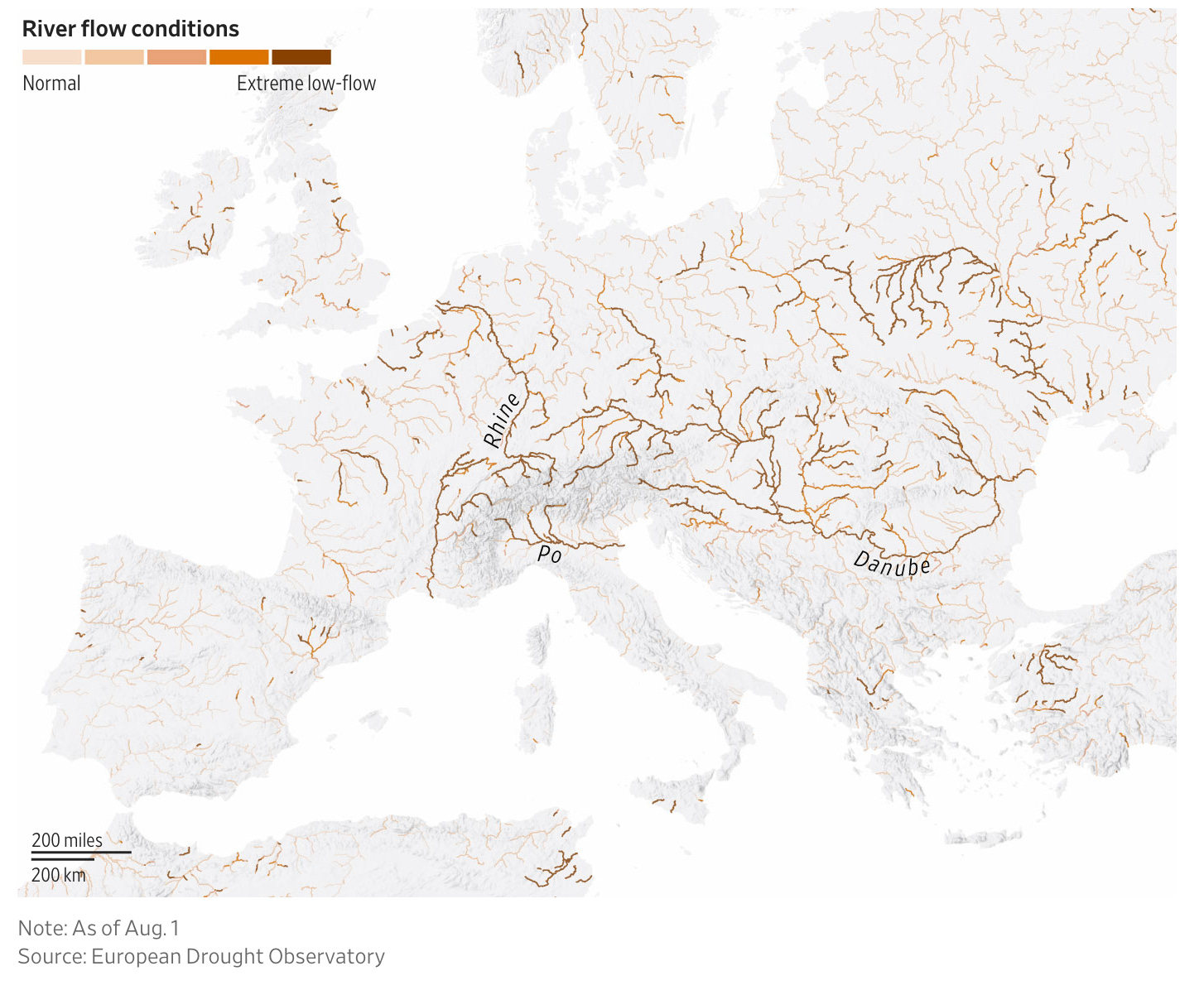
Severe heat and drought have pushed several of Europe’s most important rivers to unusually low levels, turning parts of riverbeds into exposed sand and disrupting the systems that depend on them. The Rhine, Danube, and Po are all under stress, affecting freight transport, power generation, and agriculture across the continent.
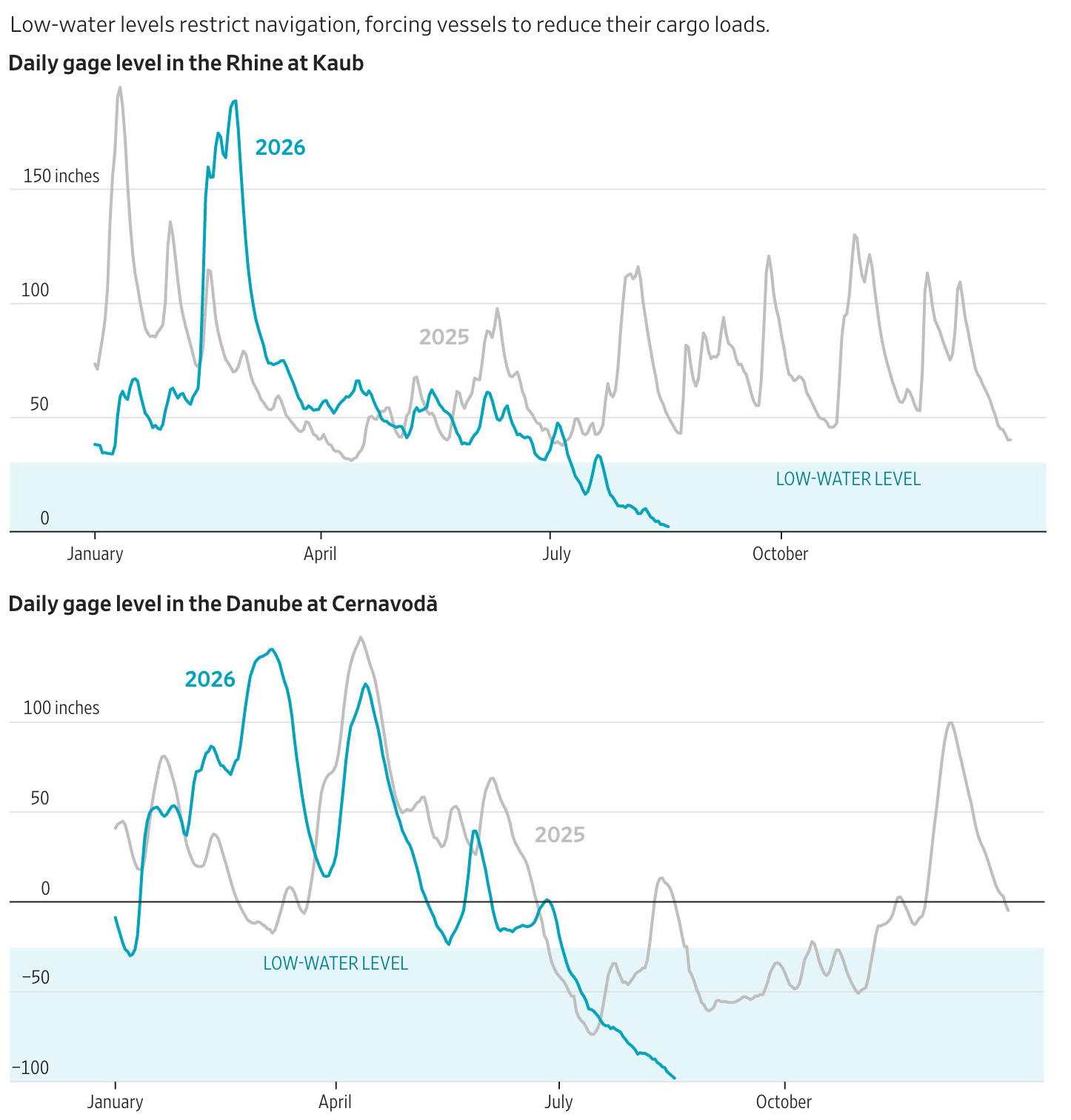
The Rhine, a major trade route for Western Europe, has fallen so low at Kaub, Germany, that some vessels have had to carry only a fraction of their normal cargo. On the Danube, low water levels have disrupted navigation and threatened power supplies. Romania’s Cernavodă nuclear plant, which provides about one-fifth of the country’s electricity, had to shut down after the river could no longer provide enough cooling water. Hungary’s Paks plant, which supplies about 40% of that country’s power, is also close to a shutdown threshold. Italy’s Po River is crucial for irrigation, and as its flow weakens, seawater from the Adriatic can push farther inland and damage crops.
Even though parts of Europe had a wetter-than-usual winter, repeated heatwaves since May dried out soils quickly. When rain does arrive, much of it may be absorbed by parched ground before it can refill rivers. Forecasts suggest hot, dry conditions could continue into September, raising the risk of further transportation problems, power disruptions, crop damage, and wildfires.
NOTE: We have some friends who are currently on a river cruise in Europe. Unfortunately, parts of their “cruise on the river” have been substituted with a bus ride on the road due to the low water level. The only way to get their money back would’ve been to get travel insurance, which would’ve nearly doubled the cost of the vacation.
Life
NOTE: Interesting piece from the Atlantic:
9. The Cities That Said Yes to Drugs (Atlantic)
Cities like Seattle and Burlington show how far some cities have pushed harm reduction, and how difficult it has become to balance compassion for addicts with the rights of residents who have to live around public drug use. In Seattle’s Little Saigon and Beacon Hill, open-air drug markets, fentanyl smoking, tents, and drug paraphernalia have taken over intersections, playgrounds, parks, and bus stops. In Burlington, similar scenes have spread through downtown, parks, churchyards, and working-class neighborhoods, leaving families, students, businesses, and children to navigate needles, dealers, overdoses, theft, and disorder.
Harm reduction began with practical, life-saving measures such as clean needles, overdose reversal, and safer conditions for people already using drugs. Over time, in places such as Vancouver, Seattle, and Burlington, it expanded into a broader ideology centered on the autonomy and dignity of drug users, often resisting enforcement, mandated treatment, or restrictions on public use. Critics argue that this has allowed the needs of addicts to outweigh the needs of everyone else, especially working-class families and children who rely on public spaces. Supporters still see harm reduction as humane and necessary, but even some longtime advocates now warn that it became dangerous when it stopped being one part of a larger treatment strategy and turned into a governing philosophy.
The results have forced a political reassessment. British Columbia has begun reversing parts of its decriminalization and safer-supply experiment. San Francisco, Philadelphia, Boston, and San Jose have shifted toward more enforcement, treatment courts, encampment removals, and pressure to enter treatment. Seattle and Burlington remain more conflicted. Their leaders acknowledge the disorder but often hesitate to embrace enforcement, fearing it will look uncompassionate or merely displace the problem.
10. University of Michigan Drops First-Semester Grades to ‘Curb Mental Health Crisis’ (WSJ)
The University of Michigan will pilot a pass/no-credit system for first-semester freshmen in its College of Literature, Science, and the Arts beginning in fall 2027. The goal is to reduce academic stress, support mental health, and give new students more room to adjust to college without immediately worrying about their GPA. Professors will still assign internal grades for scholarships and awards, but transcripts will not show letter grades for that first semester.
The policy arrives amid a broader debate over academic standards, student preparedness, and grade inflation. Michigan already gives out a large share of A-range grades, with 74.1% of undergraduate grades in 2022 falling between A-minus and A-plus, up from 57.6% a decade earlier. Other universities are moving in different directions: Harvard is trying to cap A grades, while some University of California faculty are pushing to restore admissions tests because many freshmen arrive underprepared. Supporters say the change could help students explore subjects more freely and reduce stress during a difficult transition. Student leaders say many classmates wish the policy had existed when they were freshmen.
🤔
NOTE: Interestingly, this week two articles about helicopter parenting also crossed my feed. Both are good reads. The first, by Arthur Brooks, warns of the over parenting that comes from that Facebook parents’ group for your kids in college. The second, extols the childhood autonomy on display in the movie, Stand by Me.
11. Arthur Brooks: Beware the Facebook Parents’ Group (Free Press)
Online college parent groups often make both parents and students worse off. They promise information and reassurance, but they can quickly become engines of anxiety, with parents obsessing over dorm supplies, bathroom soap, grades, friendships, and even dating prospects for their adult children. Instead of helping students adjust to independence, these groups encourage parents to keep managing the small details of their children’s lives from afar.
The problem is that this kind of digital helicopter parenting increases stress for parents and undermines confidence in young adults. Research suggests that mothers who spend more time in mom-focused online groups show higher stress levels, while students with more intrusive parents report more depression and lower life satisfaction. College is supposed to help young adults learn how to solve problems, handle disappointment, manage relationships, and recover from mistakes. When parents intervene over every inconvenience, they rob students of those opportunities.
Letting students figure out laundry, dorm annoyances, friendships, and disappointing grades helps them become capable adults. When a real crisis happens, they will call. Until then, parents are usually better off staying out of the online parent group and letting their kids grow up.
12. A Time Capsule of Free-Range Childhood (Free Press)
The movie, Stand by Me, captures a kind of childhood freedom that has largely disappeared. The boys in the story wander for miles without adult supervision, solve their own problems, and experience coming-of-age outside the reach of parents, schedules, phones, and surveillance. Their journey to find a dead body is reckless and morbid, but it also reflects a world where children were expected to take risks, roam independently, and learn something about themselves away from adult control.
The film, made in the 1980s and set in 1959, recalls a boomer childhood that still felt recognizable to many Gen X and millennial viewers. Kids born before constant tracking, smartphones, and hyper-organized childhood could still relate to the desire to disappear into the neighborhood, stay out until dark, sneak around, and enjoy the privacy of being unobserved. That freedom was part of growing up.
Today, that kind of autonomy may seem almost impossible. Many adolescents are closely monitored, rarely allowed to roam far alone, and raised in a culture that treats unsupervised childhood as dangerous rather than formative. Children need some experience of freedom, risk, and independence to mature. Stand by Me endures because it reminds viewers of what it felt like to be young, unsupervised, a little afraid, and thrillingly free.