Space
1. NASA boss announces three Moon Base missions scheduled for later this year, at least 12 to come (NY Post)
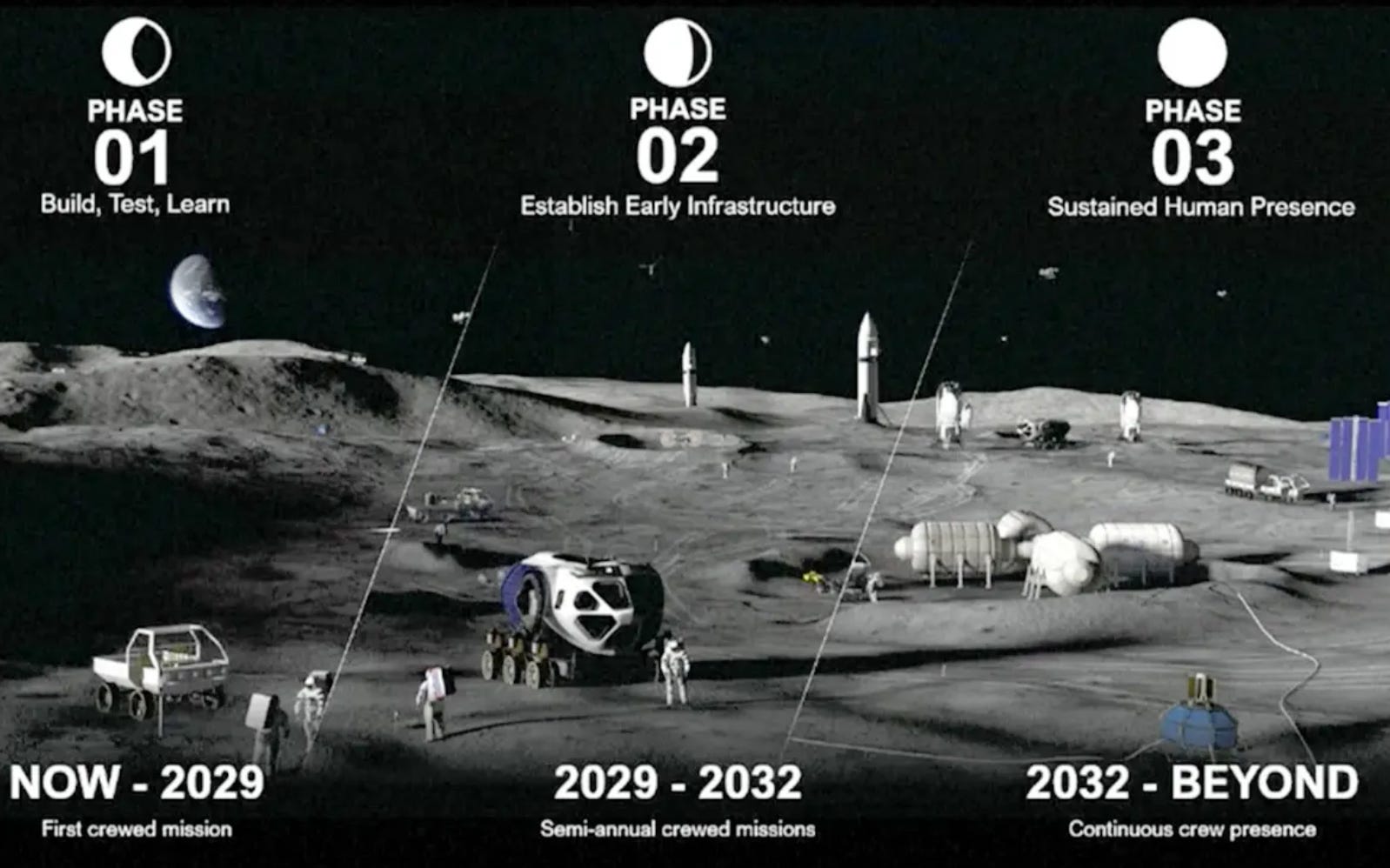
NASA plans to begin building toward a permanent Moon Base with three lunar missions later this year. The missions will deliver key payloads to the lunar surface, including equipment for the Lunar South Pole, a large commercial payload, and instruments to study the Reiner Gamma swirl. NASA Administrator Jared Isaacman said these are the first of more than a dozen planned missions as the agency shifts from returning to the Moon to building a lasting presence there.
The Moon Base effort will unfold in three phases: 1) learning, building, and testing; 2) early habitation; and 3) sustained human presence. NASA hopes to reach early habitation by 2029. The finished base could span hundreds of square miles and require infrastructure such as power grids, communications towers, rovers, drones, and landing-site support. NASA is leaning heavily on private companies, awarding major contracts to Blue Origin, AstroLab, Lunar Outpost, and Firefly Aerospace to develop and deliver vehicles, drones, and other lunar systems. NASA wants a broad commercial ecosystem rather than a few highly specialized pieces of hardware, while also pushing industry partners to solve delays, supply-chain issues, and performance problems.
Society
2. America’s Toxic Divide Reaches the Jury Room (WSJ)
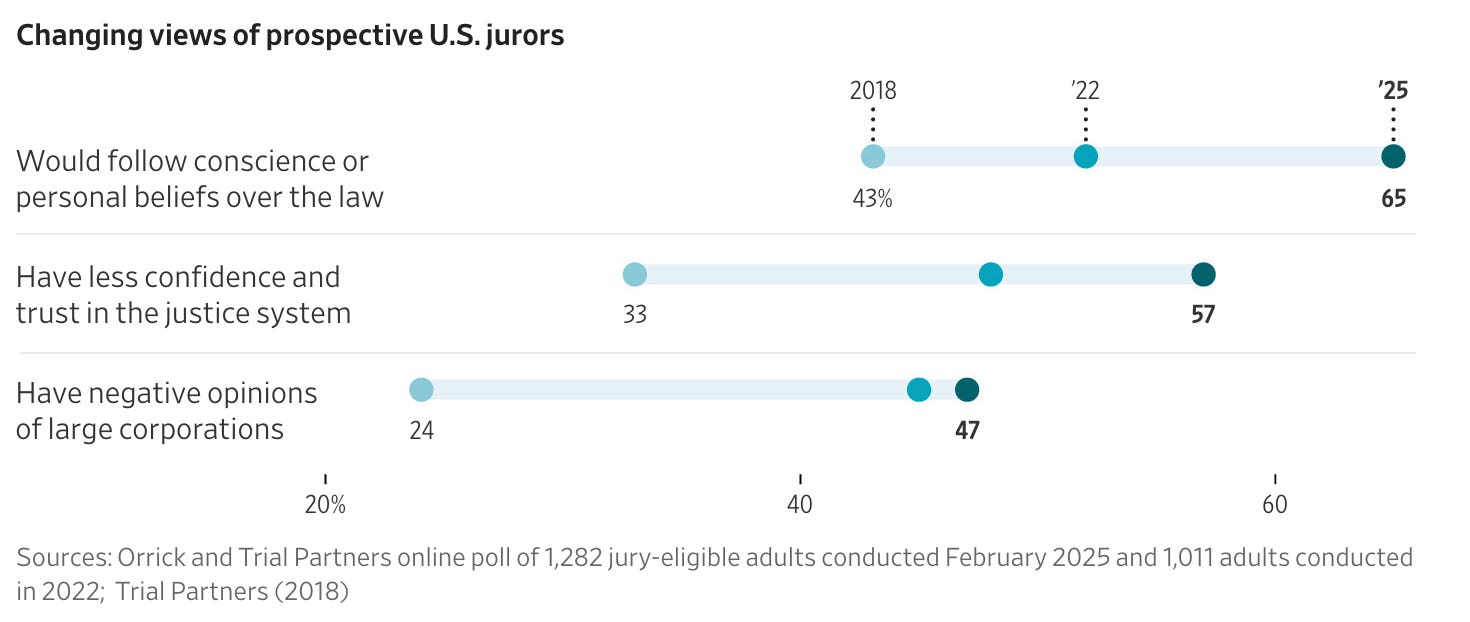
Juries are becoming harder to manage as broader social distrust, political polarization, and rigid personal viewpoints spill into deliberation rooms. Surveys show rising distrust in the justice system, growing bias against large corporations, and more willingness among prospective jurors to follow personal beliefs over a judge’s instructions. In both civil and criminal cases, lawyers are adjusting strategy around jurors’ trust levels, political leanings, and likelihood of nullification.
Jobs
3. New York City Unions Keep Winning Six-Figure Salaries (WSJ)
Unionized workers in New York City are winning unusually large pay increases as the city’s cost of living keeps climbing. Hotel housekeepers, nurses, doormen, and commuter rail workers have all secured or are reviewing contracts with sizable raises, preserved healthcare benefits, and in some cases pension gains or new funds to help with housing and child care. Hotel workers won the largest pay increase in their union’s nearly 100-year history, with most wages rising 50% and housekeepers eventually earning more than $100,000 a year. Employers and fiscal watchdogs warn that higher labor costs may be passed on through hotel prices, healthcare costs, transit fares, taxes, or borrowing.
4. This Summer’s Teen Job Market Is the Toughest in Decades (WSJ)
Teenagers are facing an unusually difficult summer job market, with demand for limited openings far outpacing supply. Challenger, Gray & Christmas projects teens will get about 790,000 jobs in May, June, and July, which would be the lowest summer-hiring total since the government began tracking the data in 1948.
The biggest weakness is in entertainment and leisure, where hiring announcements are down 70% from last year. Those jobs at resorts, hotels, amusement parks, restaurants, and activity centers are typically where teens find summer work. Inflation and higher fuel prices are pressuring small businesses and leisure employers, making them more cautious about staffing. There are a few bright spots, especially lifeguard jobs, which are advertised at much higher levels than last year.
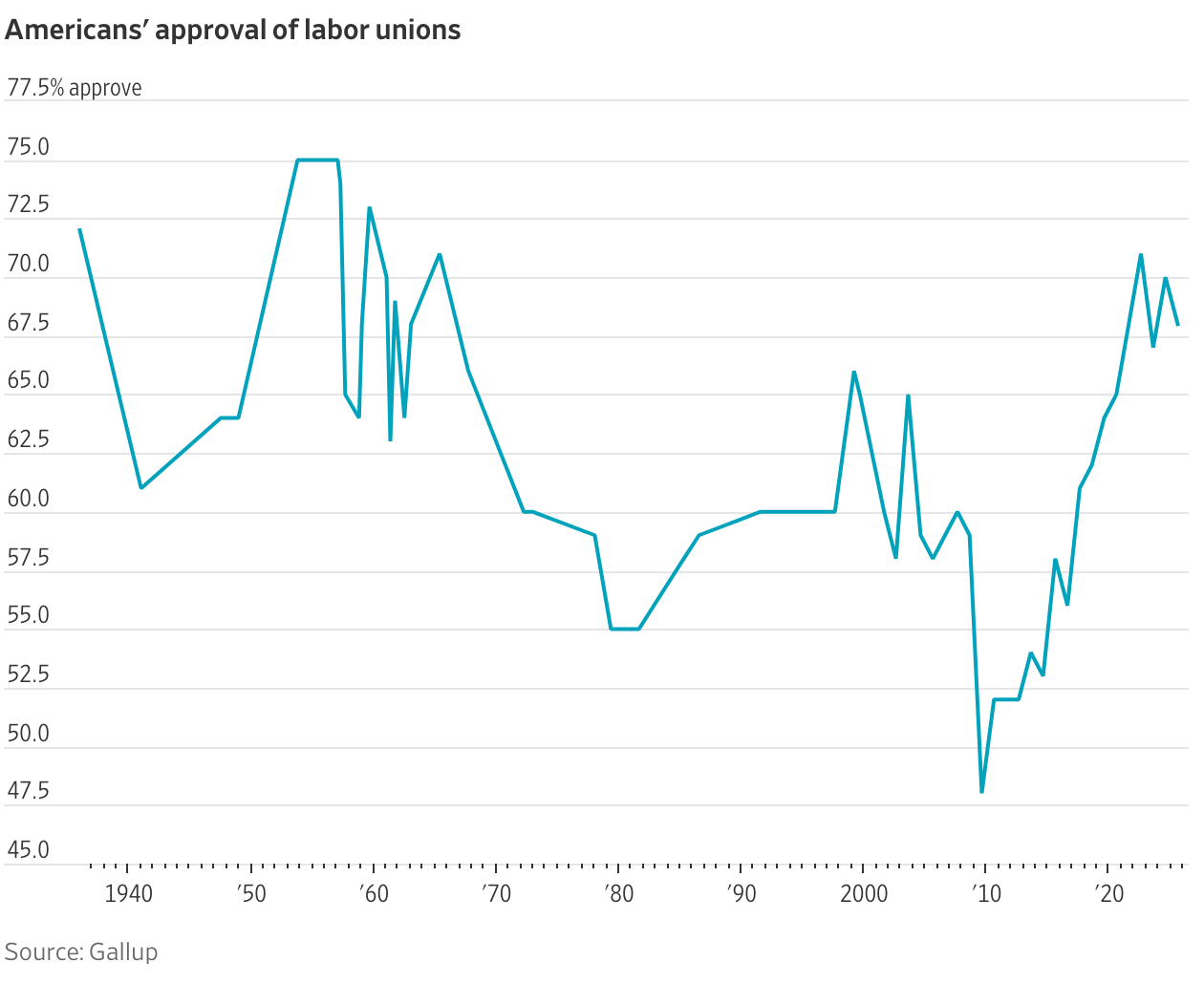
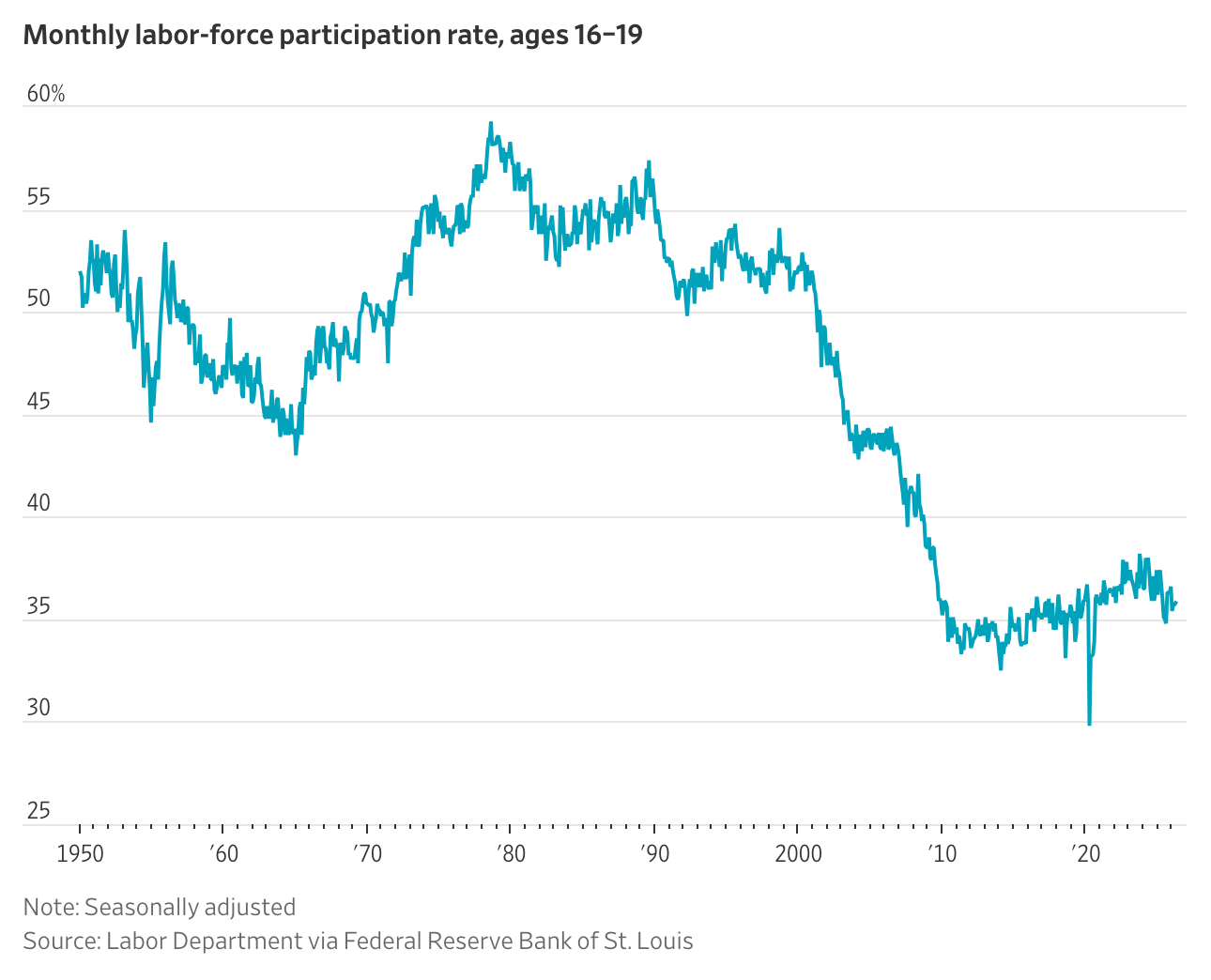
The teen job search has also become more competitive and adult-like. Parents are using networks, social media, references, and direct outreach to help their kids find openings, while employers often prefer older teens who can stay longer and require less training. At the same time, fewer teens are looking for work than in past generations because college prep, sports, extracurriculars, and content creation compete for their time. Teen employment routinely topped 50% in the 1970s and 1980s, but now sits around 35%.
Economy
5. The Stock Market Has Never Been So Good When People Have Felt So Bad (WSJ)
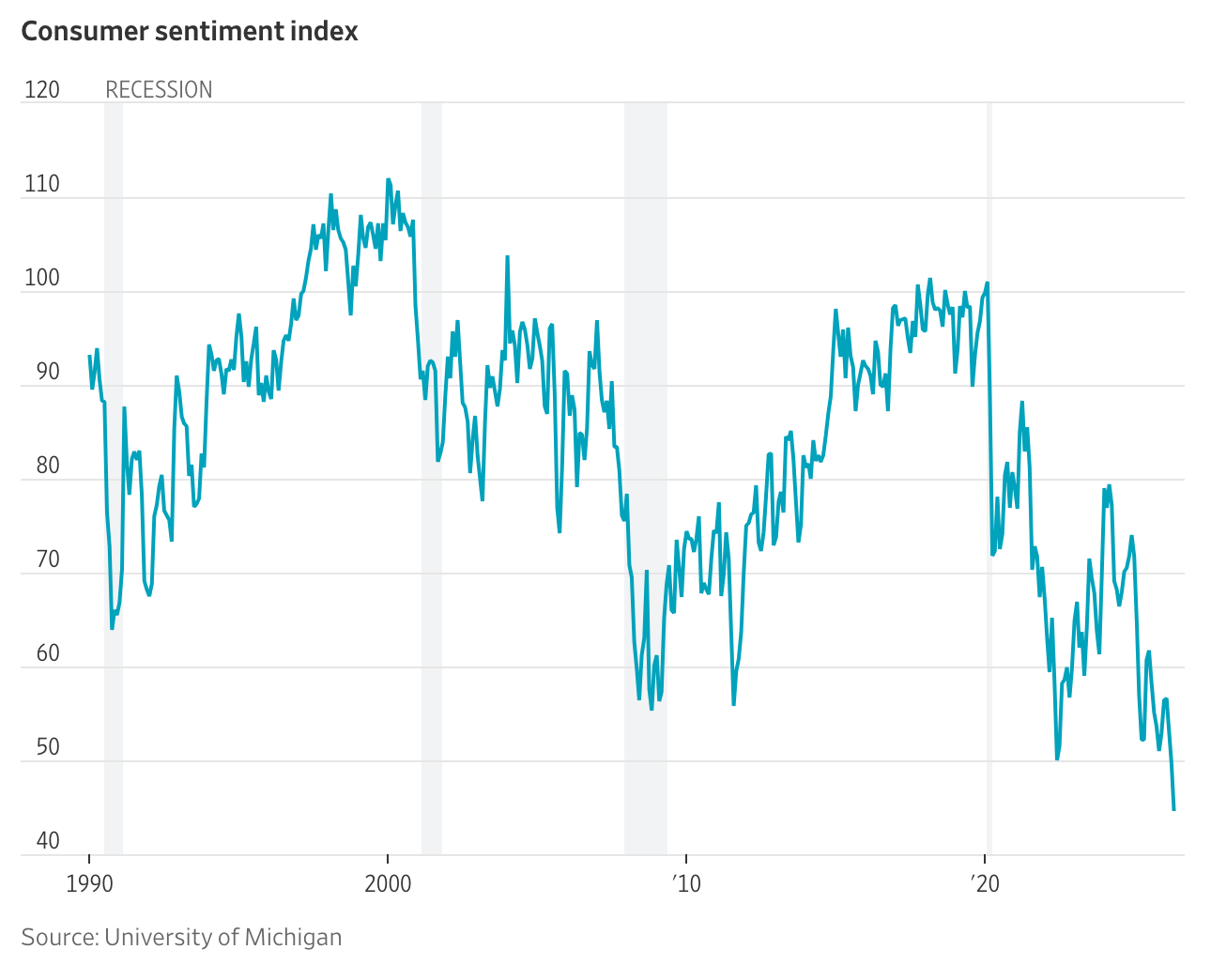
Consumer sentiment and the stock market are moving in opposite directions in a way that breaks with historical patterns. Americans are unusually pessimistic, with the University of Michigan’s consumer sentiment index falling to its lowest level in roughly 70 years of surveys. High prices, a weaker labor market, the Iran war, and higher gas prices have all contributed to the gloom. Normally, that kind of consumer mood would line up with a weaker stock market.
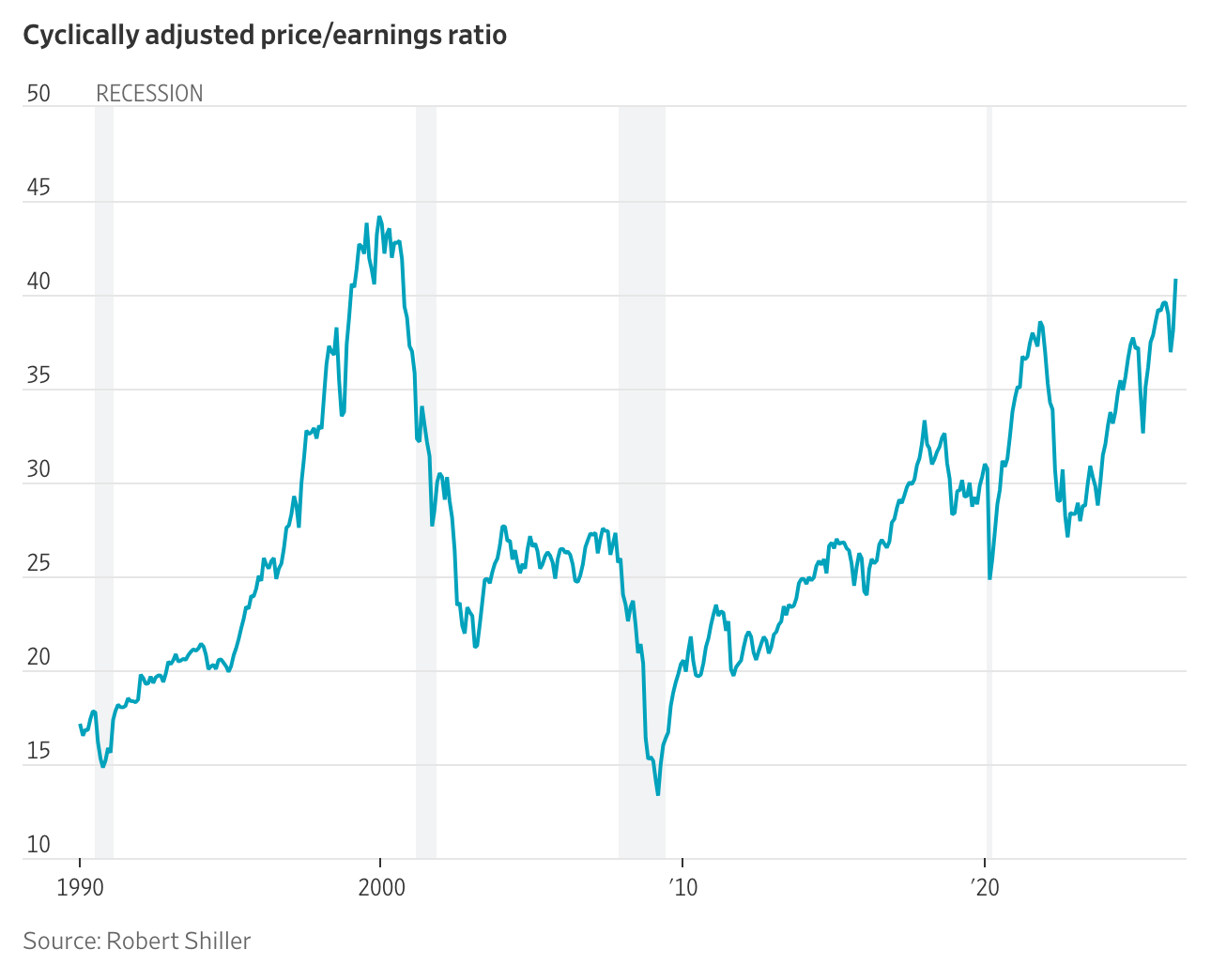
Instead, stocks are surging. The S&P 500 has risen for eight straight weeks, the Dow has hit record highs, and market valuations are extremely elevated. By Robert Shiller’s cyclically adjusted price/earnings ratio, the S&P 500 is above 40, a level seen only around the dot-com bubble. That makes the current split striking: in 2000, high stock prices came alongside widespread optimism about jobs, growth, low inflation, globalization, and the promise of the internet.
The disconnect may have several explanations. Stocks may be overvalued and ignoring economic weakness, which would mean consumers are reading the situation more accurately. Or markets may be anticipating better conditions ahead, including an end to the war, lower inflation, and stronger growth. The most unsettling possibility is that both consumers and investors are reacting to the same force: AI. Investors see AI as a way for companies to cut labor costs and boost profits, while households worry it could make jobs harder to find. In that sense, a booming market and unhappy consumers may not be contradictory at all.
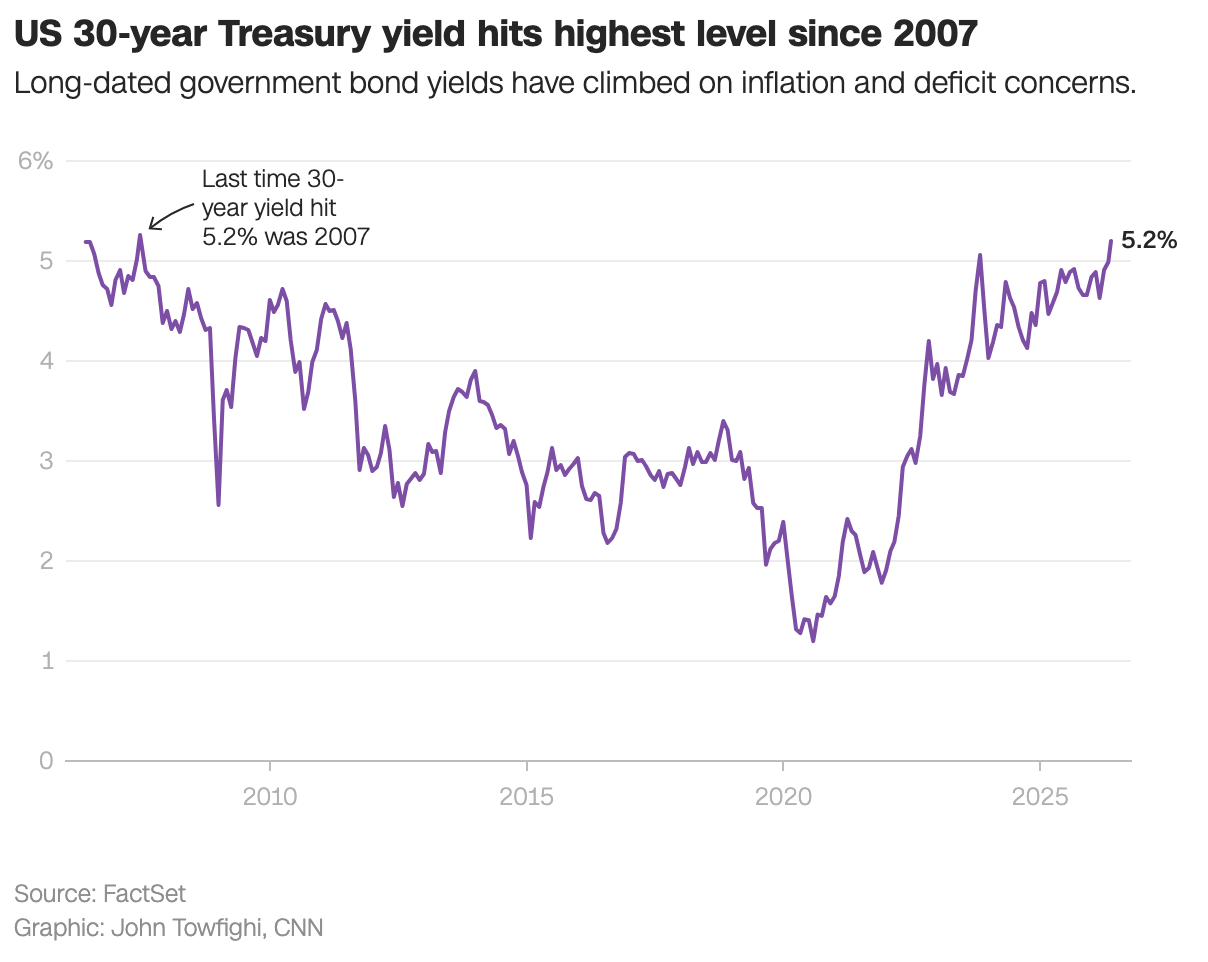
6. 30-year US Treasury yield hits highest level in 19 years (CNN)
Inflation fears are driving a sharp sell-off in government bonds, pushing Treasury yields to levels not seen in years. The 30-year U.S. Treasury yield has climbed to 5.2%, its highest since 2007, while the 10-year yield has risen to about 4.67%. The main pressure is coming from the Iran war’s energy shock, which has sent oil and gas prices higher and is beginning to filter into food, airfare, and broader consumer prices. Since bond prices fall when yields rise, investors are demanding more compensation for the risk that inflation will stay elevated and erode returns.
The sell-off is also tied to deeper worries about government deficits, higher defense spending, and the possibility that central banks may have to keep rates high or even raise them again. Those concerns are not limited to the United States. Long-term bond yields in the U.K. and Japan have also hit major highs as investors reassess inflation and fiscal risks around the world. In the U.S., rising yields threaten to lift mortgage rates, auto loans, business borrowing costs, and other forms of credit across the economy.
Stocks are starting to feel the pressure as well. Higher bond yields can make equities less attractive and change how investors value future corporate earnings. The Dow, S&P 500, and Nasdaq all fell Tuesday, with the S&P and Nasdaq notching a third straight day of losses. Before the Iran war, the 10-year yield was just below 4%; now it is near 4.7%, and analysts are watching 4.8% as a key danger zone.
7. The Risk Premium for Holding Stocks Over Bonds Is Vanishing (WSJ)
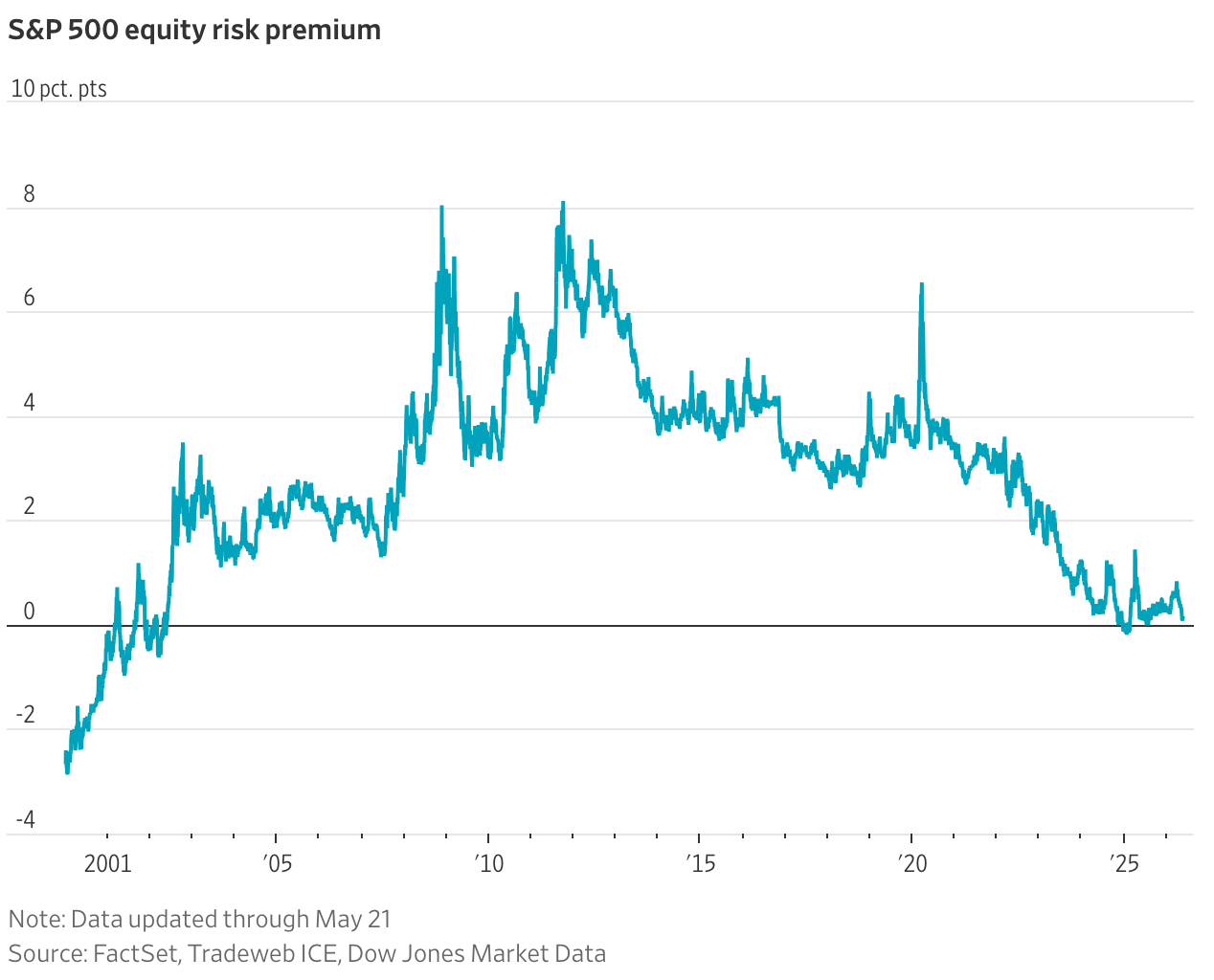
Stocks have surged even as the bond market is flashing warning signs. The equity risk premium, which compares the S&P 500’s earnings yield with the 10-year Treasury yield, has nearly vanished. That means investors are getting only a small expected-return advantage for owning stocks instead of much safer government bonds, a setup that looks similar to the period after the dot-com bubble burst.
The main cause is the global bond sell-off tied to inflation fears from the Iran conflict and the closure of the Strait of Hormuz. Oil prices have jumped sharply, expectations for rate cuts have faded, and the 10-year Treasury yield has climbed from just under 4% before the conflict to around 4.57%. At the same time, stock prices have risen, pushing the S&P 500’s earnings yield lower and making valuations look stretched.
Investors are split on whether the rally is justified. Skeptics argue that stock prices now require years of very strong earnings growth, especially from AI-related companies, to make sense. Optimists believe the AI boom is still early and could keep lifting profits and productivity. For now, the market’s outlook depends heavily on two things: whether Middle East tensions ease enough to bring oil prices down, and whether investors get both lower interest rates and stronger corporate earnings. Without both, stocks may look increasingly expensive.
Education
8. Harvard Votes to Cap A’s in Effort to Curb Grade Inflation (WSJ)
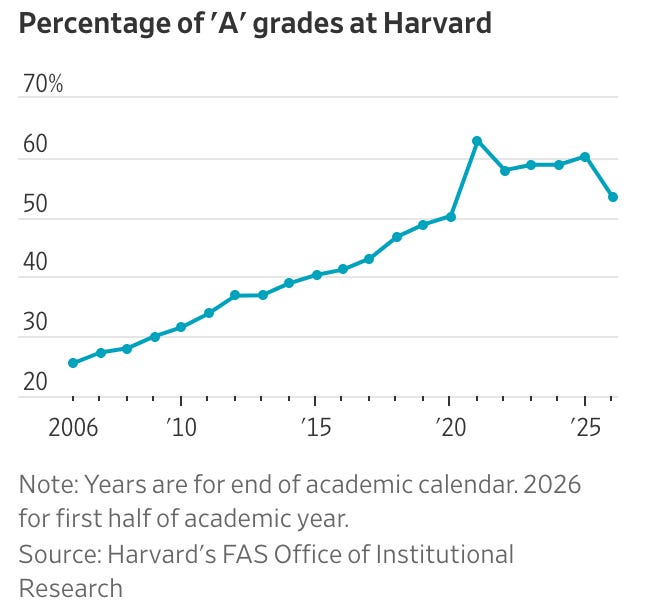
Harvard’s faculty approved a new cap on A grades in undergraduate courses as part of a long-running effort to curb grade inflation. Beginning in fall 2027, each course will be limited to A’s for 20% of students, plus four additional A’s to account for smaller classes. The cap does not apply to A-minuses, which administrators expect may become the most common top grade. Faculty supporters argue that the change will make grades more meaningful, encourage stronger academic engagement, and protect the value of a Harvard degree.
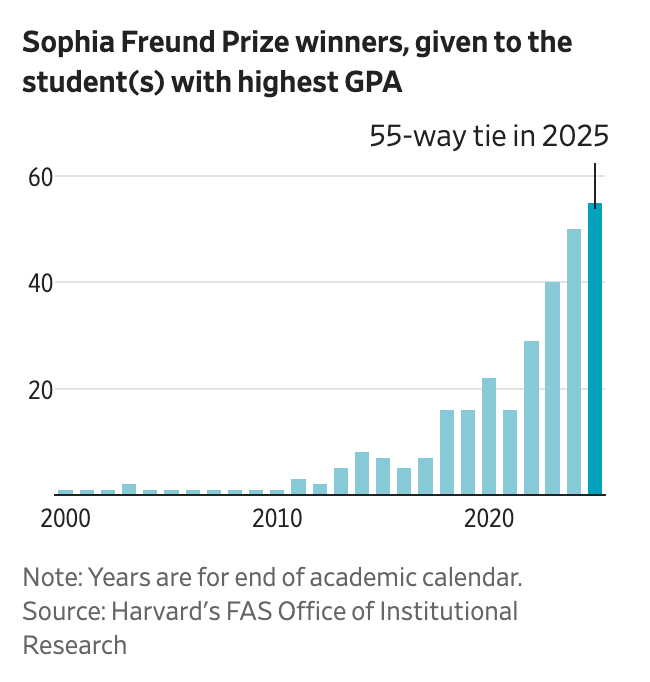
The move follows evidence that A’s have become dramatically more common. About 60% of grades in 2024–25 were A’s, compared with about 25% in 2005–06. GPA compression has also made academic distinctions harder to award, with Harvard’s top-GPA Sophia Freund Prize going from one or two winners in earlier years to a 55-way tie in 2025. Faculty also voted to replace GPA with percentile rank for internal honors and prizes.
9. New College Grads Confront a Tight Job Market but Still Have an Edge (WSJ)
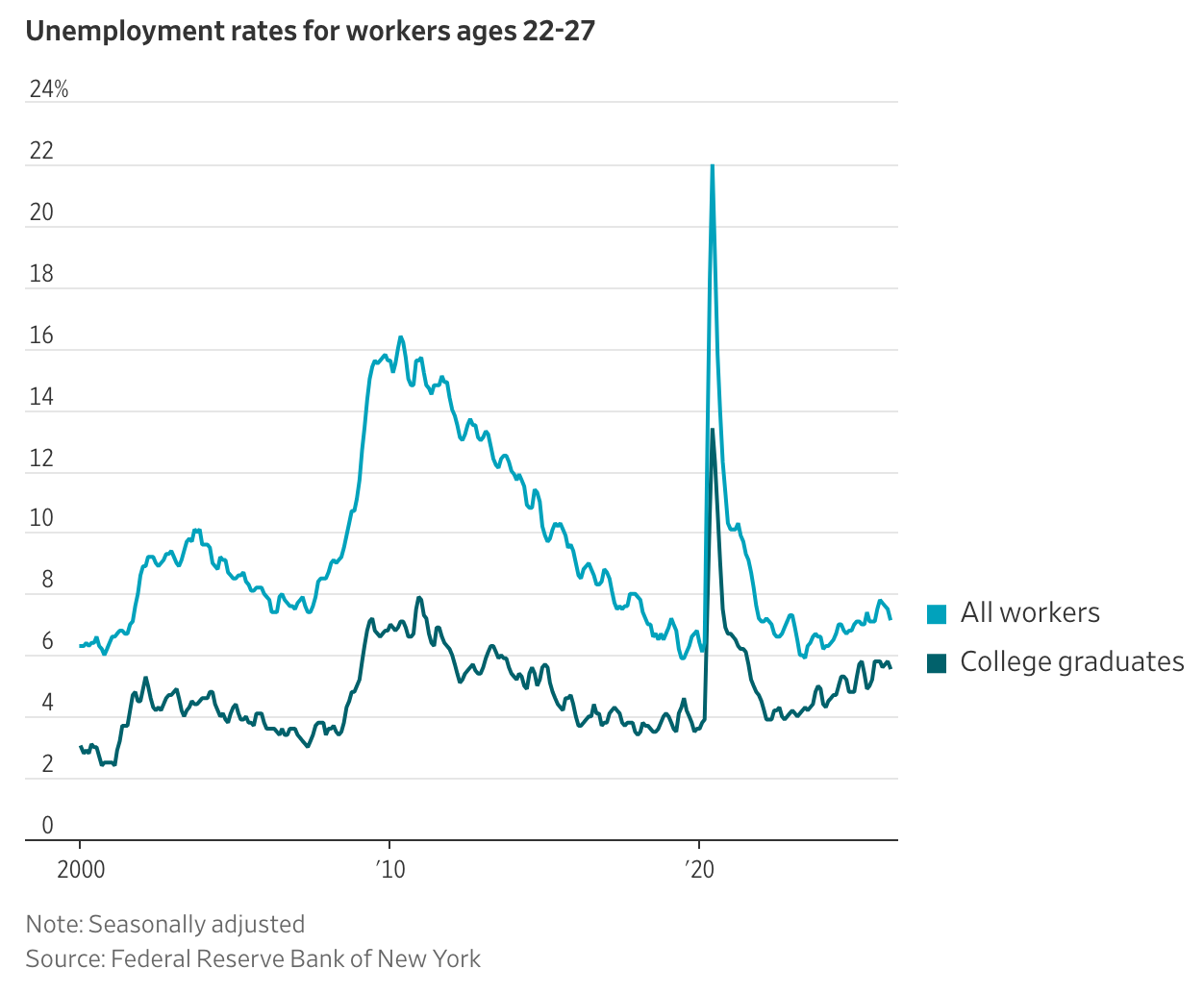
The job market for young adults has weakened, but the headline unemployment numbers may make college graduates look worse off than they really are. The unemployment rate for 22- to 27-year-olds with bachelor’s degrees rose to 5.6% in March, up from 3.6% before the pandemic. That increase is sharper than the rise for all workers in the same age range, suggesting that recent graduates are facing a rougher transition into work, especially as employers slow hiring and anxiety grows over AI replacing entry-level skills.
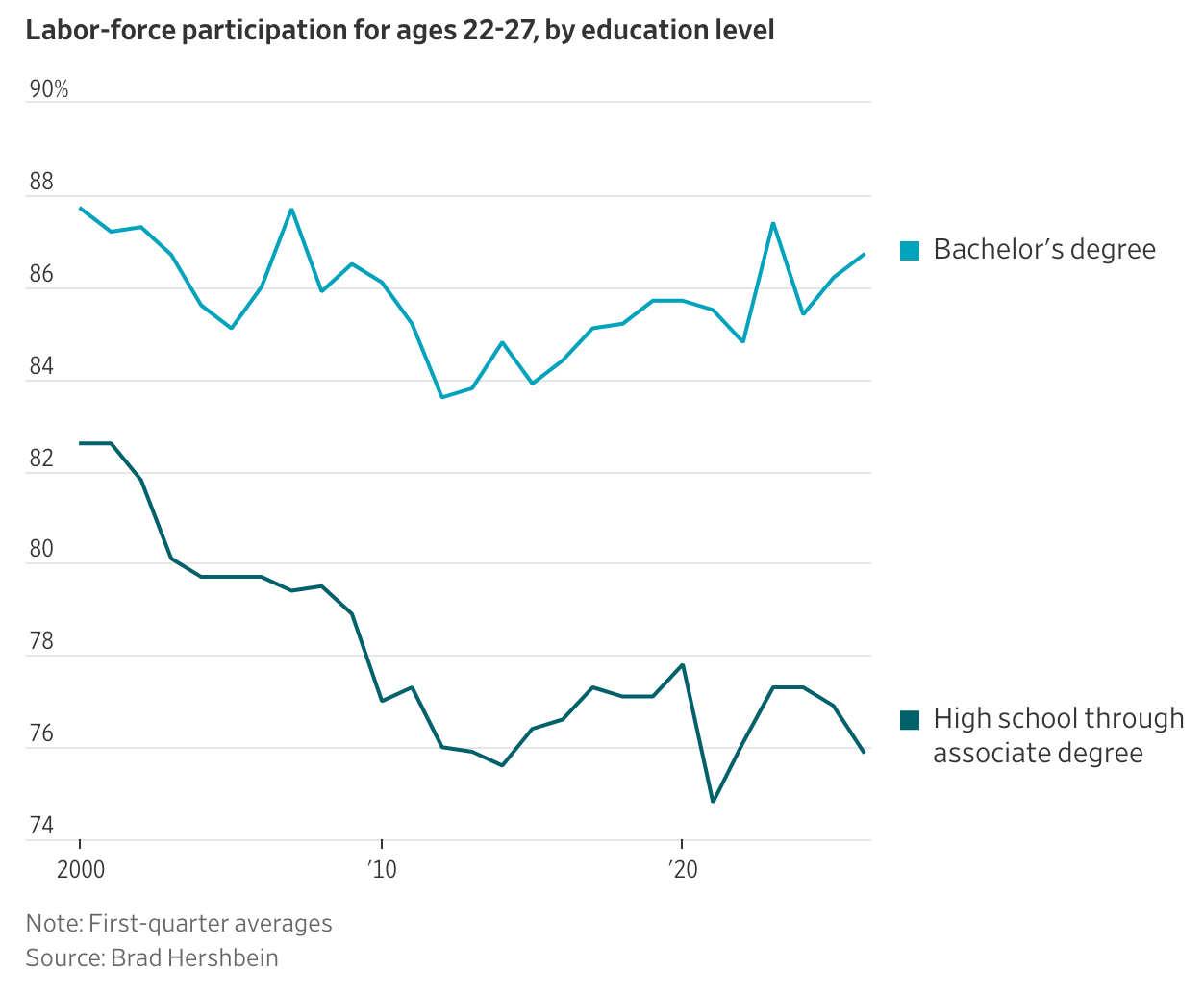
But unemployment only counts people actively looking for work, which changes the comparison. Young adults without bachelor’s degrees are more likely to have left the labor force altogether, meaning they are not counted as unemployed. Their labor-force participation has fallen since 2019, while participation among young college graduates has actually risen. Looking at the share of people who are working, college graduates have held nearly steady, while young adults with high-school through associate degrees have seen a clearer decline. College graduates still have better employment prospects than less-educated peers, but the college advantage is not as strong as it used to be. A bachelor’s degree remains valuable, yet its wage premium has slipped as more workers earn degrees and the credential becomes less distinctive.
Artificial Intelligence
10. These 5 charts show how ChatGPT has flooded our lives (WP)
ChatGPT’s broad social impact is just…“more”: more written, creative, legal, scientific, and online content generated at lower cost and higher speed. Since its release in late 2022, AI tools have made it much easier to produce work that resembles books, lawsuits, music, scientific papers, and web content. This has shifted the burden to readers, judges, moderators, platforms, and audiences who must sort useful human work from low-quality or machine-generated volume.
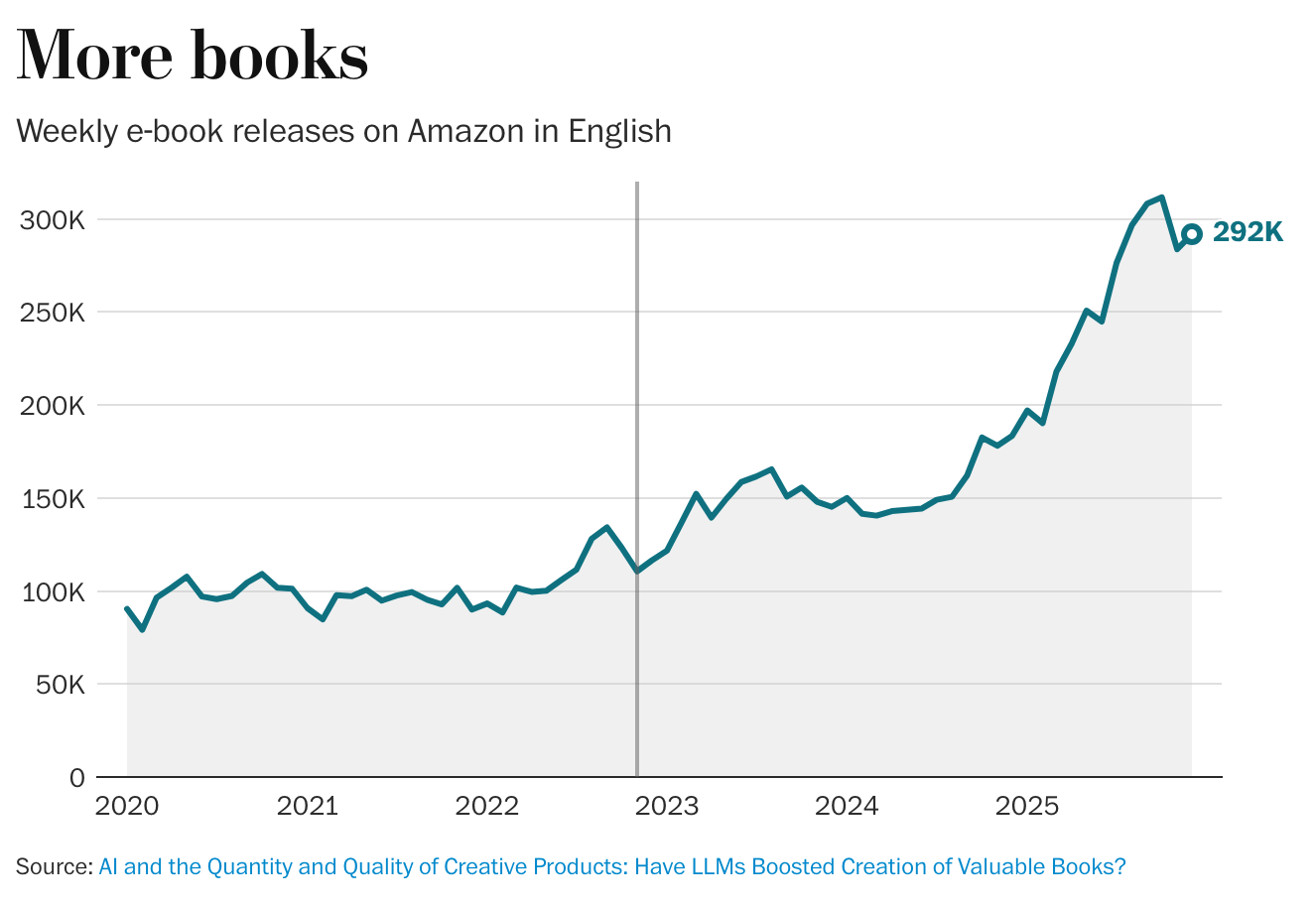
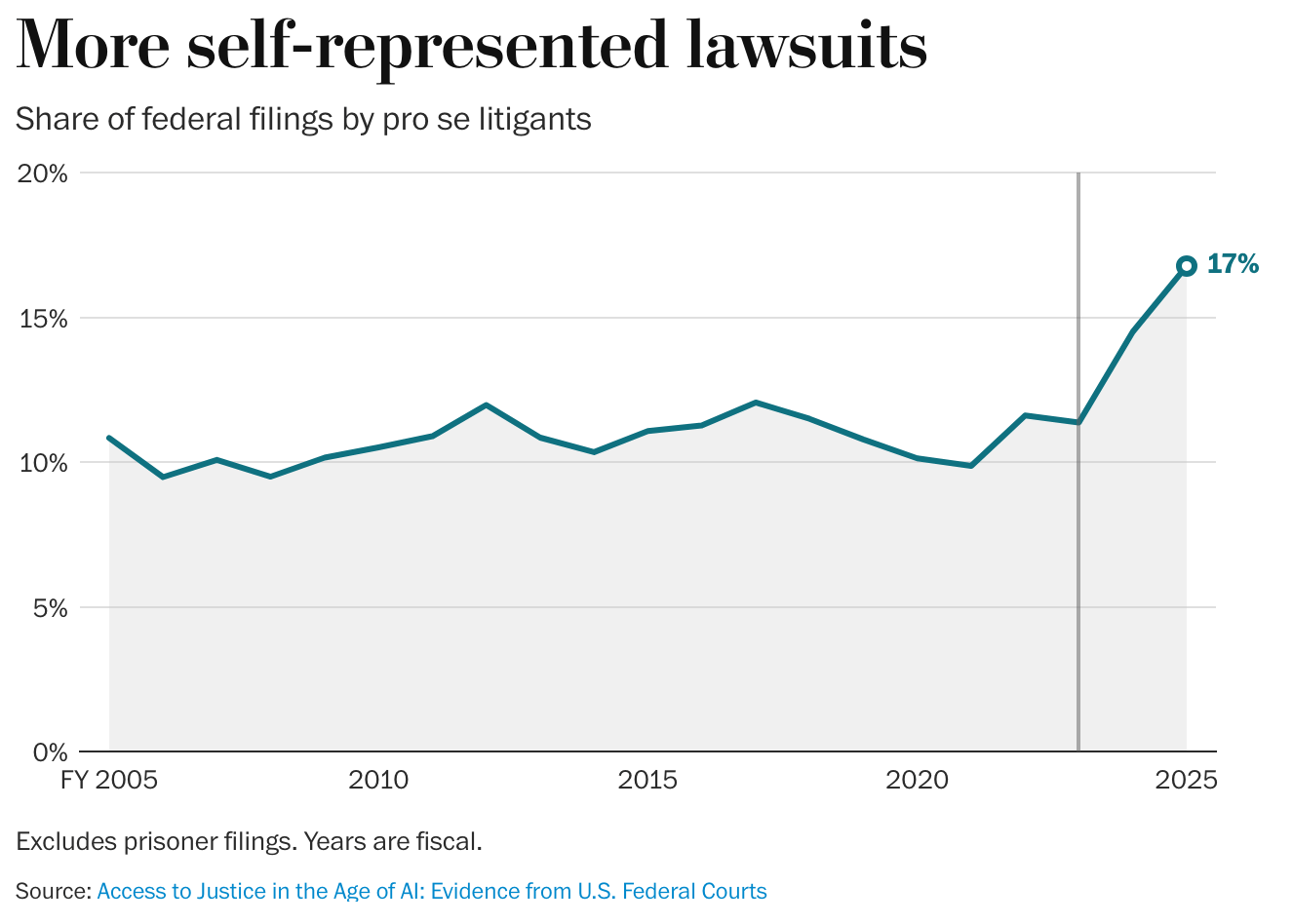
The clearest examples are in publishing and law. Weekly English-language e-book releases on Amazon have nearly tripled since ChatGPT’s launch, and one study found that more than half of new books by late 2025 contained AI-generated text. In federal courts, self-represented non-prisoner filings rose to about 17% of cases, up from a historical average of 11%, with researchers attributing the increase to AI. That may expand access to courts, but it also creates more work for judges and raises the risk of fake AI-generated citations.
The same pattern is spreading across music, science, and the web. Deezer estimates that more than 40% of uploaded tracks are now fully AI-generated, or about 75,000 songs a day. ArXiv has tightened submission rules after a rise in low-quality or non-scientific papers, including some with fake citations or hidden prompts aimed at manipulating AI-assisted reviewers. Researchers also estimate that as much as a third of new web content in some months is partly or wholly AI-generated.
NOTE: Below are two of the five charts: