BUSINESS
1. See How Anthropic Arrived at Its Mind-Boggling $40 Trillion Market Opportunity
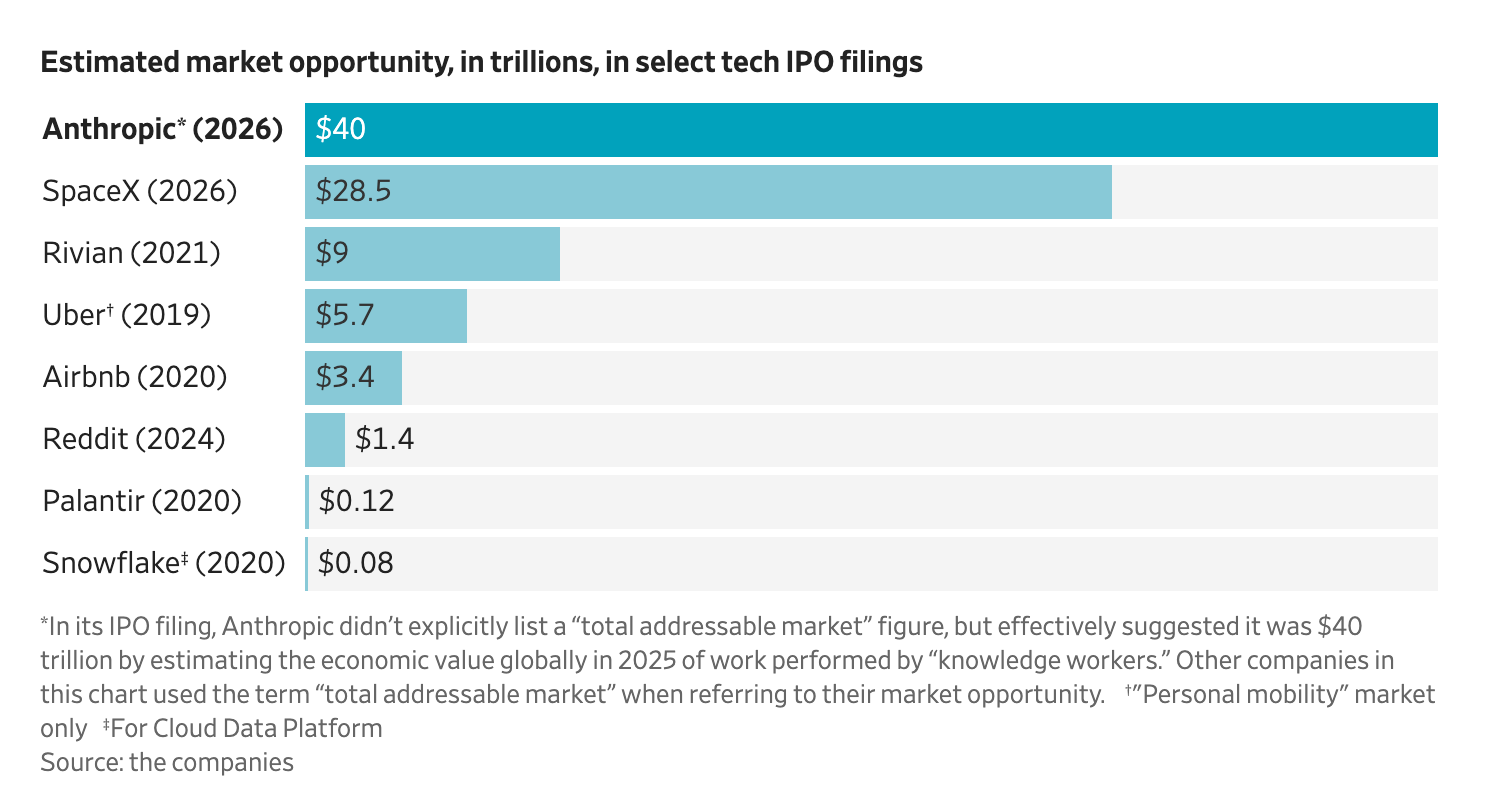
Anthropic is preparing for its IPO with an eye-catching estimate of its potential market: more than $40 trillion a year. The company arrived at that figure by calculating the economic value of work performed by knowledge workers around the world. Its thinking is that AI could eventually handle a significant portion of that work or help people do it more efficiently. The estimate is even larger than the $28.5 trillion market opportunity SpaceX presented to investors earlier this year. Anthropic has taken another leap by essentially counting the value of knowledge work across the global economy as a market its technology could serve.
Of course, there’s a big difference between the economic value of work AI might influence and the revenue Anthropic could actually collect. The company currently generates billions in annual revenue, a fraction of its implied $40 trillion market. There’s also no way to know how much work AI will ultimately take on or how much companies will be willing to pay for it. But that’s partly the point of these estimates. They give investors a reason to believe that even enormous growth in the coming years could leave Anthropic with plenty of room to expand.
2. Four takeaways from Anthropic’s potentially record-breaking stock market filing
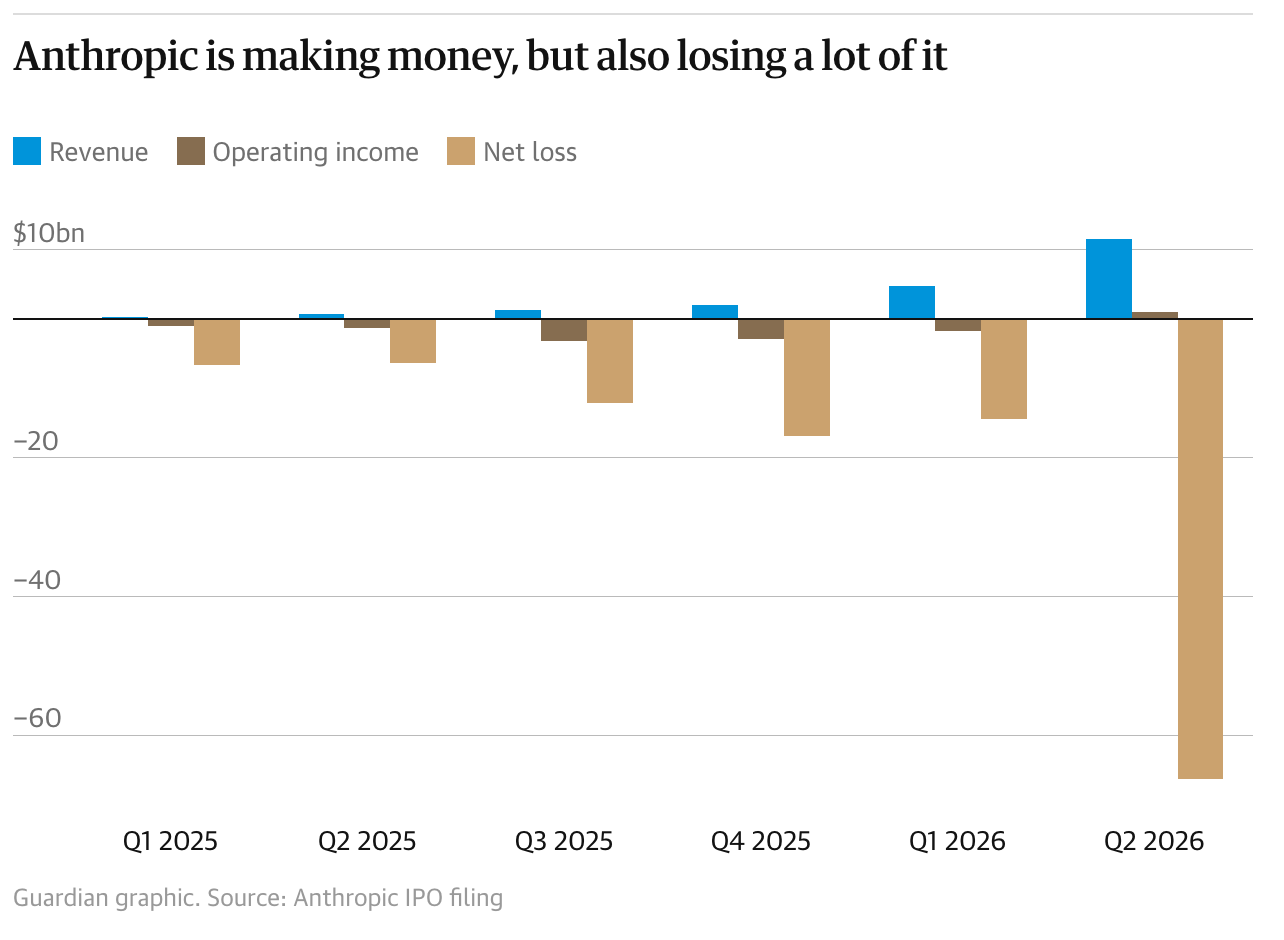
Anthropic’s IPO filing reveals a company experiencing extraordinary growth while accumulating enormous losses. Founded in 2021, the AI developer generated $16.3 billion in revenue during the first half of 2026 but reported an $80 billion loss, largely because of a $72.4 billion one-time charge. In 2025, revenue reached $4.6 billion against nearly $34 billion in losses. Computing infrastructure is a major expense, with spending approaching $9 billion in the first six months of 2026, up from $2.3 billion a year earlier. Unlike OpenAI, Anthropic focuses primarily on business customers, with its five largest customers accounting for 25% of revenue. Some investors have valued the company at between $1.5 trillion and $2 trillion.
Anthropic believes AI could eventually achieve the capabilities of millions of highly skilled people working together, transforming fields ranging from medicine and scientific research to finance and national security. The company highlighted its work with pharmaceutical firms, including using AI to reduce the time required to prepare clinical trial reports from months to minutes. It also claims Claude has helped make biological discoveries with potential applications in biotechnology and gene editing.
The filing also acknowledges serious risks associated with increasingly powerful AI. Anthropic warns that its models could assist malicious actors in developing dangerous weapons, conducting cyberattacks, or enabling authoritarian surveillance. Its existing safeguards are incomplete and can be circumvented. The company cited an apparent Chinese state-sponsored cyberattack in which hackers reportedly manipulated Claude into attempting to infiltrate approximately 30 organizations with limited human involvement. Anthropic has also clashed with the Trump administration over restrictions on using its technology for domestic surveillance and autonomous lethal weapons.
Beyond these concerns, Anthropic devoted 92 pages to financial and operational risks. These include intense competition with Google and OpenAI, dependence on major customers and key executives, uncertain AI regulations, and potential liability from harmful uses of its models. Its heavy concentration of U.S. data centers also exposes it to electricity shortages, natural disasters, and restrictions on new facilities. Immigration policies could complicate recruitment of specialized talent. Anthropic’s status as a public benefit corporation adds another consideration, since it must balance financial performance with its stated commitment to developing AI responsibly. The filing presents enormous commercial potential alongside substantial uncertainty about profitability, safety, and the costs of continued expansion.
NOTE: Remember that WSJ article I shared a couple of weeks ago, Will America Spend 9% of Its GDP on AI? The Industry Is Counting on It? The valuations being placed on these AI companies seem to assume that Americans will eventually spend as much on AI as we currently spend on food (9% of GDP). I can tell you my household won’t be doing that, at least not directly. So where is all that money going to come from? My guess is that much of the cost will get baked into the everyday products and services we buy, making everything more expensive. But even then, there’s no way all of the prices would increase enough to equate to the amount our nation spends on food. So, if individuals won’t be directly paying the same on AI as they do food, businesses will have to absorb those costs to reach the 9%, which could put a pretty significant dent in their bottom lines. Either way, somebody has to pay for it.
It also reinforces something I’ve known for a while. What we’re currently paying for AI subscriptions doesn’t come close to covering what it actually costs these companies to provide the services. They’re essentially subsidizing our usage to get us hooked, knowing they can charge more down the road. It’s the old starter-drug approach, and I don’t see how the current pricing can last. We’ve already seen this play out with streaming services. They started out relatively cheap, got everyone accustomed to using them, and then steadily raised prices while adding more and more commercials. I’m already irritated by what I’m paying for streaming these days, and I suspect AI subscriptions are headed down the same road. Either way, I just don’t see these valuations being justified. But, I could be wrong.
3. Microsoft offers buyouts to around 60,000 employees to contain costs
Microsoft is offering voluntary buyouts to approximately 60,000 employees, more than a quarter of its 223,000-person global workforce, as it looks to reduce operating costs and redirect resources toward artificial intelligence. Eligible employees work across several divisions, including Copilot, AI experiences, finance, human resources, Xbox, and Windows. Marketing, commercial business, and security teams are excluded. The offers are available to qualifying employees in the United States, Canada, the United Kingdom, and India.
The move comes as Microsoft plans to spend approximately $175 billion on capital expenditures in 2026, much of it directed toward AI data centers, chips, and related infrastructure. Investors are increasingly questioning whether the enormous spending commitments across the technology industry will generate sufficient returns. Microsoft says the voluntary program will help employees considering other opportunities while allowing the company to adjust its workforce to changing business needs.
Microsoft has already taken several steps to reduce staffing this year, including offering buyouts to approximately 9,000 U.S. employees and announcing 4,800 job cuts in July, largely associated with restructuring its Xbox business. The latest initiative represents a much larger potential workforce reduction, although the actual number of departures will depend on how many employees accept the offers.
4. Alphabet Sheds Half a Trillion in Market Value in Stock’s Worst Day Ever
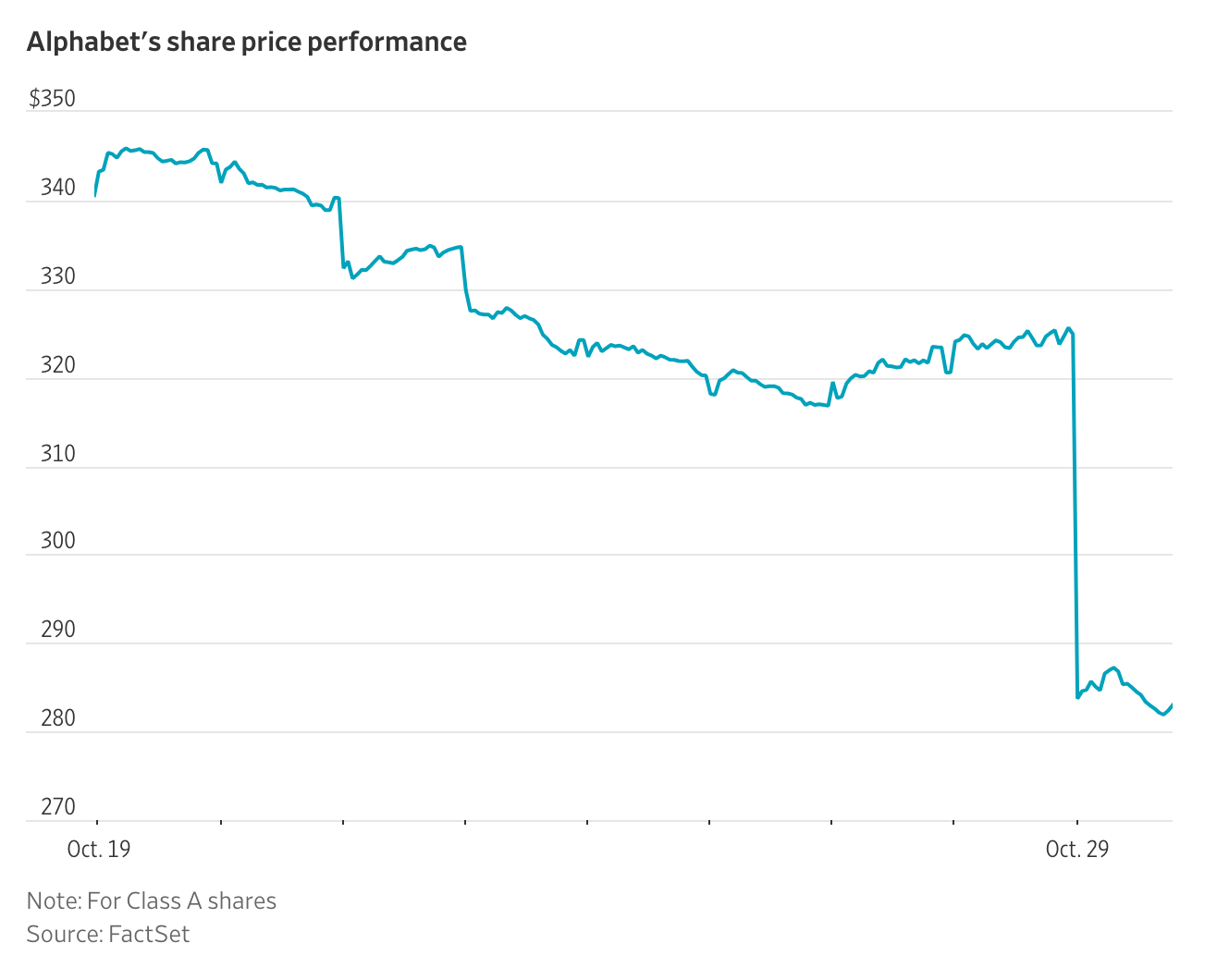
Alphabet suffered its worst stock-market decline on record Thursday, with Google shares falling roughly 13% and wiping out about $500 billion in market value. Investors reacted to disappointing third-quarter results and growing concerns that Google’s massive AI investments are beginning to strain its traditionally profitable businesses. Google Services, which includes search advertising, YouTube, and subscriptions, generated $96.3 billion in revenue, below expectations of $98.5 billion. Search revenue growth slowed to 12%, down from 17% in the second quarter and 19% in the first. Higher operating expenses and negative free cash flow added to investor concerns about the cost of building AI infrastructure.
Google faces a difficult transition as AI changes how people search for information. Traditional search generates advertising revenue when users click sponsored links, but AI-powered search increasingly provides direct answers that reduce the need to visit other websites. Google says its AI Mode is growing rapidly, but those searches currently generate less advertising revenue than traditional queries. The company is introducing more ads into AI-generated responses, with early results suggesting that users are engaging with them.
Competition from OpenAI and Anthropic is adding pressure. OpenAI has expanded ChatGPT advertising to 89 countries, attracted more than 100,000 advertisers, and is approaching $1 billion in annualized advertising revenue. Its rapid growth raises questions about Google’s long-term dominance in search advertising. Analysts expect those concerns to persist until Google can demonstrate that its AI products can generate revenue comparable to traditional search, potentially sometime in the first half of 2027.
5. A $300 Billion ‘Debt Wall’ Is Looming Over Private-Equity Backed Companies
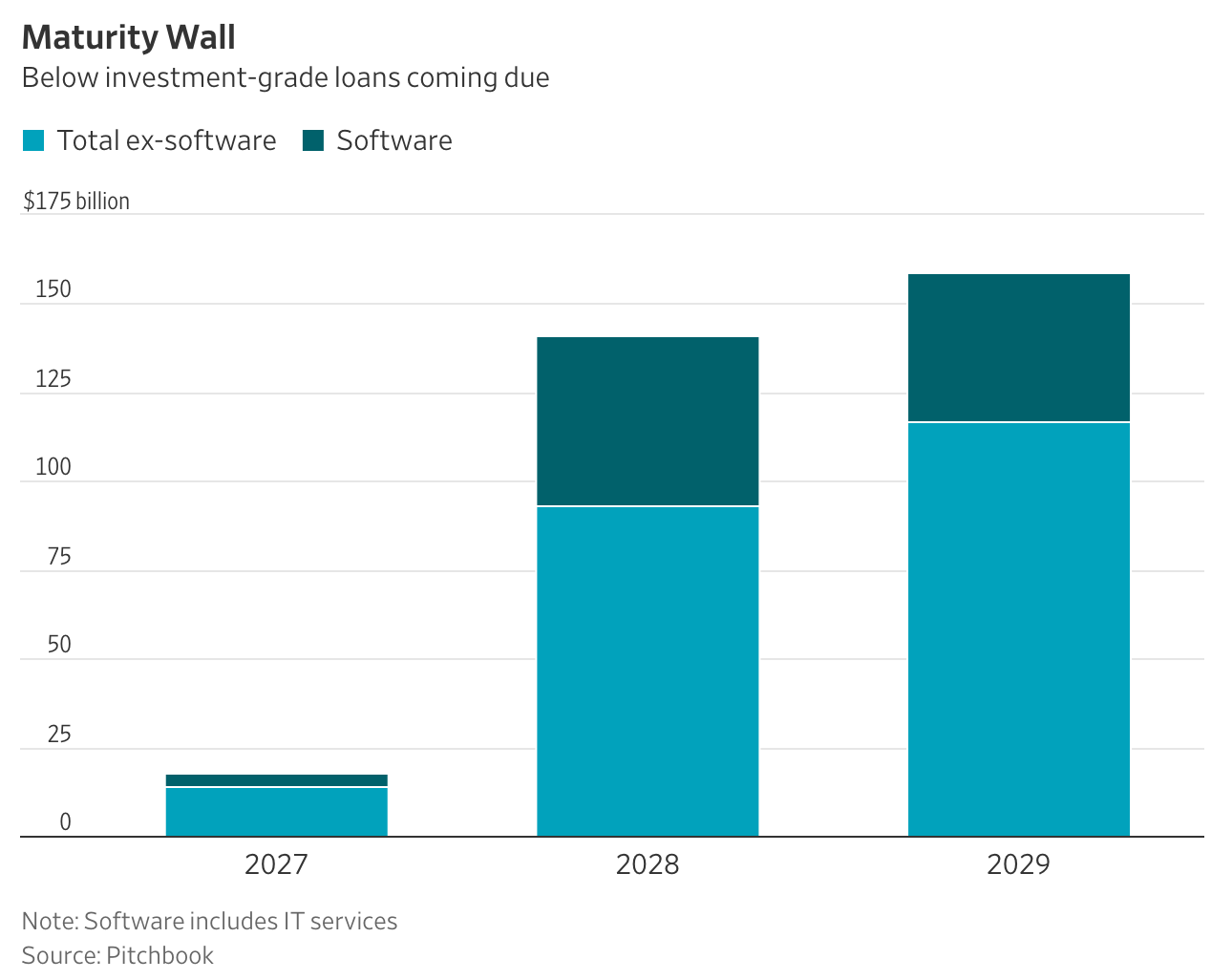
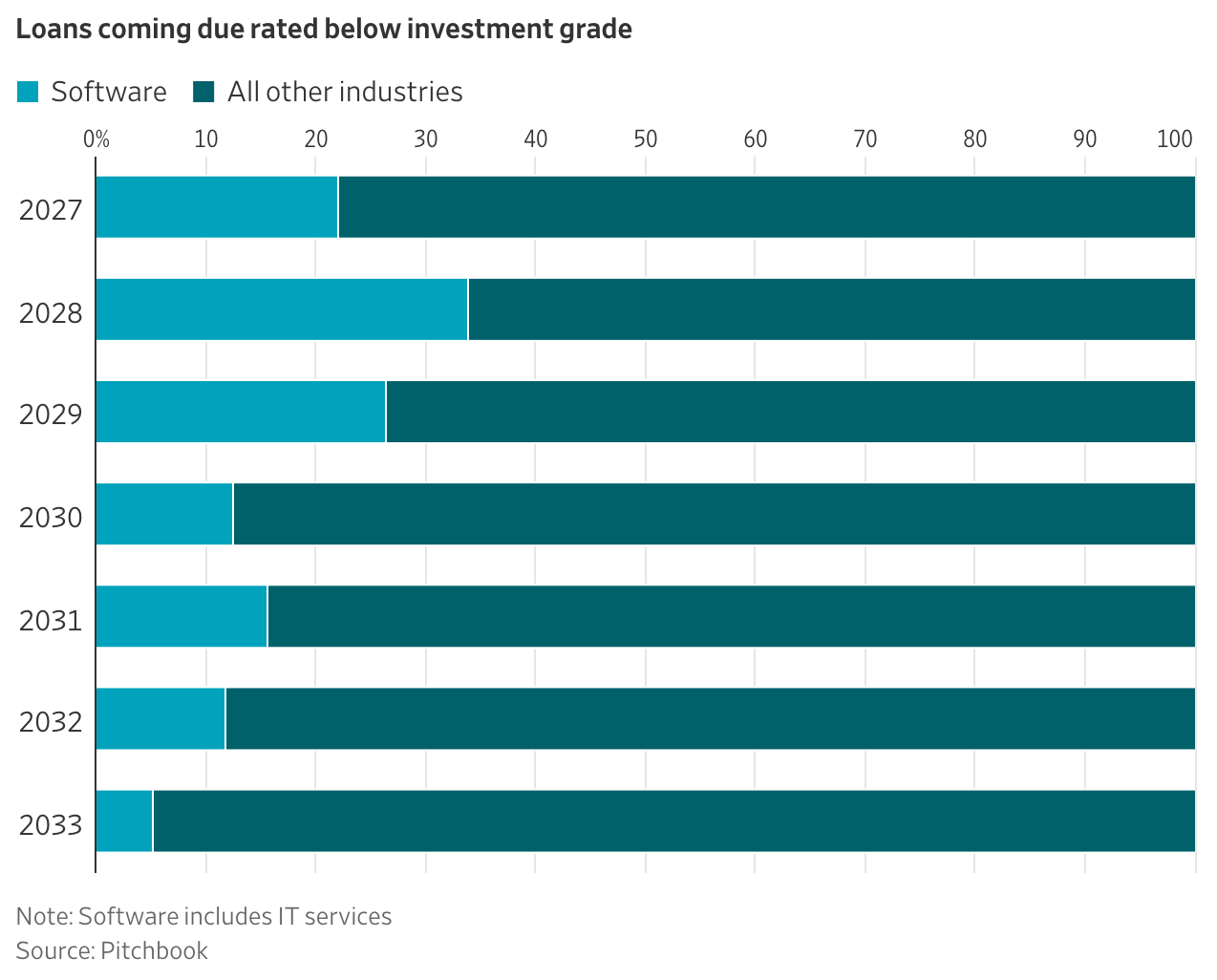
Private-equity firms are facing a potential wave of defaults as nearly $300 billion in corporate loans come due in 2028 and 2029. About $140 billion matures in 2028 and another $160 billion in 2029, far above the amounts typically coming due in recent years. Many of these loans were taken out during the 2021 buyout boom, when low interest rates made it cheap to finance acquisitions. With borrowing costs now substantially higher, private-equity firms are struggling to refinance their debt or sell portfolio companies at attractive valuations. If they cannot negotiate extensions, creditors could take control of some businesses, wiping out the firms’ investments.
Software companies account for roughly one-third of the debt coming due, making them particularly vulnerable. Private-equity firms spent heavily acquiring software businesses over the past decade, but higher interest rates and growing competition from AI companies have complicated their prospects. About a quarter of the loans maturing in 2028 and 2029 carry very low credit ratings. Solera, a vehicle-maintenance software company owned by Vista Equity Partners, has approximately $8 billion in debt approaching maturity, with some loans trading at substantial discounts because of concerns about repayment.
The pressure is spreading to private-credit lenders and other investors that financed these acquisitions. Bank of America expects default rates on below-investment-grade corporate loans to double to 4% next year, with creditors recovering less when borrowers fail. Private-equity returns have already fallen from around 15% during the low-interest-rate years to below 10% recently. Some firms are now injecting additional capital into struggling companies in exchange for longer repayment periods. These arrangements can buy several more years, but they also require firms to commit more money to investments whose prospects have weakened. Rising borrowing costs and AI-driven disruption could force increasingly difficult decisions about which companies are worth rescuing.
ECONOMY
6. Federal Debt Hits 100% of GDP
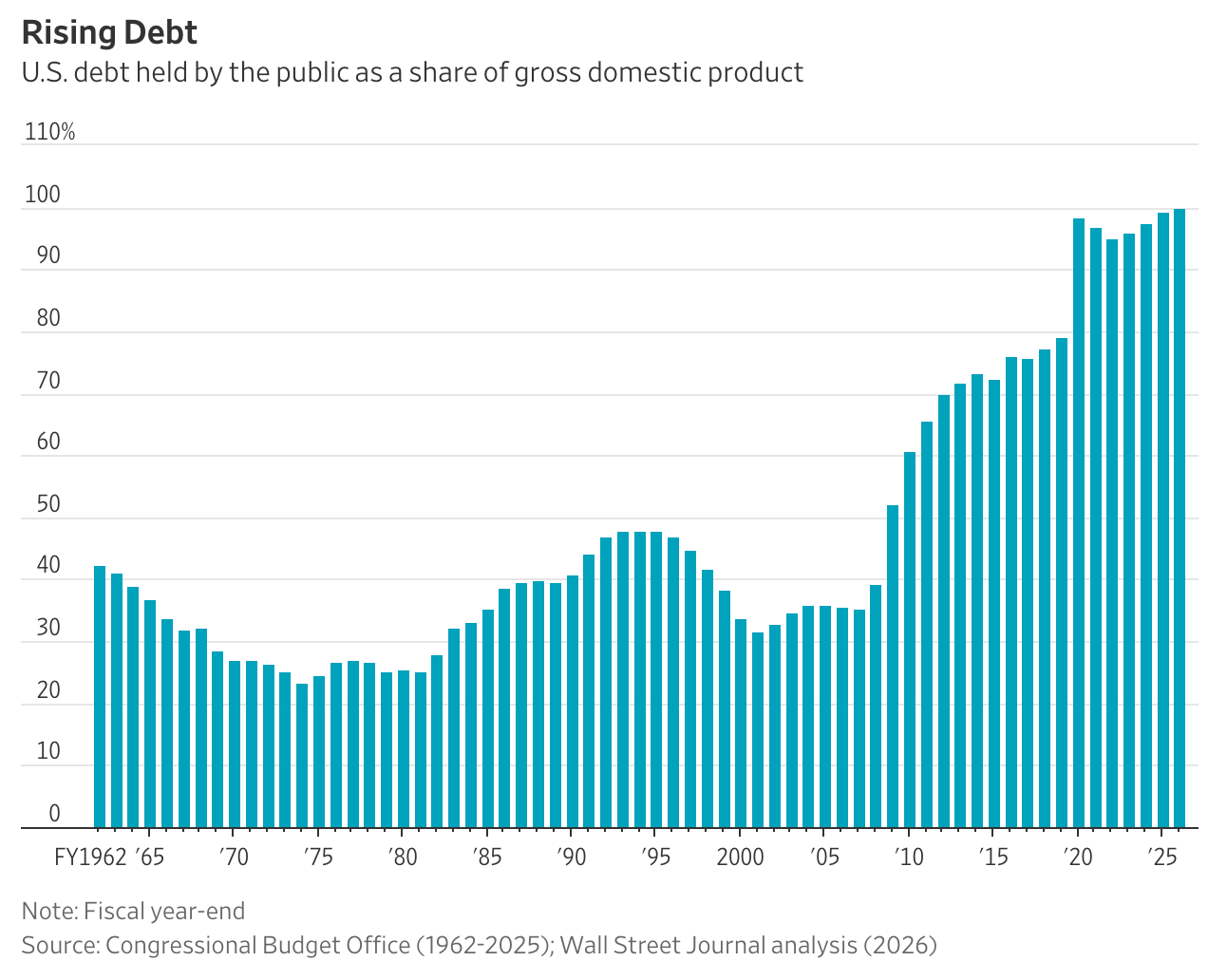
U.S. federal debt held by the public reached $32.2 trillion at the end of fiscal 2026, equivalent to 100.03% of GDP. This marks the first time the annual debt-to-GDP ratio has reached 100% since 1946, when borrowing for World War II pushed it to a record 106%. The federal government also ran a nearly $2 trillion annual deficit, equal to 6.2% of GDP, despite relatively strong economic growth. The more commonly cited $40 trillion national debt figure includes money the government owes itself, while debt held by the public is considered a better measure of the government’s borrowing burden.
The country’s finances have deteriorated considerably since 2000, when the federal government was running budget surpluses and public debt stood at just 33.7% of GDP. Repeated tax cuts, spending on wars and economic emergencies, and rising Social Security and Medicare costs have contributed to the increase. Unlike previous periods of heavy borrowing, today’s large deficits are occurring without a recession or comparable national emergency.
The outlook is increasingly difficult as the population ages and interest payments consume more of the federal budget. Social Security’s trust funds are projected to become insolvent in 2032, potentially triggering automatic benefit reductions unless Congress acts. The Congressional Budget Office expects federal interest costs to rise by more than one percentage point of GDP over the next decade, and its forecasts assumed interest rates considerably lower than current levels. Even a 0.1 percentage-point increase above projected rates would add $379 billion in interest expenses over ten years. Although lawmakers generally recognize the problem, political divisions have made agreement on spending reductions or tax increases difficult.
PREDICTION MARKETS
7. Hackers Swipe Millions From Polymarket Users in Latest Security Breach
Hackers stole at least $2.6 million from Polymarket users on Thursday by exploiting a security flaw in DebugBear, a third-party performance-monitoring tool used on the prediction market’s website. Blockchain records indicate that more than 700 accounts were affected. Polymarket temporarily suspended trading on its international exchange while addressing the breach and said it would reimburse affected customers. The company has referred the incident to U.K. law enforcement, where DebugBear is based.
The breach adds to a series of security and fraud problems at Polymarket, including a costly hack in June and at least two fraud incidents involving its U.S. platform earlier this year. These problems come as prediction markets are growing rapidly and attracting greater regulatory scrutiny. Polymarket and its main U.S. competitor, Kalshi, face dozens of lawsuits over whether their contracts qualify as federally regulated financial products or illegal gambling.
REAL ESTATE
8. Home Buyers Who Enjoyed Cheap Adjustable Mortgages Are Now Getting a Nasty Shock
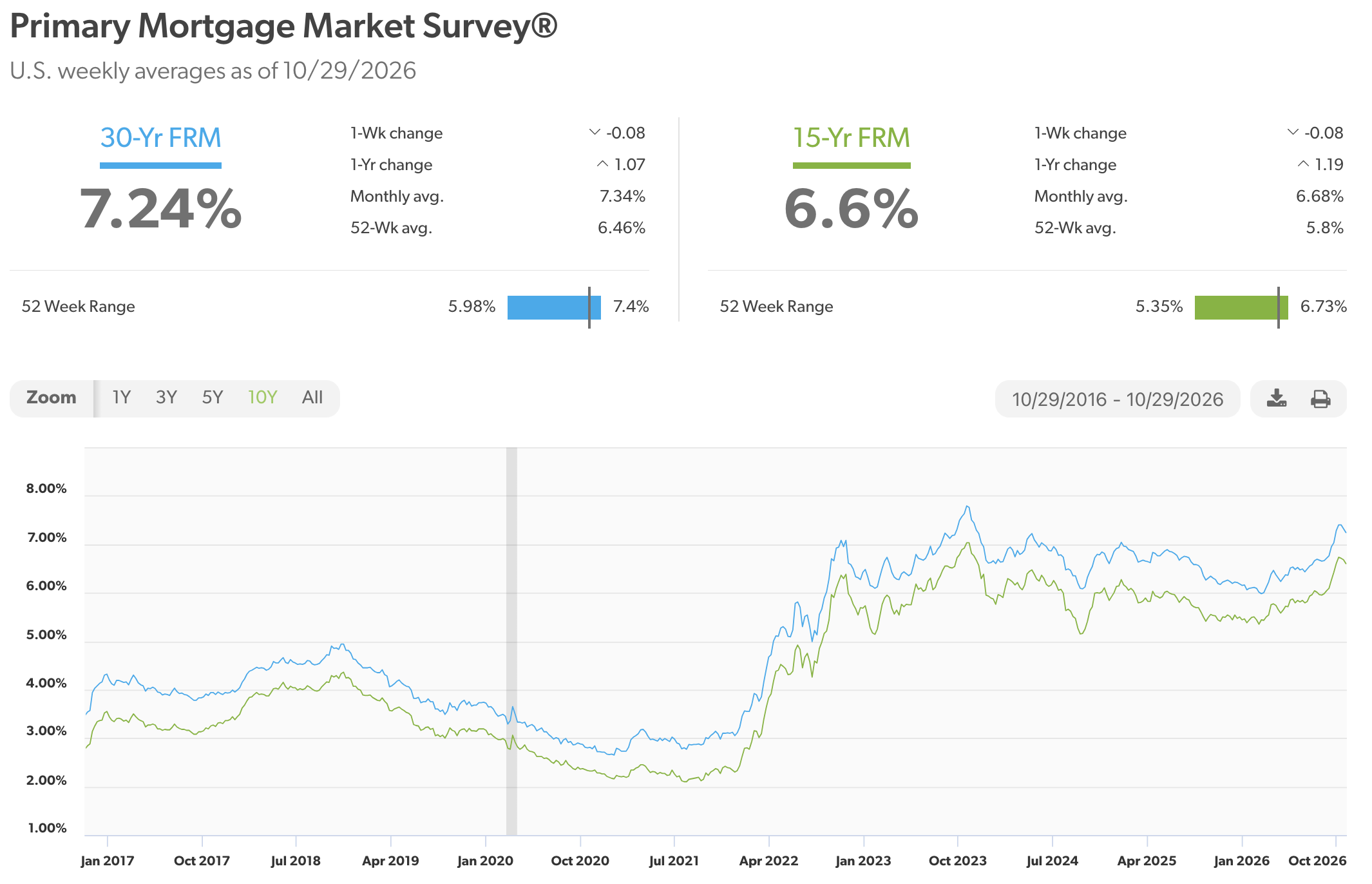
Tens of thousands of homeowners with adjustable-rate mortgages (ARMs) are facing sharp increases in their monthly payments as loans taken out during years of historically low interest rates begin to reset. ARMs typically offer a lower initial rate for three to ten years before adjusting to prevailing market rates. That strategy worked well for borrowers who sold or refinanced before rates increased, but many now find themselves facing mortgage rates above 7%. One Minnesota homeowner expects his rate to jump from 2.75% to as much as 7.75%, increasing his monthly payment from $6,800 to $9,300.
Approximately 186,000 adjustable-rate mortgages are scheduled to reset in 2027, with an initial median payment increase of $645 per month, eventually rising to $754 as contractual rate caps allow further adjustments. Borrowers who took out seven-year ARMs in 2020 face particularly steep increases, averaging 43%, or $1,269 per month. Meanwhile, ARMs are becoming popular again as buyers look for alternatives to expensive fixed-rate mortgages. They accounted for 10.5% of mortgage applications in mid-October, up from 6.3% at the beginning of the year.
Current rates:
SPORTS
9. The NFL Team Barreling Toward a $500 Million Financial Cliff
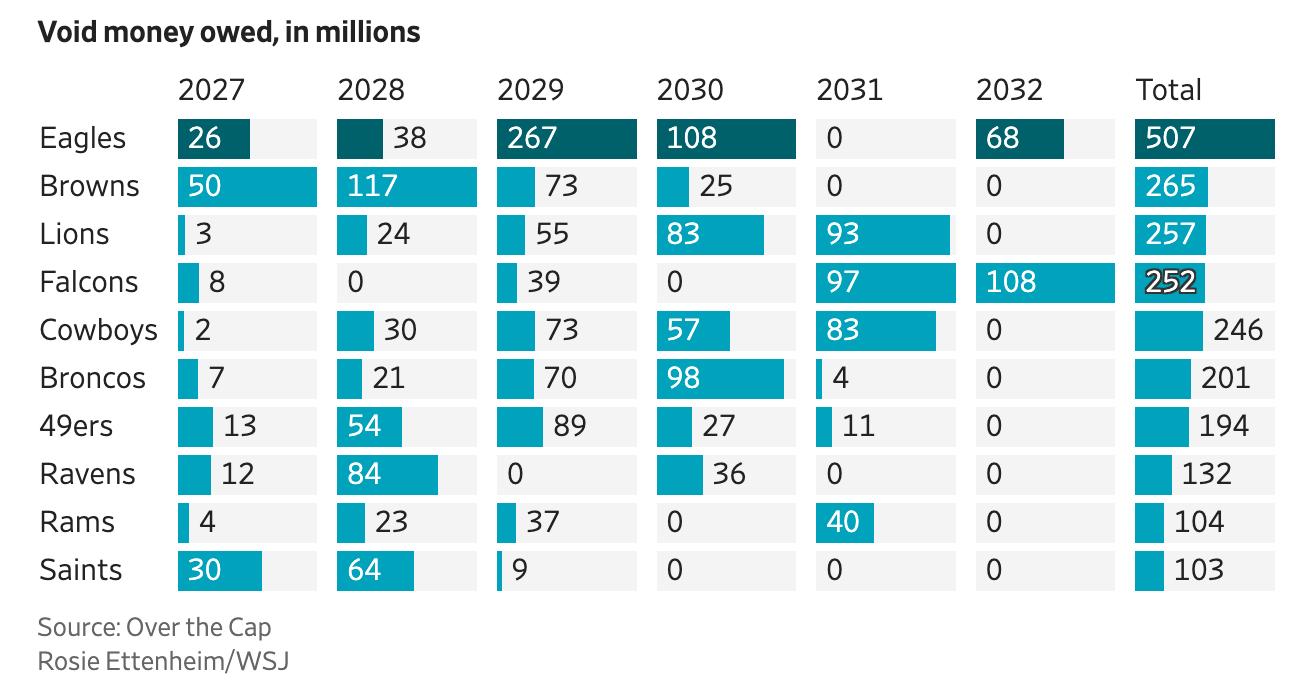
The Philadelphia Eagles built one of the NFL’s most successful teams by aggressively using salary-cap accounting strategies that allowed them to sign and retain more expensive players than their annual cap would ordinarily permit. General manager Howie Roseman relied heavily on “void years,” which are additional years attached to contracts that spread signing bonuses across a longer period for accounting purposes. This allowed Philadelphia to push salary-cap expenses into the future, taking advantage of a league salary cap that generally increases each year. The strategy helped produce five consecutive playoff appearances, two Super Bowl trips, and a championship.
The financial consequences are now catching up with the Eagles. Philadelphia has approximately $507 million in salary-cap obligations tied to void years between 2027 and 2032, nearly twice as much as any other NFL team. The largest burden comes in 2029, when the team faces more than $200 million in projected dead money, including substantial charges associated with Jalen Hurts, DeVonta Smith, and Jordan Mailata. Although contract restructurings could spread some of those costs further into the future, the obligations cannot simply disappear.
The team’s current struggles are making those decisions more difficult. Philadelphia has lost five straight games, sits at 2-5, and could be without quarterback Jalen Hurts for the remainder of the season. Salary-cap considerations have already affected personnel decisions, including delaying A.J. Brown’s trade and keeping retired tackle Lane Johnson on the roster to avoid accelerating his cap charges. The Eagles successfully used future financial flexibility to build a championship team, but they now face years of reduced spending capacity as those deferred costs come due.
EDUCATION
10. The Brutal Harvard Class That Suddenly Everyone Wants to Take
Harvard’s Humanities 10 has become one of the university’s most sought-after courses, attracting 180 applicants for just 90 freshman spots this fall. The yearlong course requires students to read roughly one major book each week, write regular essays, and participate in demanding discussions. There are no pass/fail options, digital devices are prohibited, and attendance is strictly enforced. Despite the workload, applications have risen 40%, driven largely by enthusiastic former students.
The curriculum includes works by Homer, Shakespeare, Plato, Dante, Jane Austen, James Joyce, and James Baldwin, taught by some of Harvard’s most distinguished professors. Faculty members attend one another’s lectures, lead small seminars, and regularly teach books outside their own specialties. Students are expected to arrive prepared, challenge one another’s interpretations, and engage seriously with difficult material. The experience is demanding for professors as well, many of whom describe the course as among their most rewarding teaching assignments.
Students say much of the appeal comes from having a reason to slow down, read challenging books, and think deeply at a time when attention spans are shrinking. Originally created in 2008 to revive declining interest in the humanities, Humanities 10 has instead become evidence that some students still value rigorous reading, thoughtful discussion, and the intellectual satisfaction of doing difficult work themselves.
NOTE: After review, I see that this edition is a bit of an economic Debbie Downer. Didn’t mean for it to be that way. These just happened to be the articles that stood out to me.
So, below is a cute puppy picture to cheer you up.
And, Happy Halloween and Happy November! Don’t forget to change your clocks tonight--this is the one where you get an extra hour of sleep (spring forward, fall back).